

Newgrange is a 5,200-year-old passage tomb in County Meath, Ireland, and it does something that took its builders 30 years to engineer: every year, on the winter solstice, the rising sun sends a single narrow beam of light down a 19-metre stone corridor and floods the inner chamber with gold for exactly 17 minutes. Not in roughly the right direction. Not approximately. Exactly. The alignment works to within a fraction of a degree, and it has worked every year for five thousand years.
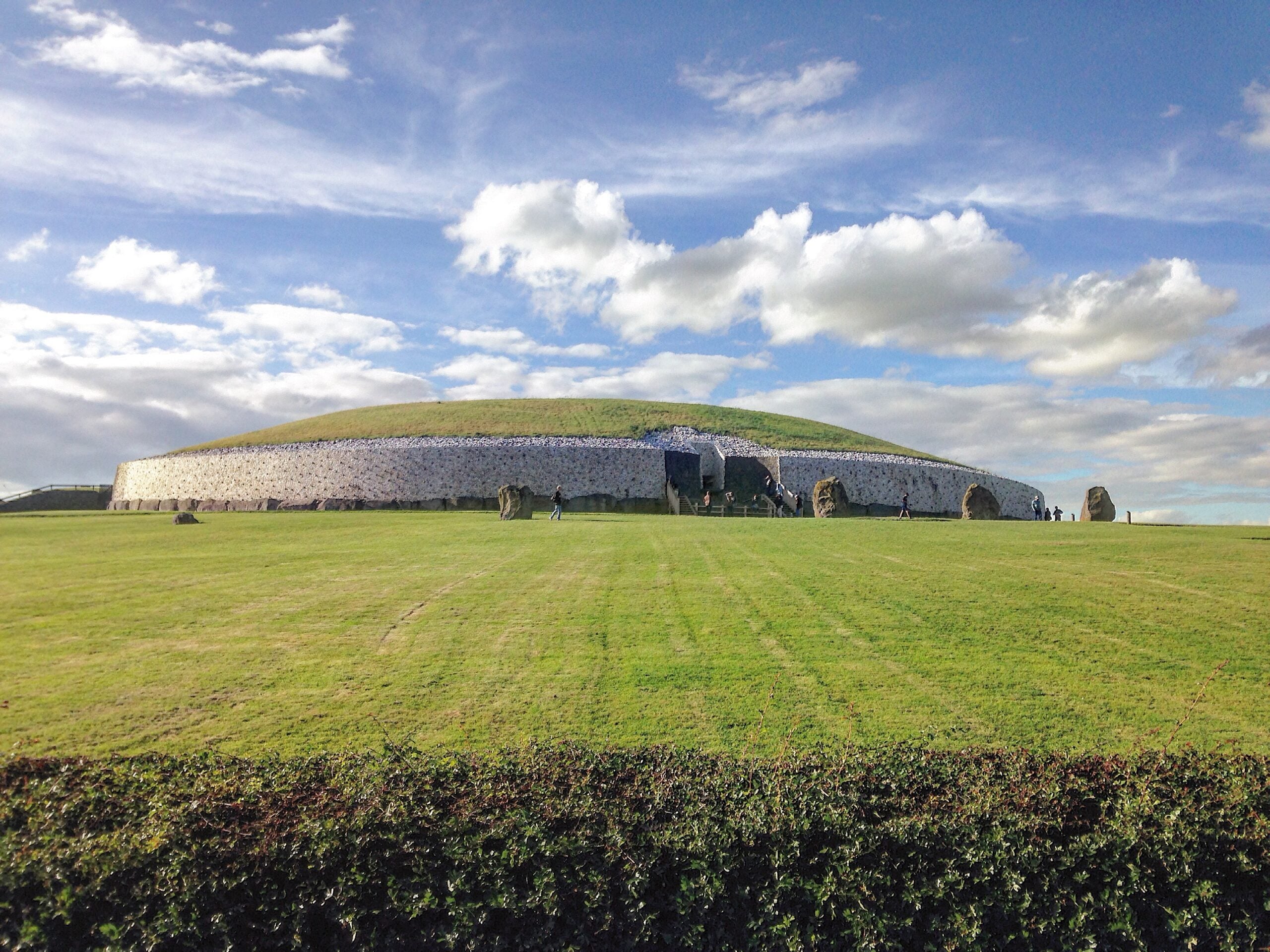
What Is Newgrange?
Newgrange sits in the Boyne Valley, County Meath, about 50 kilometres north of Dublin. It predates Stonehenge by roughly 700 years and the Egyptian pyramids by roughly 640 years. Neolithic farmers built it between approximately 3,200 and 3,100 BC — during an era when Ireland had no written language, no metal tools, and no wheeled vehicles. They moved 200,000 tonnes of stone to build it. They sourced quartz from the Wicklow Mountains, 80 kilometres to the south. They figured out the winter solstice alignment without any of the instruments we would use today.
The monument measures 85 metres in diameter and stands 13 metres high. A single passage, lined with standing stones carved with spirals and geometric designs, leads to a cross-shaped inner chamber. The chamber roof uses a technique called corbelling — stones laid in overlapping rings that gradually close at the top — so precisely constructed that the chamber stayed completely dry for over 5,000 years without any mortar or waterproofing material.
🇮🇪 Discover Your Irish Heritage
Join 64,000 people staying connected to their Irish roots. Get our free Irish Ancestry Guide — surnames, counties, parish records and emigration history — when you subscribe free.
The Winter Solstice: What Actually Happens
On the morning of the winter solstice — 21 December, give or take a day — the sun rises at exactly the right position to shine through a narrow roof-box above the entrance passage. The roof-box is a small rectangular opening, just 20 centimetres high, positioned so that no other point in the year’s solar cycle sends light through it. Sunlight from any other morning of the year hits the outer stones or misses the opening entirely.
From sunrise, light gradually fills the passage. At around 9 am, it reaches the inner chamber and spreads across the floor. It stays for approximately 17 minutes, then the Earth’s rotation carries the sun past the alignment angle and the chamber goes dark again. The event repeats for two or three days on either side of the solstice, but the light is fullest and most direct on the solstice itself.
The Neolithic builders who designed this alignment had to understand the precise point where the sun rises on the shortest day of the year. They had to translate that into a physical corridor pointing at a spot on the horizon. They had to calibrate the roof-box height and angle with enough precision that the effect works across a chamber 19 metres long. And they had to do all of this before breaking the first stone.
☘️ Planning a trip to Ireland?
Our free 7-day road trip itinerary covers Ireland from Dublin to the west coast — day-by-day driving guide with hidden gems, practical tips, and local secrets.
The Mythology of Newgrange
In Irish mythology, Newgrange was the home of the Dagda — the chief god of the Tuatha Dé Danann, Ireland’s pre-Christian divine race. The Dagda owned a magical cauldron that never emptied and a club that killed with one end and restored life with the other. His son was Aengus, the god of love and poetry, who tricked his father into giving him the monument as his permanent home.
The story goes like this: Aengus asked the Dagda if he could live at Newgrange for a day and a night. The Dagda agreed. When the time came, Aengus refused to leave, arguing that “a day and a night” was equivalent to “all time” — since all time consists of days and nights. The Dagda, outwitted, let him stay. Aengus lived there among the dead, where he ruled as lord of the passage between the living world and the otherworld.
In the mythological tradition, the great mounds of the Boyne Valley — Newgrange, Knowth, and Dowth — were the homes of the gods and the entrance points to the otherworld. The winter solstice light illuminating the chamber was, in this tradition, the moment when the gods’ world and the human world aligned. The dead buried in the chamber received the light of the sun on the one day of the year when the boundary between worlds was thinnest.
Who Built Newgrange and Why
The builders were Neolithic farmers who arrived in Ireland around 4,000 BC, about 1,000 years before Newgrange’s construction. They cleared the native forest, grew wheat and barley, kept cattle and pigs, and built the permanent stone monuments that still define the Irish landscape. Newgrange did not stand alone in the Boyne Valley — within a 10-kilometre radius, there are 40 passage tombs, including Knowth (which is larger than Newgrange) and Dowth.
The monuments served as burial sites — archaeologists found the cremated remains of at least five individuals in the inner chamber when they excavated it in the 1960s under Professor Michael J. O’Kelly, who made the solstice discovery. But burial was likely not the primary function. The scale of the engineering — 200,000 tonnes of material, 30 years of labour, 200 standing stones around the exterior — suggests a structure built for the living as much as for the dead. A place where a community gathered to mark time, to observe the solar calendar, and to perform the rituals that governed agricultural and spiritual life.
☘️ Enjoying this? 64,000+ Ireland lovers get stories like this every week. Subscribe free →
The Stone Carvings
The most famous image at Newgrange is the triple spiral carved on the stone at the entrance to the passage — three interlocking spirals, each made from a single continuous line. It appears nowhere else in the world in exactly this form. Nobody knows what it meant to the people who carved it. Scholars have proposed solar calendars, representations of triple goddesses, maps of sacred geography, and abstract spiritual symbols. The debate is unsettled because the builders left no written record.
What is clear is that the carvers worked with flint tools on tough greywacke stone, and they did it with extraordinary precision. The spirals on the entrance stone repeat a consistent radius, maintain their spacing across the full width of a two-metre stone, and sit exactly at eye level when you approach the passage entrance. Other carvings inside the chamber include diamond patterns, zigzags, concentric circles, and chevrons — geometric forms that appear across Neolithic art from Ireland to Malta.
Some carvings are hidden from view — placed on stones deep inside the structure where no one can easily see them, or on the backs of stones facing away from any possible viewer. This tells archaeologists that the carving itself carried significance independent of being seen. The act of marking the stone mattered, not the display of the mark.
The Lottery for the Winter Solstice
Just over 16,000 people applied for the 2025 lottery, the most recently completed draw. The Office of Public Works, which manages the site, runs a lottery to select the lucky few who get to stand inside the chamber at dawn around the solstice. In 2025, 38 people won places across the five mornings centred on the solstice (19 to 23 December). The lottery opens in September and closes at the end of the month. Results go out in October.
If you do not win the lottery — and the odds are roughly 420 to 1 — the site runs live-streamed footage of the solstice light event each year, which you can watch online. The Brú na Bóinne Visitor Centre, which manages both Newgrange and Knowth, also runs simulated solstice light demonstrations inside the chamber during regular opening hours throughout the year, so the experience of seeing the chamber and understanding what happens is available even without the real December event.
How to Visit Newgrange
Access to Newgrange is only through the Brú na Bóinne Visitor Centre, located on the south bank of the River Boyne near Donore village in County Meath. Shuttle buses run from the visitor centre to the monument. You cannot drive to Newgrange directly or walk up to it independently.
The visitor centre opens daily year-round except 24 to 27 December and 1 January. Opening hours vary by season: from May to September the site is open roughly 9 am to 5:45 pm, and from December to February hours run about 9 am to 4:15 pm, with reduced hours in spring and autumn. Adult admission for the Brú na Bóinne Tour plus Newgrange Chamber costs €18 (current OPW rates). Booking in advance is strongly recommended from April to October, when visitor numbers are highest. The OPW tickets website handles reservations.
From Dublin, the drive takes about 50 minutes via the M1 motorway north and then east on the N51. Bus Éireann runs a seasonal coach service from Dublin’s Busáras to the Brú na Bóinne Visitor Centre during summer months. The Boyne Valley is also home to the Hill of Tara (30 minutes by car) and the Battle of the Boyne site, making it an easy full-day heritage excursion from the capital. Our Ireland planning guide has more on building a route through the Boyne Valley, and our free 7-day road trip itinerary includes a Meath heritage day.
Newgrange and Knowth: The Difference
Knowth, 1 kilometre from Newgrange, is larger in area and contains more carvings than any other Neolithic site in Europe — roughly 250 decorated stones, which represents about a third of all Neolithic art in Western Europe. Knowth has two passages, oriented east and west to mark the equinoxes rather than the solstice. People used Knowth as a burial site and settlement for over 4,000 years after its original construction.
Dowth, the third major monument, sits 2 kilometres east of Newgrange. It has not undergone the same degree of professional excavation as Newgrange and Knowth, and its passage is partly collapsed, but it is accessible from the road without the visitor centre system and makes a quieter alternative for those who prefer less managed heritage. All three monuments form the core of the Brú na Bóinne UNESCO World Heritage Site, designated in 1993.
Frequently Asked Questions About Newgrange
How old is Newgrange, and is it really older than the pyramids?
Newgrange dates to approximately 3,200 BC, making it around 5,200 years old. Workers completed the Great Pyramid of Giza around 2,560 BC, meaning Newgrange predates it by roughly 640 years. Stonehenge’s main stone circle went up around 2,500 BC, placing Newgrange about 700 years before it.
How do I get into the winter solstice lottery for Newgrange?
The lottery opens each September on the OPW (Office of Public Works) website. It typically closes at the end of September, and winners hear in October. In 2025, the most recently completed draw, just over 16,000 people entered for 38 places across the five solstice mornings. If you do not win, the site live-streams the event and offers simulated demonstrations year-round at the visitor centre.
Is Newgrange worth visiting outside the winter solstice?
Yes — the monument, the passage, the inner chamber, and the carved stones are remarkable in any season. The visitor centre offers simulated solstice light events and a full archaeological exhibition. Combining Newgrange with Knowth and the wider Boyne Valley makes an excellent full-day heritage excursion from Dublin, around 50 kilometres away.
What is the significance of the spiral carvings at Newgrange?
The triple spiral at the Newgrange entrance stone is unique in world Neolithic art. Scholars have proposed interpretations including solar calendars, triple goddess symbolism, and abstract spiritual markers. No written records exist to confirm the builders’ meaning. The carvings appear both on visible stones and on hidden surfaces, suggesting the act of carving carried spiritual significance independent of display.
☘️ Join 64,000+ Ireland Lovers
Every weekday morning, get Ireland’s hidden gems, local secrets, and travel inspiration — the kind you won’t find in any guidebook.
Subscribe free — enter your email:
Get the free guide
Enter your email and we will send you straight to the download.
📲 Know someone who’d love this? Share on WhatsApp →
Love more? Join 43,000 Scotland lovers → · Join 29,000 Italy lovers → · Join 7,000 France lovers →
Free forever · Unsubscribe anytime
Tours & experiences you might love


Powered by Viator. Some links are affiliate links — we may earn a small commission at no extra cost to you.
Secure Your Dream Irish Experience Before It’s Gone!
Planning a trip to Ireland? Don’t let sold-out tours or packed attractions spoil your journey. Iconic experiences like visiting the Cliffs of Moher, exploring the Rock of Cashel, or enjoying a guided walk through Ireland’s ancient past often sell out quickly—especially during peak travel seasons.

Booking in advance guarantees your place and ensures you can fully immerse yourself in the rich culture and breathtaking scenery without stress or disappointment. You’ll also free up time to explore Ireland’s hidden gems and savour those authentic moments that make your trip truly special.
Make the most of your journey—start planning today and secure those must-do experiences before they’re gone!