

The first time you see the Cliffs of Moher, something happens that nobody quite warned you about. You’ve read the guidebooks. You’ve scrolled through the photographs. You think you know what to expect. But when you actually stand at the edge — the Atlantic crashing 200 metres below, the horizon stretching towards America, the wind pulling at your coat — you realise that some places simply cannot be explained by photographs. They have to be felt.
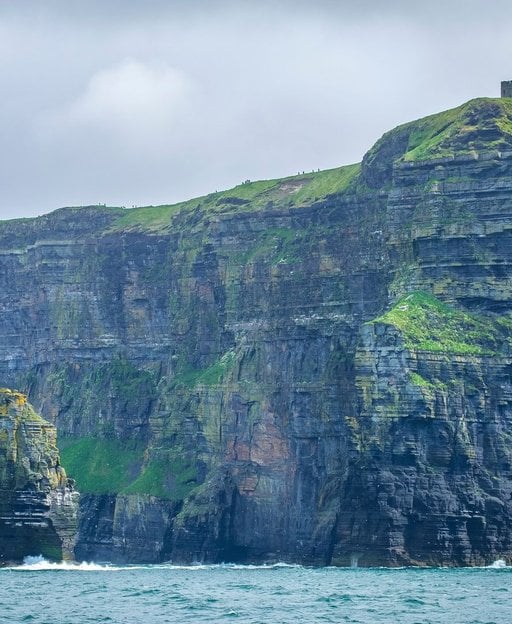
And what so many visitors feel, standing at the Cliffs of Moher in County Clare, is something that catches them completely off guard: the unmistakable feeling that they’ve come home.
What Are the Cliffs of Moher?
The Cliffs of Moher stretch for approximately 14 kilometres along the western coastline of County Clare, reaching heights of up to 214 metres at their tallest point. They are Ireland’s most visited natural attraction, welcoming well over a million visitors every year — and yet, despite the numbers, the landscape never loses its power to silence a person mid-sentence.
Formed from alternating layers of shale and sandstone deposited over 300 million years ago, the cliffs are home to one of Ireland’s most important seabird colonies. Puffins, razorbills, guillemots, and kittiwakes nest in the rocky faces each spring, and if you look carefully enough at the cliff edge, you’ll spot them wheeling out over the sea in great wheeling arcs. But geology and wildlife statistics only tell you what the Cliffs of Moher are. They don’t explain what the Cliffs of Moher do to you.
The Emotional Pull of the Cliffs of Moher
Why Diaspora Visitors Say They Feel “Called Back”
There is something in the Irish psyche — and in the Irish diaspora’s collective memory — that is permanently oriented westward. For generations, the west coast of Ireland was the last thing emigrants saw as their ships pulled out into the Atlantic. The Cliffs of Moher, rising dramatic and immovable against the grey-green sea, became a symbol of that final, painful goodbye.
For the descendants of those emigrants — Irish-Americans, Irish Australians, Irish Canadians visiting for the first time — standing at the Cliffs of Moher is often an unexpectedly emotional experience. Not one of sadness, exactly. More like recognition. As though some inherited memory has been activated by the sight and sound of the place. People find themselves standing there far longer than they planned, reluctant to leave, unable to fully explain why.
This is not sentiment — it is geography doing what it has always done. The Atlantic has a long memory, and so do we.
The Landscape That Gets Under Your Skin
Part of what makes the Cliffs of Moher so emotionally affecting is sheer, uncompromising scale. There is nothing gradual about the drop — the land simply ends, and the sea begins far below. The light changes constantly, moving across the water in ways that photographers will tell you is impossible to capture properly. On a clear day, you can see the Aran Islands sitting in the bay like rough-cut stones. On a misty morning, the cliffs retreat into their own mythology.
That combination — the dramatic geography, the shifting light, the sound of the sea, the wild Atlantic air — works on the nervous system in ways that feel less like tourism and more like lived experience. You don’t just see the Cliffs of Moher. You absorb them.
What to Expect When You Visit
The Visitor Experience
The Cliffs of Moher Visitor Experience is a thoughtfully run underground visitor centre, built directly into the hillside so as not to interrupt the landscape above. It includes engaging exhibitions on the geology and wildlife of the cliffs, a café serving local produce, and comprehensive information on walking trails along the cliff top. The path itself is well maintained, with safety barriers in the most popular sections, though the route extends further in both directions for those who prefer a quieter, more solitary experience.
Allow at least two hours for a proper visit — longer if you intend to walk a section of the Burren Way, which connects the cliffs to the extraordinary karst landscape of the Burren National Park to the north.
O’Brien’s Tower
At the highest section of the cliffs stands O’Brien’s Tower, a circular stone observation tower built in 1835 by local landlord Sir Cornelius O’Brien, who constructed it specifically so that tourists could enjoy the best possible view of the coastline. That it is still performing exactly that function nearly 200 years later says something rather wonderful about the Irish relationship with optimism and good vantage points.
Entry to the tower costs a small additional fee and is well worth it — on a clear day, the views from the top extend all the way to the Twelve Bens mountains of Connemara.
The Best Time to Visit the Cliffs of Moher
The Cliffs of Moher are open year-round. Summer brings the largest crowds and the most reliable weather, but there is a strong case to be made for visiting in the shoulder season. September and October deliver dramatic cloud formations, quieter paths, and that particular quality of Atlantic light that turns the clifftops a deep, burnished gold in the late afternoon. Winter visits, while cold and unpredictable, can reward the hardy visitor with moments of extraordinary, solitary beauty that no amount of Instagram planning can replicate.
Arrive early — before 10am if possible — to experience the cliffs before the tour coaches arrive. The early morning, with mist still settling over the water, feels like your own private discovery.
Planning Your Trip to the Cliffs of Moher
The Cliffs of Moher sit in the western reaches of County Clare, roughly an hour’s drive from Galway and around three hours from Dublin. They are most naturally included as part of a broader west-coast itinerary — typically combined with the Aran Islands, a wander through the Burren, or a section of the Wild Atlantic Way coastal drive. For help planning a full west-of-Ireland trip, our Ireland trip planning hub is the best place to start.
Admission to the Cliffs of Moher Visitor Experience includes car parking; adult entry is approximately €8. Booking online in advance is strongly recommended during peak summer months, as the site can reach capacity on popular days. If you arrive and the car park is full, nearby Doolin village offers overflow options and is worth visiting in its own right for its traditional music scene.
Getting There From Around Ireland
From Galway: Drive south via Kinvara and Ballyvaughan, passing through the heart of the Burren (approximately 1 hour 15 minutes). This route is widely considered one of the most beautiful drives in the country and deserves to be taken slowly, with stops.
From Dublin: Take the M6 motorway west to Galway and continue south (approximately 3 hours in total). Many visitors pair a Dublin-to-Cliffs road trip with an overnight stay in Galway city.
From Limerick: Head north via Ennis and then west through Ennistymon (approximately 1 hour 20 minutes). This route passes through several lovely Clare villages worth a short stop.
If you’re travelling without a car, the Cliffs of Moher can be reached by Expressway coach from Galway or by organised day tours operating from Dublin. The nearest village is Liscannor, with Doolin — just a short drive north — offering traditional music, food, and ferry trips to the Aran Islands. For more inspiration on where the cliffs fit into a broader coastal adventure, take a look at our guide to Ireland’s most dramatic coastlines.
Why the Cliffs of Moher Will Stay With You
Long after you’ve returned home, the Cliffs of Moher have a habit of staying with you. They reappear during ordinary moments — while you’re making tea, or looking out a rain-streaked window, or telling someone about a trip they should take. People who have visited often describe the cliffs in terms usually reserved for people rather than places: as though the landscape made a personal impression on them, remembered them, and left something behind in return.
That feeling — of being recognised, of finding something you didn’t know you were looking for — is perhaps what thousands of people reach for when they ask why the Cliffs of Moher feel like they’re calling you home. The answer, it turns out, is that some places simply know how to hold people. And once the cliffs have held you, a part of you never quite leaves.
☘️ Join 64,000+ Ireland Lovers
Every Friday, get Ireland’s hidden gems, local secrets, and travel inspiration — the kind you won’t find in any guidebook.
Free forever · One email per week · Unsubscribe anytime
Tours & experiences you might love


Powered by Viator. Some links are affiliate links — we may earn a small commission at no extra cost to you.
Secure Your Dream Irish Experience Before It’s Gone!
Planning a trip to Ireland? Don’t let sold-out tours or packed attractions spoil your journey. Iconic experiences like visiting the Cliffs of Moher, exploring the Rock of Cashel, or enjoying a guided walk through Ireland’s ancient past often sell out quickly—especially during peak travel seasons.

Booking in advance guarantees your place and ensures you can fully immerse yourself in the rich culture and breathtaking scenery without stress or disappointment. You’ll also free up time to explore Ireland’s hidden gems and savour those authentic moments that make your trip truly special.
Make the most of your journey—start planning today and secure those must-do experiences before they’re gone!