

He was the greatest god Ireland ever knew. He carried a club so heavy it dragged a trench in the earth. His cauldron never ran dry. His harp could silence a battlefield or break a warrior’s heart. The Dagda — the All-Father of the Tuatha Dé Danann — is one of the most fascinating figures in Irish mythology. And if your family has Irish roots, his story is part of your story too.
Who Was the Dagda?
The Dagda was the chief god of the Tuatha Dé Danann — the divine race said to have ruled Ireland before the Gaels arrived. His name means “the Good God.” Not morally good. Good at everything.
The early Irish admired power, skill, and knowledge. The Dagda had all three. He was a warrior, a druid, and a craftsman. He knew the secrets of life and death.
His full name was Eochaid Ollathair — the All-Father. He was also called Ruad Rofhessa, meaning Lord of Perfect Knowledge. These were not empty titles. They reflected the depth of his power in Irish tradition.
He looks nothing like the gods you might expect. Old texts describe him as a large, round man in a short brown tunic. His club was so huge it needed eight men to carry it. He is deliberately unglamorous — the opposite of the shining gods of Greece and Rome. The Irish didn’t want a perfect god. They wanted a real one. The Dagda was exactly that.
The Dagda’s Three Great Treasures
The Dagda owned three legendary objects. Each one told a different story about what the early Irish valued most.
The Cauldron of Abundance
The Dagda’s cauldron — known in Old Irish as Coire Ansic, or the Undry — had one remarkable quality. Nobody left it hungry.
It was one of the Four Treasures of the Tuatha Dé Danann. The others were the Lia Fáil (the Stone of Destiny at Tara), the Sword of Lugh, and the Spear of Mananán mac Lir. Each treasure came from one of four mythical cities — Falias, Gorias, Findias, and Murias. The cauldron came from Murias.
The idea of a vessel that feeds all without emptying appears across many cultures. The Irish version predates Holy Grail stories by centuries. Some scholars trace a direct line from the Dagda’s cauldron to the Grail legends that spread through medieval Europe.
The Great Club
The Dagda’s club — his lorg mór — was both weapon and tool. One end killed. Nine men could fall with a single blow. The other end gave life. Touch a dead man with it, and he breathed again.
Texts say the club was so heavy it left a rut in the ground like a wagon wheel as the Dagda dragged it behind him. In Irish mythology, the power to give life and take it rested in the same hand. That balance — between death and renewal — sat at the heart of the early Irish view of the natural world.
The Magic Harp
The Dagda’s harp was called Uaithne — also known as the Oak of Two Meadows. It was a living thing.
When the Fomorians stole it before the great battle, the harp hung silent on a wall in the enemy’s hall. The Dagda called out to it by name. The harp tore itself free and flew to him — killing nine Fomorians on the way.
The Dagda used his harp to play three great melodies. Suantrai — the sleep song — sent warriors to sleep. Geanntrai — the laughter song — filled a room with joy. Goltraí — the sorrow song — could make the hardest fighter weep. An Irish ancestor who heard this story knew something true about music. It holds power over the heart that no weapon can match.
☘️ Your Irish family has a story waiting to be found.
Discover where your Irish ancestors came from — their county, their name, their story. Our free step-by-step guide walks you through every record, DNA tool, and ancestry archive. No experience needed.
Claim Your Free Irish Ancestry Guide →The Dagda’s Children: The Gods Who Shaped Ireland
The Dagda was a father as much as a fighter. His children shaped the whole of Irish culture.
Brigid is his most famous daughter. She was the goddess of healing, poetry, and craftwork. When Christianity came to Ireland, her legend merged with Saint Brigid of Kildare. Her feast day falls on 1 February — now a national public holiday in the Republic of Ireland. Her sacred flame burned in Kildare for centuries. It was re-lit in 1993 and burns there still.
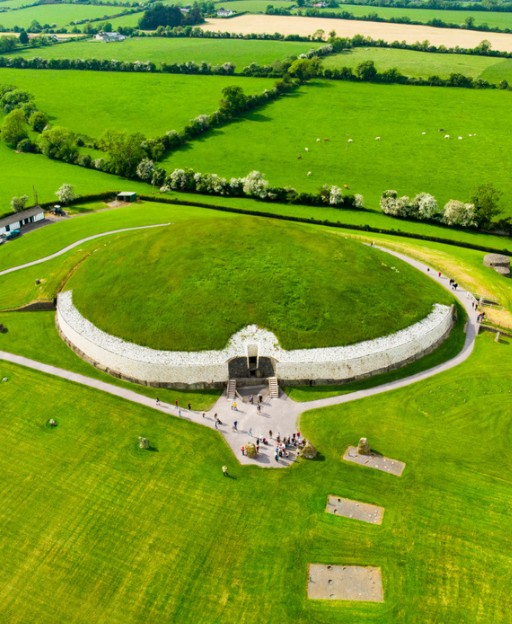
Aengus Mac Óg was the god of love and youth. He lived at Brú na Bóinne — Newgrange. He got it by tricking his own father. He asked to stay “a day and a night.” In Irish, that phrase means all time. The Dagda gave his home away to his son.
Bodb Dearg became the king of the Tuatha Dé Danann after his father. Medieval Irish genealogies traced many noble families back through him. The O’Brien and MacMahon dynasties, among others, claimed descent from Bodb Dearg. In the Irish tradition, mythology and family history were never truly separate.
If your Irish surname belongs to one of the great Munster families, genealogists have traced lines of descent that stretch back through these mythological figures. The mythology and the ancestry are inseparable in Irish culture.
☘️ Enjoying this? 64,000 Ireland lovers get stories like this every week. Subscribe free →
Newgrange: The Dagda’s Home on the Boyne
The most powerful monument in Irish mythology is still standing.
Newgrange in County Meath was built around 3200 BCE. That makes it older than Stonehenge and older than the Great Pyramid at Giza. It is one of the oldest buildings on earth.
In Irish mythology, Newgrange — or Brú na Bóinne — was the Dagda’s great hall. His son Aengus tricked him out of it. The gods moved in and made it theirs.
Every year on 21 December, a shaft of light enters the narrow passage of Newgrange at dawn. It fills the inner chamber for seventeen minutes. Nobody built that alignment by accident. Those Stone Age people read the sky. The Dagda was the god of abundance and the harvest. This is the sunrise that marks the return of the light.
Whether you believe the mythology or not, standing in Newgrange on the solstice connects you to something very old. The Irish government runs an annual lottery for places at the sunrise ceremony. You can visit year-round. The visitor centre sits at Donore in County Meath — around 50 kilometres north of Dublin.
Your Irish ancestors once told stories about this place. They knew it as the Dagda’s home. Many families in County Meath, County Louth, and across the midlands have walked this same ground for hundreds of generations. If your roots are in that part of Ireland, this is your sacred landscape.
The Battle of Mag Tuired
The greatest story about the Dagda comes from the Battle of Mag Tuired — Cath Maige Tuired. This clash between the Tuatha Dé Danann and the Fomorians is one of the oldest narratives in Irish tradition. You can read about the full history of Ireland’s mythological invasions to understand where it fits.
Before the battle, the Fomorians tried to humiliate the Dagda. They made him eat a porridge from a cauldron big enough to hold eighty cows. They added whole goats and pigs to the pot. He ate it all with a ladle large enough for a man and woman to lie in.
He walked away barely able to move. The Fomorians thought they had broken him. They hadn’t.
In the battle, the Tuatha Dé Danann won. The Fomorians were driven to the edges of the world. Before the fighting, the Morrígan appeared to the Dagda at the River Unshin and pledged her support. That partnership between the Dagda and the Morrígan — between abundance and war — speaks to the balance at the heart of Irish mythology.
The texts describing this battle were written down around 1150 CE. But they drew on stories far older. These were the tales your Irish ancestors told by firelight long before anyone wrote them down. In the winter months — during the dark weeks around Samhain — families gathered and told these stories to keep the dark at bay.
The Dagda’s Living Legacy in Ireland Today
The Dagda has no churches or dedicated shrines. But his influence runs through Irish culture in quieter ways.
His daughter Brigid became Saint Brigid. Her feast day — 1 February — is now a national public holiday in Ireland. The Brigid’s Cross, hung above the door of Irish homes for generations, is her symbol. Irish-American families have kept this tradition alive for over a century.
His son Aengus gives his name to Irish boys still. The Hill of Tara in County Meath — where Bodb Dearg ruled the Tuatha Dé Danann after his father — is one of the most visited heritage sites in the country.
The Boyne Valley is a UNESCO World Heritage Site. It includes Newgrange, Knowth, and Dowth — three great passage tombs. Walking through the Boyne Valley, you walk through the landscape the early Irish imagined as the home of their gods.
If your family came from County Meath, County Louth, Westmeath, or anywhere in the Irish midlands, this was their world. The Dagda lived — in the imagination of your ancestors — exactly where they lived too.
Frequently Asked Questions About the Dagda
What does the Dagda mean?
The name means “the Good God” — not good in a moral sense, but good at everything. He was the most skilled and powerful of the Tuatha Dé Danann, Ireland’s divine race of ancient gods.
What are the Dagda’s most famous possessions?
He owned three legendary objects: his cauldron (Coire Ansic or the Undry) that fed all who came to it without ever emptying, his great club (the lorg mór) that could kill or revive the dead, and his magic harp (Uaithne) that could play the melodies of sleep, joy, or sorrow.
Where did the Dagda live?
In Irish mythology, the Dagda lived at Brú na Bóinne — Newgrange in County Meath. His son Aengus Mac Óg tricked him out of it by asking to stay “a day and a night,” which in Irish means all time. You can visit the site year-round — it is one of Ireland’s greatest heritage landmarks.
Who were the Dagda’s children?
His most famous children were Brigid (goddess of healing and poetry, later linked to Saint Brigid of Kildare), Aengus Mac Óg (god of love and youth at Newgrange), Bodb Dearg (who became king of the Tuatha Dé Danann), Midir, and Cermait. Many Irish families later claimed descent through Bodb Dearg.
What Irish families claim descent from the Dagda?
Medieval Irish genealogies traced dynasties such as the O’Briens and MacMahons back through Bodb Dearg to the Dagda. These connections blend mythology with history. In Irish culture, the two were never fully separate. If your name is Irish and your ancestors came from Munster or the midlands, the Dagda is part of your heritage story.
Your ancestors lived in the same landscape that inspired these stories. They walked past the Boyne. They knew the solstice. They told these tales by firelight in the long winter months. The mythology and the ancestry are inseparable — and tracing your family roots is the way to bring the story home.
☘️ Join 64,000+ Ireland Lovers
Every Friday, get Ireland’s hidden gems, local secrets, and travel inspiration — the kind you won’t find in any guidebook.
Subscribe free — enter your email:
Already subscribed? Download your free Ireland guide (PDF)
📲 Know someone who’d love this? Share on WhatsApp →
Love more? Join 43,000 Scotland lovers → · Join 29,000 Italy lovers → · Join 7,000 France lovers →
Free forever · One email per week · Unsubscribe anytime
Tours & experiences you might love


Powered by Viator. Some links are affiliate links — we may earn a small commission at no extra cost to you.
Secure Your Dream Irish Experience Before It’s Gone!
Planning a trip to Ireland? Don’t let sold-out tours or packed attractions spoil your journey. Iconic experiences like visiting the Cliffs of Moher, exploring the Rock of Cashel, or enjoying a guided walk through Ireland’s ancient past often sell out quickly—especially during peak travel seasons.

Booking in advance guarantees your place and ensures you can fully immerse yourself in the rich culture and breathtaking scenery without stress or disappointment. You’ll also free up time to explore Ireland’s hidden gems and savour those authentic moments that make your trip truly special.
Make the most of your journey—start planning today and secure those must-do experiences before they’re gone!