

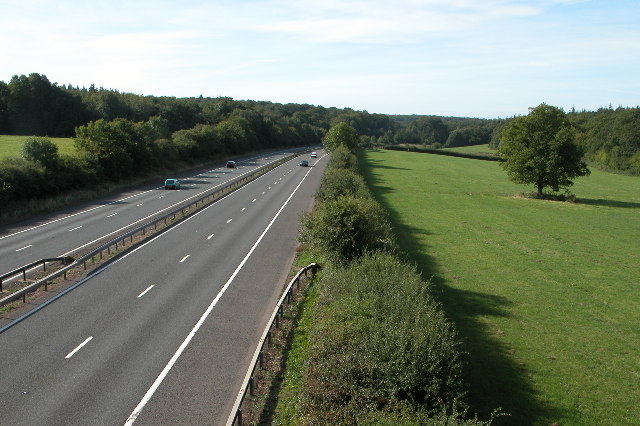
How EU Billions Built Ireland’s Motorway Network in the 1990s
Ireland in 1989 had a road problem that was, statistically speaking, almost impossible. It had more miles of road per person than any other country in the European Community. And almost no motorways to speak of.
The first motorway sections in the entire country — the Naas bypass on what became the M7, and an initial stretch of the M1 north of Dublin — had opened only in 1983. Six years on, while Germany had the Autobahn threading from border to border and Britain had thousands of miles of dual carriageway, Ireland’s national road network accounted for just 6% of total road mileage. Those roads carried 34% of all traffic.
The calculation is worth sitting with. Two-thirds of every mile driven in Ireland was being squeezed onto a fraction of the network — national primary routes that ran from Dublin to Cork, Galway, Limerick, Waterford, and out to the western towns. Heavy goods vehicles from the new industrial estates the government had been building across the regions, tourist coaches, lorries bound for the ports, tractors, family saloons: all sharing the same two-lane roads that had been designed for an earlier economy and an earlier volume of use. Economists at the ESRI — the Economic and Social Research Institute — noted, with academic restraint, that government expenditure on road maintenance had been “lacking by international standards for the last 10 to 15 years.” Decades of deliberate regional industrialisation policy had made it worse: factories were dispersed to spread prosperity beyond Dublin, which was sensible, but the goods they produced still had to reach the ports. Those goods now moved over roads that weren’t built for the job.
Then, in 1989, a very large sum of money arrived from Brussels. What it eventually produced changed the experience of crossing Ireland by road more profoundly than almost anything before or since.
What the Community Support Framework Actually Was
In 1988, Jacques Delors oversaw a doubling of the European Community’s regional development budget. The logic was that a single European market — which was coming — would benefit the richer countries most, and the poorer ones would need help to keep up. The money was channelled through multi-year packages called Community Support Frameworks, or CSFs. The first ran from 1989 to 1993. The second from 1994 to 1999. They were not grants handed over with no strings — they required recipient governments to draw up spending plans, demonstrate matching national investment, and account for what the money was used on.
Ireland qualified, and qualified well. At the start of the first CSF, it was among the poorest countries in the EC by income per head. The transfers it received, measured as a share of national income, were larger than those received by any of the other three designated “cohesion” countries — Greece, Portugal, and Spain. Having been at around 1.5% of GNP for years, EU structural transfers to Ireland climbed to over 3% of GNP in 1991-93. When the Celtic Tiger began pushing Irish incomes upward rapidly, that percentage fell back to around 2.5% in the 1994-99 period — not because the flow of ECUs had decreased, but because the economy had grown so fast that the same European payments now represented a smaller slice of a much bigger national income.
Of the total first CSF allocation, physical infrastructure — primarily roads and ports — received roughly £1.4 billion in total expenditure, with approximately £830 million of that coming directly from the European Commission. Infrastructure accounted for 27 to 29% of the first framework’s total spend — the largest single category, narrowly ahead of human resources (28%). By the second framework (1994-99), its share had risen to around 36%, again the largest category (FitzGerald, 1998).
The Cohesion Fund
Then, in 1993, a separate mechanism opened up. The Cohesion Fund was established as part of the Maastricht Treaty settlement — a targeted instrument for countries whose GNP per head fell below 90% of the EU average. Ireland’s GNP per capita at the relevant reference period was around 88% of the EU average, just under the threshold. Between 1994 and 1999, some 115 projects in Ireland received Cohesion Fund approval. The money ran to specific works: the Balbriggan bypass north of Dublin was among the funded road projects; a road interchange at Killarney was another. These were not dramatic ribbon-cutting projects at the time. They were bypasses and interchanges and dual carriageway sections, the incremental infrastructure of a country beginning, methodically, to address a road network that had been running badly over capacity for a long time.
The Economics of It
John FitzGerald of the ESRI spent years modelling what the two CSFs were doing and would do to the Irish economy. His 1998 paper, written as the second framework was entering its final year, captured both the scale and the straightforward limits of what EU structural funds could claim credit for.
The combined effect of the two frameworks, the HERMIN macroeconomic model projected, would be to raise the level of Ireland’s GNP by between 3% and 4% above what it would otherwise have been during the period 1995-99. The long-run supply-side benefit — roads that stay usable, ports that function — was modelled at approximately 2 percentage points of GNP permanently, above the baseline that would have existed without the investment. At peak construction activity, the employment effect was estimated at over 30,000 jobs.
FitzGerald and his colleagues were careful to frame these as model projections, not observed outcomes — and they were explicit about the structural funds’ place in the wider story. Ireland’s growth in this era was driven primarily by inward foreign direct investment, favourable corporate tax policy, and a young, well-educated workforce. Structural funds played, in their assessment, a “minor, though important” role. But for roads specifically, the EU funding was not minor. It was the financial mechanism through which the underfunding of a decade and a half was, at last, being addressed.
The modellers also noted something counterintuitive: transport costs turned out to be a relatively small share of total costs for Irish firms, meaning the direct productivity gains from road investment were harder to isolate than the headline infrastructure spend suggested. What roads did was not so much reduce firm-level costs in any single dramatic way as remove a long-standing constraint on the movement of goods and people across a country that had been trying to industrialise on roads that weren’t built for it.
Building It, Section by Section
The motorway network that the CSF funding helped finance did not spring into existence during the 1989-1999 period. Infrastructure at that scale rarely does. What the two frameworks built, in those years, was the financial and institutional foundation: the planning consents, the land acquisition processes, the engineering surveys, the early bypasses and route upgrades, the Cohesion Fund project approvals. The National Development Plans that followed in the 2000s then channelled accumulated public investment — some of it still EU-assisted, much of it now from a richer Ireland — into the motorway build-out proper.
The Dublin to Galway route is a case in point. It was completed in five distinct sections over three years. Kinnegad to Tyrellspass opened in December 2006. Tyrellspass to Kilbeggan followed in May 2007. Kilbeggan to Athlone opened in July 2008. Athlone to Ballinasloe in July 2009. The final section, from Ballinasloe into Galway, opened on 18 December 2009. Before the motorway existed, the drive from Dublin to Galway took more than three hours. After it: approximately two.
The M8 to Cork completed in stages as well. When the final sections opened, the journey time saving was measured at up to 45 minutes. The full Major Inter-Urban motorway project — the spine of national routes connecting Dublin continuously to Cork, Limerick, Waterford, and Galway — reached 916 kilometres by December 2010. As early as May of that year, over 700 kilometres were already open to traffic.
There was a cross-border dimension too. On 2 August 2007, four months ahead of schedule, the A1/N1 dual carriageway linking Dublin’s M1 motorway to the A1 at Newry opened to traffic. It was the first cross-border road project completed as a single scheme — 14 kilometres built across two jurisdictions, with Minister for Foreign Affairs Dermot Ahern and Northern Ireland Minister Conor Murphy on hand for the opening. The route it replaced had been a notorious bottleneck on the main Dublin-Belfast corridor. The route that replaced it was not.
The Country It Made
Ireland in 1989 had, paradoxically, too many roads and not enough of the right ones. It had the highest road mileage per person in the European Community and one of the lowest motorway densities. Its national routes were underfunded, overloaded, and inadequate for the kind of economy it was trying to become. The EU structural transfers of 1989-1999 — rising at their peak to over 3% of national income, larger per head than any other cohesion country received — began the process of correcting that. Specific projects came first: bypasses, interchanges, early dual carriageway sections. The big motorways followed in the decade after. By the time the network reached its full extent in December 2010, at 916 kilometres of continuous motorway connecting the island’s main cities, the gap between what Ireland had and what every comparable European economy had long taken for granted had finally been closed.
The money came from Brussels. The roads got built. And a country that had somehow managed to be both overstocked with rural lanes and desperately short of usable inter-city routes found itself, two decades on, with a network that would have been unrecognisable to anyone who drove those congested national routes in 1989.
The numbers in this story — the 6%, the 34%, the 3% of GNP, the 916 kilometres — are not especially dramatic on their own. What they describe, collectively, is a structural problem that accumulated over decades, a funding mechanism that finally made it addressable, and an infrastructure transformation that reshaped how the island moves.
Tours & experiences you might love


Powered by Viator. Some links are affiliate links — we may earn a small commission at no extra cost to you.
Secure Your Dream Irish Experience Before It’s Gone!
Planning a trip to Ireland? Don’t let sold-out tours or packed attractions spoil your journey. Iconic experiences like visiting the Cliffs of Moher, exploring the Rock of Cashel, or enjoying a guided walk through Ireland’s ancient past often sell out quickly—especially during peak travel seasons.

Booking in advance guarantees your place and ensures you can fully immerse yourself in the rich culture and breathtaking scenery without stress or disappointment. You’ll also free up time to explore Ireland’s hidden gems and savour those authentic moments that make your trip truly special.
Make the most of your journey—start planning today and secure those must-do experiences before they’re gone!