

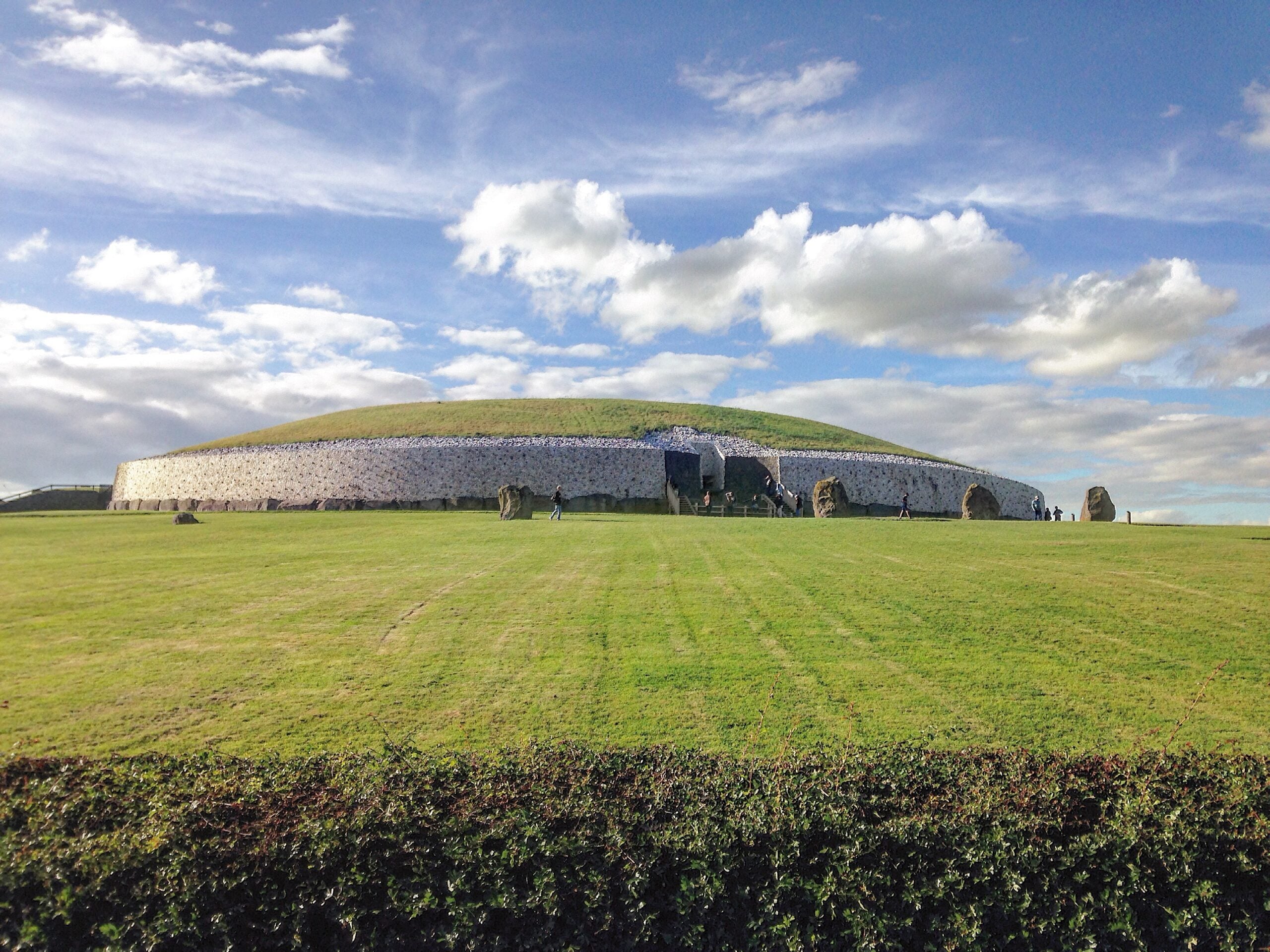
Newgrange Winter Solstice: How a 5,000-Year-Old Tomb Was Built to Catch 17 Minutes of Sunlight
Some minutes before sunrise on 21 December 1967, a Cork archaeologist named Professor Michael J. O’Kelly crawled into a stone passage in County Meath and sat down in the dark to wait. He was in the middle of a thirteen-year excavation, and he had heard the local stories: that on the morning of the winter solstice, sunlight entered the chamber. Nobody in living memory had deliberately verified this. Nobody had gone in to check.
He waited. Then, slowly, “the chamber grew steadily lighter.” A beam of sunlight entered through a small opening above the passage entrance, travelled inward along the floor, and eventually “the whole chamber — side recesses, floor and roof six metres above the floor — were all clearly illuminated.” It lasted about seventeen minutes. Then it was over for another year.
What O’Kelly witnessed that morning was the first intentional observation of the Newgrange solstice alignment in at least 5,000 years. The monument had been waiting patiently for someone to come back inside and notice.
Older Than You Think — By a Long Way
Newgrange sits on a low ridge above a bend in the River Boyne in County Meath, roughly an hour north of Dublin. The mound is about 85 metres across and 13.5 metres high — wide as a football field, taller than a four-storey building — and it covers just over an acre of ground. Around its base sit 97 enormous kerbstones, many carved with spirals and geometric designs. The facade facing the entrance is clad in white quartzite that catches the light.
It was built around 3200 BC.
That date matters. The Great Pyramid of Giza was completed around 2560 BC — more than 600 years after Newgrange was finished. Stonehenge’s main stone circle wasn’t erected until around 2500 BC, roughly 700 years later. When the pharaohs were young, Newgrange was already ancient.
The dating was not always so certain. Until the 1980s, archaeologists placed passage tombs like Newgrange in the Bronze Age, around 2800 BC. Improved radiocarbon analysis revised that significantly. Current calibrated radiocarbon determinations put Newgrange’s construction firmly in the middle Neolithic, making it one of the oldest precisely dated structures on Earth.
How They Built It Without Metal
The people who built Newgrange were Stone Age farmers. No metal tools. No wheel in any meaningful sense. What they had, apparently, was extraordinary organisational capacity and a great deal of collective purpose.
The white quartzite on the facade was quarried in the Wicklow Mountains, roughly 80 kilometres to the south. The large stones forming the passage and chamber — around 300 of them — came from near Clogherhead in County Louth, about 25 kilometres away. The 97 kerbstones came from the same source, each weighing roughly three tonnes. Estimates suggest the entire project required around 300 people working for approximately 30 years.
The stones were most likely transported by raft along the Irish coast and then up the River Boyne, before being hauled uphill to the ridge. The builders left no written records and no tools we can identify as theirs. What they left was the structure.
The interior is a single passage — 19 metres long — that opens into a cruciform chamber with three recessed alcoves. Above the chamber, the builders constructed a corbelled roof: each successive course of stone projects slightly inward, course by course, until the courses meet at the apex some six metres above the floor. No mortar. No cement. Many of the corbels had grooves cut into their upper surfaces to drain rainwater away from the chamber below.
That corbelled roof has remained watertight for more than 5,000 years. There is no evidence of significant water intrusion since the monument was sealed.
The Opening That Looks Like an Accident
Set into the facade above the passage entrance is a small rectangular opening — roughly 25 centimetres high — that O’Kelly named the “roof-box.” For most of the year it does nothing you would particularly notice.
For five mornings around the winter solstice, it channels the rising sun directly down the passage and into the chamber. Based on O’Kelly’s 1969 observations, the first pencil of sunlight enters the roof-box at 8:58 AM. The light travels the full 19 metres to the rear of the chamber, and as the sun rises higher, the beam widens until the whole chamber is lit. After 17 minutes, the sunbeam retreats back down the passage and the chamber returns to darkness.
The alignment is not approximate. Astronomers and archaeologists who have studied it believe the builders must have observed and recorded the solstice sunrise over multiple years before orienting the passage. They needed to track the exact position of the rising sun at its southernmost winter point, and they needed to calibrate the angle of the roof-box precisely against the slope of the passage floor. With no instruments we would recognise and no script in which to record their observations, they got it exactly right.
O’Kelly coined the term “roof-box” during his excavation. The local tradition he had heard — that light entered the chamber in winter — had been passed down orally for generations, perhaps centuries. It was accurate. The engineering it described had been quietly working, year after year, in an empty chamber.
What the Chamber Actually Contained
Newgrange was a tomb. The excavations O’Kelly conducted between 1962 and 1975 — carried out alongside his wife and archaeology collaborator Claire O’Kelly — found the cremated remains of at least five individuals inside the chamber, along with the unburnt bones of at least two others. Grave goods included bone pins and stone pendants.
The small number of burials is significant. The monument took decades to build, commands a prominent ridge, and dominates the landscape for kilometres around. Yet the burial evidence points to a very small and deliberate group of people — not a communal ossuary but something more selective. Whoever this place was built for, it was not built for everyone.
Who those people were became clearer in 2020, when researchers published a study in Nature reporting on ancient DNA extracted from remains found across the passage tombs of Brú na Bóinne. The adult male buried in the most elaborately decorated recess of Newgrange’s chamber was found to be the product of a first-degree incestuous union — a parent and child, or a sibling pair. This pattern does not appear randomly in human populations. In the historical record, deliberately sanctioned incest of this kind is documented almost exclusively within politico-religious dynasties: Egyptian pharaohs, Inca god-kings, ruling families where the concentration of bloodline was considered sacred or politically necessary. The researchers also identified relatives of this individual in passage tombs roughly 150 kilometres to the west, suggesting a network of elite kinship stretching across Neolithic Ireland.
The man buried in the finest recess of Ireland’s greatest monument was, in some meaningful sense, a dynastic god-king. The mythology, it turned out, had been saying this for centuries.
The Mansion of the Boyne
Long before any radiocarbon date was published, and long before anyone extracted DNA from a fragment of petrous bone, Irish mythology had a story about this place. In the medieval texts that preserved pre-Christian oral tradition, the great mound was called Brú na Bóinne — the mansion, or palace, of the Boyne — and it was the home of the Dagda, the chief god of the Tuatha Dé Danann, portrayed in those texts as a father-figure, king, and druid.
The most famous myth attached to the site involves the Dagda’s son Aengus. The Dagda had built the mound and owned it. Aengus wanted it for himself, so he asked his father if he could have it for just “a day and a night.” The Dagda agreed. Then Aengus declared that all time consists of days and nights — so “a day and a night” is all time, and he intended to keep the mound forever.
It is one of the older property disputes in Irish history, and the winner of it ended up, according to tradition, sleeping inside a monument astronomically aligned with the turning point of the year. The mythology and the archaeology are arriving at the same conclusion by different routes: Newgrange was built for power, and by power, and in the service of something larger than ordinary life.
The Stone That Greets You
Before entering the passage, visitors pass the entrance stone — Kerbstone 1 in the archaeological catalogue, though cataloguing it feels like an understatement. It is 3.2 metres long and 1.3 metres high, and its surface is almost entirely covered in carved spirals. A large triple spiral dominates the left half, with the loops rotating clockwise toward the centre and anti-clockwise moving away from it. Chevrons, lozenges, and arcs fill the rest of the surface. The spirals are carved to about a centimetre’s depth and width, made with stone tools, by hand, at some point during or before the monument’s construction around 3200 BC.
Nobody knows what they mean. Similar carvings appear throughout the passage and chamber — on the upright orthostats, on the corbel stones beneath the roof, on kerbstones around the perimeter. The triple spiral at the back of the chamber, on the stone known as orthostat C10, has become one of the most reproduced symbols in Irish visual culture, and it remains uninterpreted in any agreed sense. What we can say is that the people who made these carvings understood pattern and symmetry at a level that still looks deliberate and controlled to anyone who studies them.
Seventeen Minutes, 30,000 People
Today, around 30,000 people enter a lottery each year for the chance to stand inside Newgrange’s chamber on the mornings of 19 to 23 December. In 2025, 38 people won. The Office of Public Works broadcasts the event live for those who don’t make it inside, and in recent years the stream has been watched across the world — in Irish diaspora communities, in classrooms, by people in time zones that require setting an alarm.
O’Kelly was back for the solstice in 1969 and left a precise written record. At exactly 8:54 AM, the top edge of the sun appeared above the local horizon. At 8:58, the first pencil of direct sunlight came through the roof-box and along the passage. The chamber lit up. At around 9:15, the light was gone.
The people who built the monument had been dead for five millennia before O’Kelly confirmed what they had done. For all that time, on the morning of the winter solstice, the light had entered the passage, moved along the floor, reached the chamber, and retreated — with no one inside to see it. Year after year, perfectly on schedule, performing for an empty room.
What stays with us about Newgrange is not simply the age or the engineering or the dynasty buried within it — remarkable as all of those are. It is the decision, made somewhere around 3200 BC by people with stone tools and a long horizon, to spend decades building something designed to catch a single moment of light, once a year, and hold it for seventeen minutes. That decision still works. The alignment is still precise. And on a cold, clear December morning in County Meath, standing on the ridge above the Boyne as the shortest day of the year begins to come apart at the seams, it is not hard to understand why someone thought it was worth the effort.
Tours & experiences you might love


Powered by Viator. Some links are affiliate links — we may earn a small commission at no extra cost to you.
Secure Your Dream Irish Experience Before It’s Gone!
Planning a trip to Ireland? Don’t let sold-out tours or packed attractions spoil your journey. Iconic experiences like visiting the Cliffs of Moher, exploring the Rock of Cashel, or enjoying a guided walk through Ireland’s ancient past often sell out quickly—especially during peak travel seasons.

Booking in advance guarantees your place and ensures you can fully immerse yourself in the rich culture and breathtaking scenery without stress or disappointment. You’ll also free up time to explore Ireland’s hidden gems and savour those authentic moments that make your trip truly special.
Make the most of your journey—start planning today and secure those must-do experiences before they’re gone!