

Horse-Power Hour
At roughly seven in the morning on 26 August 1913, the tramway workers of Dublin did something that had never happened before in the city’s history. They simply stepped off the trams.
Not at a depot. Not at a terminus. In the middle of routes, in the middle of streets — the cars just stopped, and the men walked away. The city ground to a halt.
This was not a spontaneous act. It had been building for months, and it was the opening move in what would become the most consequential industrial dispute in Irish history — a six-month battle between the man who owned almost everything worth owning in Dublin and the workers who kept it running.
The Man Who Owned the City
☘️ Join 64,000+ Ireland Lovers
Every weekday morning, get Ireland’s hidden gems, local secrets, and travel inspiration — the kind you won’t find in any guidebook.
Subscribe free — enter your email:
Already subscribed? Download your free Ireland guide (PDF)
📲 Know someone who’d love this? Share on WhatsApp →
Love more? Join 43,000 Scotland lovers → · Join 29,000 Italy lovers → · Join 7,000 France lovers →
Free forever · Unsubscribe anytime
By 1913, William Martin Murphy had constructed a business empire that would have been remarkable in any city in these islands. He controlled the Dublin United Tramway Company — the network those men had just abandoned. He owned the Irish Independent, which by 1914 was selling more than 100,000 copies a day, having displaced the Freeman’s Journal as the dominant nationalist daily when Murphy relaunched it as a halfpenny paper in 1905. He owned the Evening Herald. He owned Clery’s department store on O’Connell Street. He owned the Imperial Hotel, also on O’Connell Street. He had previously served as a Member of Parliament.
Murphy had been born in 1845 in Castletownbere, County Cork, and had built his fortune through contracts, tramway development across Ireland, Britain and West Africa, and a sharp instinct for what the Catholic middle class wanted to read. He was not a man who lacked confidence in his own judgement.
What Murphy could not tolerate — and would not tolerate — was Jim Larkin.
Big Jim and the Union
James Larkin had arrived in Dublin in 1907, sent by the National Union of Dock Labourers to organise the port. Within a year he had done something more ambitious: he founded the Irish Transport and General Workers’ Union, a general union that aimed to organise not just dockworkers or skilled tradespeople but everyone — the casual labourers, the carters, the newsboys, the workers whom the existing craft unions had no interest in representing.
Born in 1874 in Liverpool to Irish parents, Larkin had grown up working on the docks. He was not a moderate man. His gift was oratory of a kind that Dublin had rarely heard — passionate, Biblical in cadence, capable of drawing enormous crowds. His slogan was simple: a fair day’s work for a fair day’s pay. His method was the sympathetic strike: if workers in one part of the transport network struck, workers elsewhere would refuse to handle the cargo of the employer in dispute.
For a man like Murphy, whose businesses depended on the movement of goods and people through Dublin, this was an existential threat. And by 1913, the ITGWU had around 30,000 members.
The Pledge
On 15 August 1913, Murphy issued an ultimatum to the dispatch workers at the Irish Independent and then to the tramway workers: choose between the union and your jobs. Those who refused to leave the ITGWU were dismissed. When Larkin called the tramway workers out on 26 August, Murphy had been waiting.
What made the Dublin Lockout different from an ordinary strike was what happened next. Murphy convened a meeting of the Dublin Employers’ Federation and persuaded around 400 employers — from coal merchants to shipping companies to building contractors — to act in concert. Workers across the city who were members of the ITGWU were locked out: told they could not return until they signed a document pledging to resign from the union and never to engage in sympathetic action. Those who refused were dismissed without pay.
Within weeks, around 20,000 workers had been locked out of employment. With dependants included, the dispute directly touched the lives of some 80,000 people in a city of roughly 300,000.
The City Behind the Trams
To understand what losing wages meant in Dublin in 1913, you need to understand what those wages were paying for — or failing to. Dublin’s tenements were, by any measure applied at the time, among the worst urban housing in Europe. More than 830 people were recorded as living in just 15 houses on Henrietta Street alone. Over 20,000 families across the city were recorded as living in a single room. Some 28,000 people were in dwellings that even the Dublin Corporation admitted were unfit for human habitation.
The infant mortality rate among the poor was 142 deaths per 1,000 births. The city’s overall death rate — 27.6 per 1,000 — was comparable to Calcutta. Tuberculosis deaths in Ireland ran at around 50 per cent higher than in England or Scotland.
These were the families now without wages. In the autumn of 1913, as the lockout dragged on and the weather turned cold, children went hungry in the tenements of the Liberties and the north inner city while their fathers stood outside factories and yards, refusing to sign.
Bloody Sunday: August 31, 1913
Five days into the official lockout, the Dublin Metropolitan Police issued a ban on public meetings in the city centre. Larkin announced he would speak on O’Connell Street — then called Sackville Street — anyway.
He needed a disguise. He was a man who was difficult to disguise: tall, physically imposing, with a voice that carried. But Nellie Gifford — a labour activist who would later take part in the Easter Rising — smuggled him into William Martin Murphy’s own Imperial Hotel. Larkin, wearing a beard and a frock coat, walked through the lobby and up the stairs.
From the balcony of Murphy’s hotel, looking down on Murphy’s tram route on Murphy’s street, Larkin began to speak.
The police moved within minutes. What followed — on O’Connell Street and at Beresford Place nearby — was described by eyewitnesses and subsequent investigations as indiscriminate and ferocious. The DMP baton-charged not just strikers and union men but bystanders who happened to be in the street. Hundreds were injured. Two workers, James Nolan and John Byrne, died from injuries received that evening.
Among those hurt that night were bystanders who had simply been in the wrong part of the city. The date entered Irish history as the first Bloody Sunday of a century that would see others.
The Children of the Lockout
By October, the situation in the tenements was desperate enough that a British socialist activist named Dora Montefiore proposed a scheme: working-class and trade union families in England — Liverpool, Glasgow, London — would temporarily take in the children of locked-out Dublin workers and feed and house them through the winter. Larkin heard her speak in London and endorsed it.
The Catholic Church intervened. Archbishop Walsh, who had expressed some sympathy for the strikers, condemned the plan as placing Catholic children in Protestant and atheist households. Priests organised vigilance committees. When Montefiore and her colleague Lucille Rand gathered around 50 children at the Tara Street Baths, clothed and ready for the journey, clergymen from the nearby Westland Row parish arrived and blocked them. The children did not get on the boats.
The episode divided nationalist Ireland. Writers and intellectuals who had been broadly sympathetic to the strikers — George Bernard Shaw wrote at length about the lockout, W.B. Yeats and George Russell were among those who publicly expressed horror at conditions in Dublin — found the Church’s intervention harder to defend. James Connolly, who had been Larkin’s deputy throughout the dispute, was furious.
The Food Ship and the Long Winter
In the absence of the children’s scheme, British trade unions sent food. On 27 September 1913, a ship called The Hare arrived in Dublin carrying 40 tons of provisions raised by British trade unionists. More followed. The British Trades Union Congress sent a total of £150,000 to support the locked-out workers over the course of the dispute.
But by January 1914, the money was running low and the TUC — wary of the dispute dragging British unions deeper into an Irish quarrel — began to pull back. Hunger had done what the baton charges had not quite managed. Workers began returning, and many signed the pledge they had held out for months against signing.
The lockout formally ended on 18 January 1914. It had lasted nearly five months. The workers, in the most direct sense, lost. ITGWU membership fell from around 30,000 before the dispute to around 5,000 in its wake. Many of those who had been most active were blacklisted and could not find employment anywhere in the city. Murphy and the Employers’ Federation had held the line.
What the Defeat Built
And yet. The lockout produced something that neither Murphy nor his allies had intended.
In November 1913, as the dispute was still grinding on, a former British army officer named Captain Jack White — the eccentric son of a Boer War general, motivated by something between guilt and conviction — proposed a drilling scheme for locked-out workers. The idea was to give them discipline, exercise and a degree of protection against the police baton charges that had become a feature of life in the city. Larkin and Connolly backed it. The Irish Citizen Army was born.
James Connolly — socialist, trade unionist, born in Edinburgh to Irish parents, who had been in the United States for years before returning to lead the ITGWU’s Belfast operation — took command of the Citizen Army after Larkin departed for America in 1914. Playwright Seán O’Casey, then a labour activist rather than a literary figure, sat on its early army council.
On Easter Monday 1916, the Irish Citizen Army — a direct institutional product of the Dublin Lockout — occupied the College of Surgeons and other positions across the city as part of the Rising. James Connolly commanded the rebel garrison at the General Post Office. He was executed in May 1916, unable to stand before the firing squad because of wounds he had received during the Rising, and was shot while tied to a chair.
William Martin Murphy, who had called for the execution of the Rising’s leaders, died in June 1919. He was buried in Glasnevin Cemetery, where many of those who had opposed him now also rest.
The Street Where It Happened
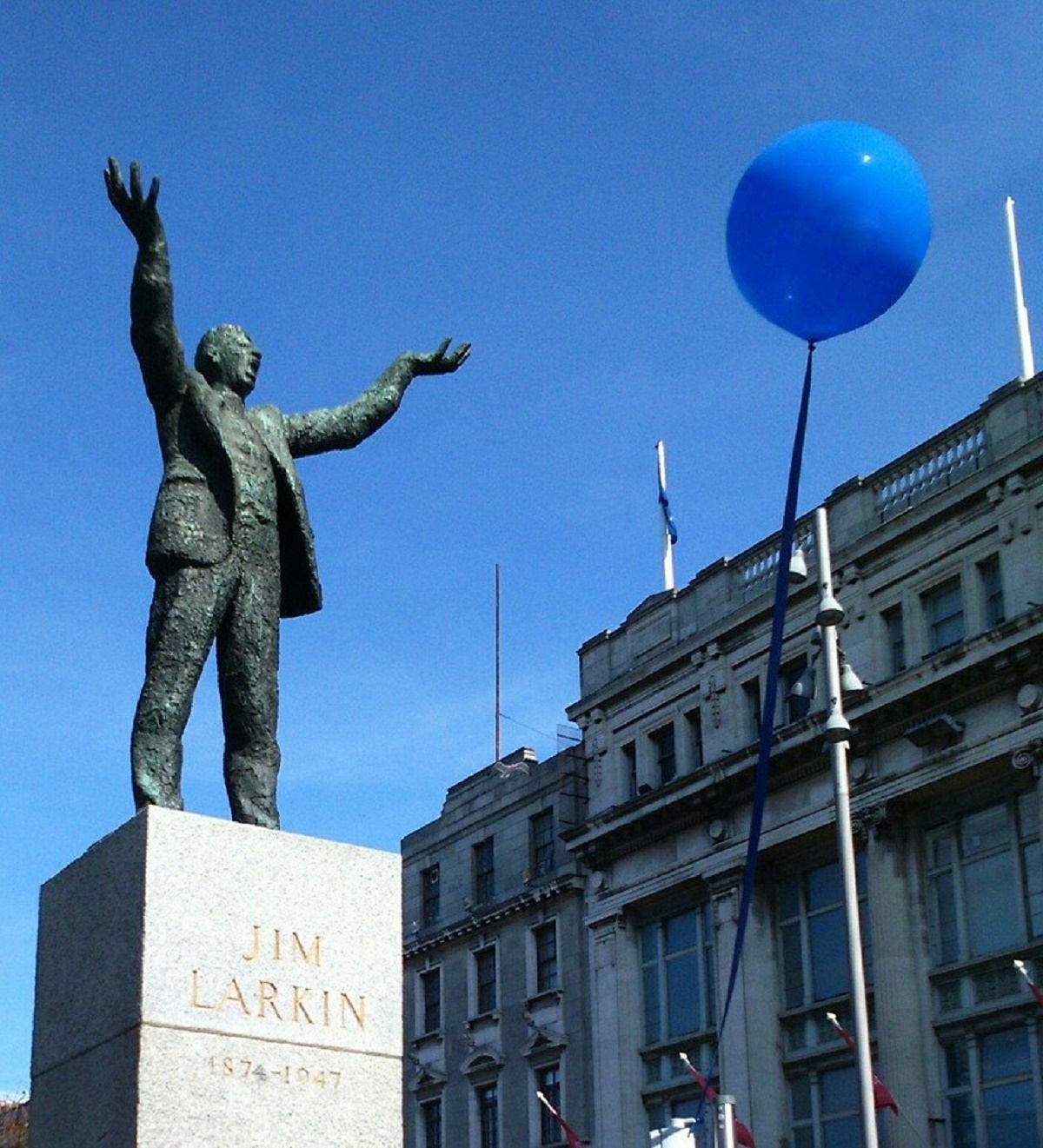
Walk down O’Connell Street today and you’ll find Jim Larkin where he stood in August 1913 — not from a balcony this time, but rendered in bronze, arms flung wide above the pavement. The sculptor Oisín Kelly captured him mid-speech, which is exactly right. The base of the statue carries words that Larkin made his own during the lockout, a line with roots in the French Revolution: The great appear great because we are on our knees: Let us rise.
The ITGWU’s successor unions are still among the largest in Ireland. The right to organise — the thing Murphy and his 400 employers spent five months and £150,000 in British solidarity money trying to defeat — is written into Irish law and the Irish Constitution. The workers of 1913 did not win the battle. But the line they held, through a winter of hunger in some of the worst housing in Europe, mattered.
Dublin’s history has no shortage of famous streets and famous buildings. For more of the city’s radical past, see the Brazen Head, Dublin’s oldest pub and a meeting place for Irish revolutionaries, and plan your own city walk with our guide to the best things to do in Dublin. O’Connell Street has statues of O’Connell and Parnell, monuments to rebellion and to politics. But the man on the bridge, arms raised above the traffic — the man who was smuggled into his enemy’s hotel and spoke from the enemy’s balcony — is something else. He’s the memory of the people who built the city and couldn’t afford to live in it, and what they were willing to risk to change that.
Tours & experiences you might love


Powered by Viator. Some links are affiliate links — we may earn a small commission at no extra cost to you.
Secure Your Dream Irish Experience Before It’s Gone!
Planning a trip to Ireland? Don’t let sold-out tours or packed attractions spoil your journey. Iconic experiences like visiting the Cliffs of Moher, exploring the Rock of Cashel, or enjoying a guided walk through Ireland’s ancient past often sell out quickly—especially during peak travel seasons.

Booking in advance guarantees your place and ensures you can fully immerse yourself in the rich culture and breathtaking scenery without stress or disappointment. You’ll also free up time to explore Ireland’s hidden gems and savour those authentic moments that make your trip truly special.
Make the most of your journey—start planning today and secure those must-do experiences before they’re gone!