

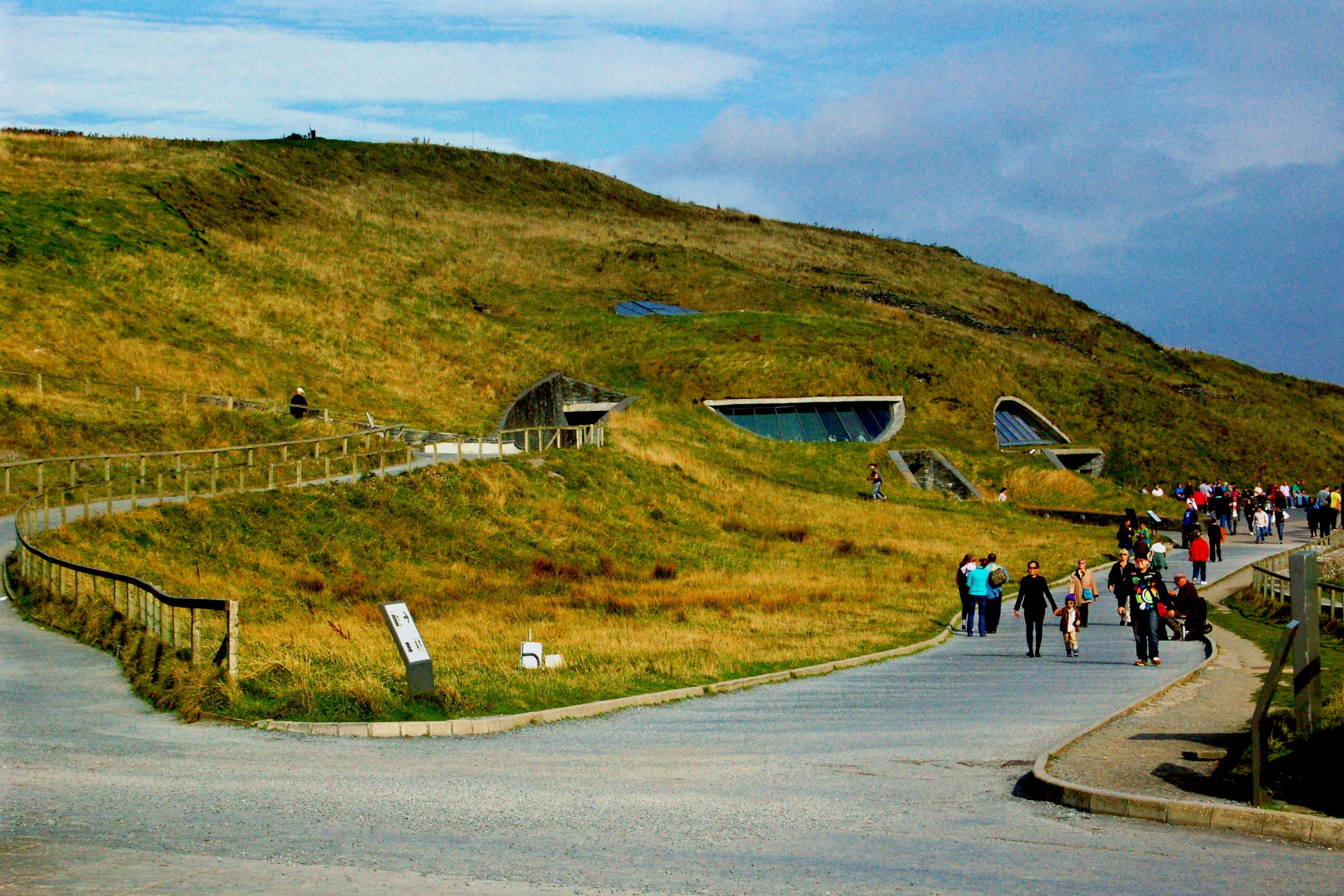
Ireland Buried a €31.5 Million Building to Save a Coastline
Stand at the edge of the Cliffs of Moher on any given day and you will see what appears to be a fairly undisturbed stretch of Atlantic coastline. Grassland runs to the cliff edge. Fulmars wheel in the updrafts below. The view across to the Aran Islands and the Twelve Bens of Connemara is essentially unchanged from what has existed here for millennia. What you won’t immediately see — because it was designed specifically so you wouldn’t — is one of the most visited tourist facilities in Ireland, sitting directly beneath the turf at your feet.
The Cliffs of Moher Visitor Centre is built underground. Not partially, not metaphorically. The structure is entirely subterranean, carved into the hillside, covered with topsoil and replanted with the same coastal grasses that grew there before construction. The walls and roof are, as the project architects described it, “subsumed into the topography of the hillside.” Nearly 1.5 million people pass through it every year. Almost none of them, looking back from the cliff path, can tell it’s there.
This is not an accident of budget or terrain. It was a deliberate act — the product of a 17-year planning fight, a conservation movement that refused to back down, a national architectural competition, and one Cork architect’s stubborn insistence on building what he called a “non-building.” Understanding how it came to be is one of the more revealing stories in modern Irish tourism.
What Was There Before
To understand what got built in 2007, it helps to understand what it replaced.
The Cliffs of Moher have drawn visitors since the 19th century, when a local landowner named Cornelius O’Brien built an observation tower on the headland to impress tourists arriving by boat. For most of the 20th century, visitor facilities amounted to very little — a car park, some vendors, the cliffs themselves. In 1978, Shannonside Tourism constructed a small visitor centre on the site of O’Brien’s former stables: a traditional-style stone stable block, solid and vernacular and almost entirely inadequate for the numbers that were, even then, making the journey to Clare.
By the time a replacement was being seriously planned, that 1978 building was handling visitor volumes it was never designed for, with facilities to match. Michael Regan, the architect who would later oversee the new centre, has described the arrangement as inadequate. There was no real interpretation of the geology, the ecology, the archaeology. The car park dominated the approach. The whole arrangement was Ireland at its most improvised-for-tourists, and Clare County Council — which owns the Cliffs of Moher site — knew by the late 1980s that something had to change.
The question was what, and more importantly, how.
The Competition and the Concept
☘️ Join 64,000+ Ireland Lovers
Every weekday morning, get Ireland’s hidden gems, local secrets, and travel inspiration — the kind you won’t find in any guidebook.
Subscribe free — enter your email:
Already subscribed? Download your free Ireland guide (PDF)
📲 Know someone who’d love this? Share on WhatsApp →
Love more? Join 43,000 Scotland lovers → · Join 29,000 Italy lovers → · Join 7,000 France lovers →
Free forever · Unsubscribe anytime
In 1992, the Royal Institute of the Architects of Ireland ran a national competition for a new visitor centre at the Cliffs of Moher. The brief was the kind that sounds clean and isn’t: design something capable of serving hundreds of thousands of visitors per year on one of Ireland’s most sensitive natural landscapes, without degrading the landscape in the process.
The winners were a Cork firm called Reddy O’Riordan Staehli Architects — RORSA. Their proposal was striking in what it refused to do. Rather than design a building that announced itself on the headland, they proposed something that would essentially vanish. The concept, which they called a “non-building,” placed the entire visitor facility underground, carved into the natural hillside, with its roof returning to grass. From the cliffs, you would see nothing. From the approach road, very little. The building would be there and not there simultaneously.
It was a clever answer to an almost impossible brief, and it set the direction for everything that followed — though “followed” would turn out to cover a remarkably long distance in time.
The Planning Wars
The competition result in 1992 and the building’s opening in 2007 are fifteen years apart. That gap is not simply a story of bureaucratic slowness. It is a story of genuine contest over what the Clare coastline should be allowed to become.
Conservation groups in Clare and nationally were watching the project closely. The Burren Action Group and An Taisce — Ireland’s national heritage organisation — had long concerns about the cumulative pressure of tourist infrastructure on the Burren and its Atlantic fringe. The Cliffs of Moher sit at the southern edge of the Burren landscape, an area that would later become a UNESCO Global Geopark. In the 1990s and early 2000s, the concern was simpler: was it possible to build a large tourist facility at one of Ireland’s most iconic natural sites without destroying the thing people were coming to see?
An earlier proposal — an above-ground version of the facility — was submitted and appealed to An Bord Pleanála. In 2000, the board rejected it. Conservation groups had objected on grounds of visual intrusion. The appeal board sided with them. The above-ground building was finished before it started.
This was the moment that converted the RORSA underground concept from an elegant competition entry into a planning necessity. If the building couldn’t be seen, it couldn’t intrude on the landscape. If it couldn’t intrude, the core objections largely fell away. The “non-building” idea wasn’t just architecturally interesting — it had become the only proposal that could actually survive the planning system.
A revised application was lodged, and permission was eventually granted for the demolition of the 1978 stable-block visitor centre and the development of the new underground facility. With that, the 17-year journey entered its final phase.
Building a Cave
Construction began in June 2005. The contractor was Rohcon. Structural and consulting engineering was handled by Arup Consulting Engineers, based in Cork. Michael Regan, who oversaw the project for the architects, would see it through to completion in 2007.
What they were building wasn’t simply a basement. It was a cave — deliberately cave-like in form as well as in concept.
The primary structural technique was in situ cast concrete on a polystyrene base, which allowed the walls and ceiling to take on an undulating, organic profile rather than the flat planes of conventional construction. The central atrium rises to a 9-metre-high dome. The exposed concrete interior was textured with a moulded pattern — worm-trail fossil markings derived from local Liscannor flagstone, the same stone that forms the cliff faces themselves. The building’s material language references the geology it sits inside.
Once the structure was complete, topsoil was laid over the roof. Natural coastal grasses were replanted. The 1978 stable-block building was demolished. The hillside, from the outside, looked much as it had before construction started — perhaps a little tidier, but continuous, unbroken, green.
The process took twenty months. The total cost is reported at roughly €31.5 to €32 million, with Clare County Council funding the project.
Opening Day
The new Cliffs of Moher interpretive centre was officially opened on February 8, 2007.
Later that year, the building won the RIAI’s award for Best Public/Cultural Building — recognition that the “non-building” approach, which had been a competition concept in 1992 and a planning solution after 2000, had produced something worth honouring architecturally. For a public tourism project, it was an unusual distinction.
The centre had been designed with a capacity of around 400,000 visitors per year. That number would prove to be a significant underestimate of what was coming.
The Numbers That Changed Everything
The story of the Cliffs of Moher Visitor Centre since 2007 is, in large part, the story of Irish tourism outpacing the infrastructure built to manage it.
By 2017, the site was drawing 1,527,000 visitors in a single year — ranking it the second-most-visited fee-charging tourist attraction in Ireland according to Fáilte Ireland’s official figures, behind only the Guinness Storehouse in Dublin. That is more than three times the facility’s designed annual capacity, inside a building that was deliberately constructed to disappear from the landscape above it.
In 2019, the numbers reached 1,605,131. That same year, revenue from the site exceeded €10 million for the first time — a milestone RTÉ reported at the time. By 2023, admission income had grown to €13.8 million. In 2024, according to the official Activity Report published jointly by Clare County Council and the National Centre for Tourism Policy Studies at the University of Limerick, visitor numbers stood at 1,495,069.
The Irish Times had already framed the paradox clearly in 2019, noting that the centre “was built to cater to 400,000 visitors annually. That number is now at 1.5 million.” The building was not under-engineered. Ireland simply became, in the years after it opened, a dramatically more visited country than anyone planning a visitor centre in the early 2000s had modelled.
Who Actually Owns It
The Cliffs of Moher site is owned by Clare County Council. That ownership is not nominal. Admission income flows directly back to the council — it is Clare County Council income, reported in the council’s annual budget, funding public services across County Clare.
Day-to-day operational management is handled by Clare Tourism Development DAC, a body established to manage the Cliffs of Moher Experience and other tourism assets under what is now branded as The Clare Collection. The arrangement runs under a Service Level Agreement between the DAC and Clare County Council. It is, in structural terms, a model of public ownership of a major natural and tourism asset — uncommon in Irish tourism, where comparable attractions often operate through private management structures.
The 2024 Activity Report states the ownership relationship plainly: “Admission income generated at the Cliffs of Moher Experience is Clare County Council income.” The €13.8 million generated in 2023 went, ultimately, to the people of Clare.
The Same Problem, Bigger
The planning disputes of the 1990s and early 2000s were resolved by building something that refused to fight with its landscape. But the success of that solution has produced a different version of the same underlying tension.
A facility built for 400,000 people per year and now processing nearly 1.5 million faces real pressure — on paths, car parks, the cliff edges themselves, and the wider Burren landscape. How to expand or adapt the site without compromising the principles that made the original facility acceptable to planners and conservation bodies is a question Clare County Council is actively working through. A rejuvenation concept was being discussed as far back as 2019; the Irish Times noted then that the centre was “struggling to cope” with numbers that had grown far beyond what the building was sized for.
It is not so different, structurally, from the challenge that drove the original design: more visitors want to come, the economics are compelling, and the landscape is finite. The difference is that the “non-building” which solved the last version of this problem is now itself part of the constraint.
What Michael Regan Built
There is something worth sitting with in the arc of this project. A Cork architecture firm wins a national competition in 1992 with a proposal for a building that essentially does not exist above ground. An above-ground alternative gets rejected by An Bord Pleanála in 2000. The original competition concept — held intact for nearly a decade — becomes the only viable path forward. Construction begins in June 2005, finishes in February 2007, and the building wins a national architecture award in its opening year.
In the years that follow, it takes in visitors at three, then four times its intended rate. By 2023, it is generating €13.8 million annually for one of Ireland’s western counties. The revenue is public. The ownership is public. The building, from outside, is largely invisible.
The insistence on the “non-building” — on making the visitor infrastructure dissolve rather than announce itself — was the act of imagination that made all of this possible. An Taisce and the Burren Action Group were right to push back on above-ground proposals. The planning system, in rejecting those proposals, was doing what it exists to do. And the architects, in holding their design concept steady across fifteen years of competition, rejection, revision, and construction, produced something that — on a clear winter day, standing on the cliff path looking back — you still cannot quite see.
Somewhere beneath the grass of that Clare headland, close to 1.5 million people each year walk through a cave moulded from concrete and fossil-imprinted stone, before emerging to stand at the edge of the Atlantic and look out toward the Aran Islands. The building is absolutely there. It just does its level best not to show it — and after all the battles it took to get that design approved, that restraint still feels, in every sense, deliberate.
The Cliffs of Moher have been drawing people to the west coast of Clare for centuries. The fact that the building which now welcomes them is the most invisible major visitor centre in Ireland is not a flaw in the design. It was always the point.
Tours & experiences you might love


Powered by Viator. Some links are affiliate links — we may earn a small commission at no extra cost to you.
Secure Your Dream Irish Experience Before It’s Gone!
Planning a trip to Ireland? Don’t let sold-out tours or packed attractions spoil your journey. Iconic experiences like visiting the Cliffs of Moher, exploring the Rock of Cashel, or enjoying a guided walk through Ireland’s ancient past often sell out quickly—especially during peak travel seasons.

Booking in advance guarantees your place and ensures you can fully immerse yourself in the rich culture and breathtaking scenery without stress or disappointment. You’ll also free up time to explore Ireland’s hidden gems and savour those authentic moments that make your trip truly special.
Make the most of your journey—start planning today and secure those must-do experiences before they’re gone!