

Pick up an Aran sweater and you are holding something that most people mistake for a fashion item. It is not. It is a document. Every stitch on a genuine Aran has a name, a meaning, and a long history on the Atlantic coast of Ireland. This guide covers what those stitches say, where the garment actually comes from, and how to find a real one.
If you want to stay up to date with Ireland’s culture, history, and hidden corners, subscribe to the Love Ireland newsletter and we will send you the best of it each week.
Where the Aran Sweater Comes From
The Aran Islands sit eleven miles off the Galway coast. There are three of them — Inis Mór, Inis Meáin, and Inis Oírr — and between them they hold a population of around 1,300 people. The landscape is almost entirely limestone. Soil is thin. The sea is close and often violent.
The heavy knitted garment worn on the islands has roots in traditional fisherman’s knitwear found across northern Europe. Irish handknitting goes back centuries, but the specific Aran-style sweater as we know it today — with its dense textured stitchwork — became documented and widely recognised in the early twentieth century. The Irish Folklore Commission gathered stitch patterns and knitting traditions from the islands in the 1930s and 1940s. From the 1950s onwards, demand grew rapidly as exports to the United States and Britain picked up.
The garments were originally knitted at home by island women, primarily for their own families. Each family developed its own combination of stitches over generations. The work was practical — the densely-packed wool repelled water, and the thick weave retained heat even when damp.
What the Stitches Mean
☘️ Your Irish family has a story waiting to be found.
Discover where your Irish ancestors came from — their county, their name, their story. Our free step-by-step guide walks you through every record, DNA tool, and ancestry archive. No experience needed.
Claim Your Free Irish Ancestry Guide →☘️ Join 64,000+ Ireland Lovers
Every weekday morning, get Ireland’s hidden gems, local secrets, and travel inspiration — the kind you won’t find in any guidebook.
Subscribe free — enter your email:
Already subscribed? Download your free Ireland guide (PDF)
📲 Know someone who’d love this? Share on WhatsApp →
Love more? Join 43,000 Scotland lovers → · Join 29,000 Italy lovers → · Join 7,000 France lovers →
Free forever · Unsubscribe anytime
This is the part most visitors want to know, and it is worth taking seriously. Aran stitching is not random decoration. Each pattern carries a specific name and association.
Honeycomb stitch represents the hard-working honeybee. The hexagonal cells are considered a symbol of industry and the rewards that come from effort. It is one of the most recognisable patterns and appears on virtually every traditional Aran garment.
Cable stitch represents the ropes used by fishermen. It is also associated with safety at sea and the wish that fishermen would return home. The twisted rope pattern runs in vertical columns and gives the sweater much of its structural bulk.
Diamond stitch represents the small fields of the island — stone-walled plots barely big enough to graze a few animals. It is associated with wealth, success, and a good harvest from the land and the sea.
Trellis stitch is sometimes called the fields of Aran. It represents the limestone walls that divide the island landscape into a grid of tiny enclosures. These walls were built by hand over many generations using stones cleared from the ground.
Tree of Life stitch shows a vertical trunk with branches. It symbolises the family — long life, strong roots, and the connections between generations. It appears frequently as a central panel on traditional sweaters.
Lobster claw stitch represents the sea’s bounty. Fishing was the main livelihood of the islands, and the lobster was a prized catch. This stitch acknowledges both the work of fishing and its rewards.
Moss stitch represents the moss and lichen that cover the island’s rocks. It creates a small, textured surface that mimics the look of ground cover.
A single Aran sweater typically combines five to eight different stitch patterns, each placed deliberately in panels across the front, back, and sleeves. The arrangement was a matter of tradition and personal preference, but the vocabulary was shared across families and islands.
The Family Crest Theory
There is a persistent and widely-repeated claim that each island family had its own unique stitch pattern, and that these were used to identify drowned fishermen when their bodies washed ashore. It is a vivid story. It is also, in large part, a myth.
Academic researchers who have looked into this claim in depth — including Deborah Pulliam and Beth Brown-Reinsel, who have published detailed studies of Aran knitting history — found no documentary evidence that individual family patterns served as identification. The Irish Folklore Commission’s own records do not support it. The story appears to have gained popularity in the mid-twentieth century as a marketing narrative, amplified when the sweaters were being commercially exported.
This does not diminish the genuine craft or the real history of the garment. The stitches do carry meaning. The tradition is real. But the identification-of-drowned-fishermen story should be treated as folklore rather than fact.
How a Genuine Aran is Made
A traditional hand-knitted Aran sweater takes between 40 and 60 hours to complete. The wool used is báinín (pronounced baw-neen), a cream or off-white undyed wool taken from the fleece of the Blackface Mountain sheep. The natural lanolin in the wool is largely retained through minimal processing, which contributes to the garment’s water resistance.
The knitting is done on straight needles using a combination of knit and purl stitches to create the raised patterns. Cable stitches require a cable needle to hold stitches temporarily while others cross over. The dense, close-knit fabric that results is heavy and warm — a genuine working garment, not a decorative one.
Machine-made versions exist and are sold widely. They look similar at first glance, but the weight, the texture, and the tension of the stitching are different. A machine-made sweater costs significantly less. A hand-knitted one, particularly from an island knitter, can cost €150 to €300 or more. The price reflects the labour involved.
Love what you’re learning? Subscribe to the Love Ireland newsletter for more on Irish heritage, culture, and travel delivered straight to your inbox.
Where to Buy an Authentic Aran Sweater
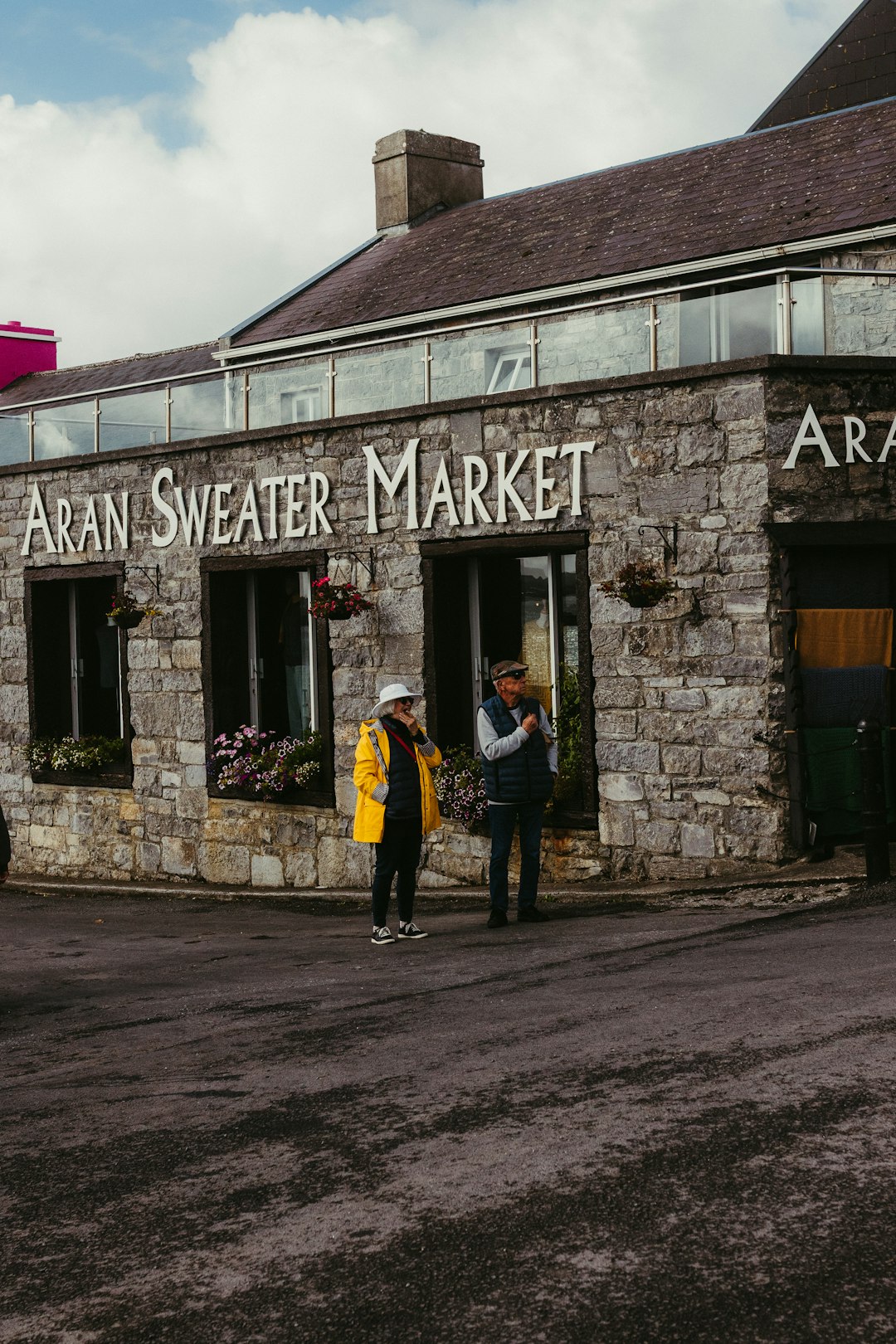
If you want a genuine hand-knitted Aran, the best place to start is the Aran Islands themselves. The Aran Sweater Market on Inis Mór stocks sweaters made by island knitters, and staff can tell you about the specific stitches on individual garments. Prices are higher than mainland shops, but the provenance is clear.
On the mainland, the following are reliable options:
Galway city has a number of reputable wool and knitwear shops, particularly on Shop Street and around the Latin Quarter. Look for shops that specify hand-knitted rather than hand-crafted — the latter term can apply to machine-made garments that have been finished by hand.
The Sweater Shop on Nassau Street, opposite Trinity College, has specialised in traditional Aran knitwear since 1986. Selection is large and the staff are knowledgeable.
Direct from knitters is increasingly possible via craft markets and online. A number of Aran Island knitters sell directly. If buying online, ask the seller to confirm hand-knitted origin and, if possible, the name of the knitter.
A few practical checks when buying in person:
- Turn the sweater inside out. Hand-knitted garments show yarn joins at irregular intervals; machine knitting is uniform.
- Look for slight irregularities in the tension — no two rows of hand-knitting are perfectly identical.
- Genuine báinín wool has a slightly waxy feel from retained lanolin. Processed or blended wool does not.
- Ask for a label or certificate of origin if buying at a higher price point.
Caring for an Aran Sweater
Wool care is not complicated, but it does require attention.
Hand wash in cool water with a wool-safe detergent. Do not wring. Press gently to remove water, then lay flat to dry on a clean towel. Never hang a wet Aran sweater — the weight of the wet wool will stretch it out of shape.
Store folded, not on a hanger. Cedar blocks or lavender sachets will deter moths without damaging the fibre. If you store it long-term, a sealed bag is advisable.
Pilling is normal and not a sign of poor quality. A wool comb or sweater stone will remove pills without damaging the surrounding fibres.
The Aran Sweater in Modern Culture
The sweater’s cultural moment arrived internationally in the 1950s and 1960s. Photographs of Irish fishermen and island life, several taken by Robert Flaherty for his 1934 documentary Man of Aran, had given the garment a romanticised association with a particular version of Ireland. When Irish-American connections were strong in the postwar period, demand from the United States drove a significant export industry.
The fashion world took notice. Vogue and other magazines featured Aran knitwear through the 1960s. Designers including Donna Karan and Ralph Lauren drew on the aesthetic. Today the Aran sweater appears in high street versions by dozens of brands, most with no connection to Ireland.
The genuine article remains a different thing entirely. It is still made in small quantities, still produced by hand in some cases by knitters on the same islands where the tradition developed, and still carries the same stitch vocabulary it has carried for generations.
Visiting the Aran Islands
If you want to see where the sweater comes from, the Aran Islands are reachable by ferry from Rossaveal, west of Galway city, or from Doolin in County Clare. The crossing takes between 15 minutes and just over an hour, depending on the departure point and destination island — the Doolin-to-Inis Oírr hop is the shortest, Rossaveal-to-Inis Oírr the longest. Inis Mór is the largest and most visited. Inis Meáin is quieter and has worked to preserve the traditional knitting industry more deliberately — the Inis Meáin Knitting Company produces garments sold globally, and a visit to the island gives a clearer sense of the contemporary craft tradition.
The islands are worth a full day visit at minimum. Apart from the sweater connection, there are prehistoric forts — including the dramatic clifftop Dún Aonghasa on Inis Mór — early Christian monastic sites, and a landscape unlike anywhere else in Ireland.
For a shorter, printable companion to this guide, see The Love Ireland Guide № 011: The Aran Sweater.
Want more like this? Subscribe to the Love Ireland newsletter and we will send you the best of Ireland’s heritage, culture, and travel stories every week.
Tours & experiences you might love


Powered by Viator. Some links are affiliate links — we may earn a small commission at no extra cost to you.
Secure Your Dream Irish Experience Before It’s Gone!
Planning a trip to Ireland? Don’t let sold-out tours or packed attractions spoil your journey. Iconic experiences like visiting the Cliffs of Moher, exploring the Rock of Cashel, or enjoying a guided walk through Ireland’s ancient past often sell out quickly—especially during peak travel seasons.

Booking in advance guarantees your place and ensures you can fully immerse yourself in the rich culture and breathtaking scenery without stress or disappointment. You’ll also free up time to explore Ireland’s hidden gems and savour those authentic moments that make your trip truly special.
Make the most of your journey—start planning today and secure those must-do experiences before they’re gone!