

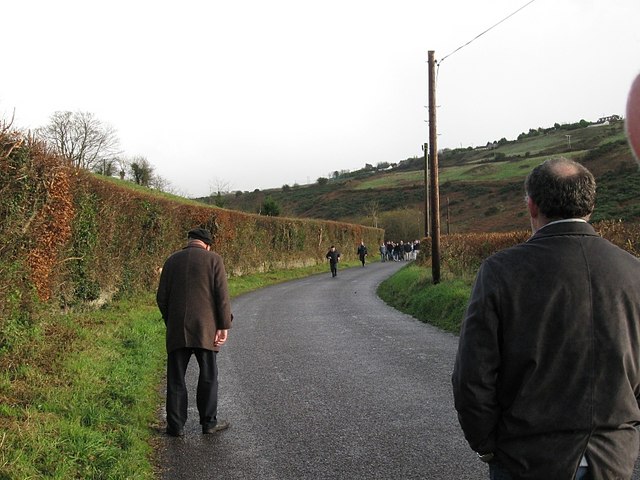
On a quiet Sunday morning in County Cork, the roads fall still for just a moment — and then they fill again. Not with cars, but with people. A man steps to a chalk mark scratched into the tarmac, swings his arm in a wide arc, and sends a heavy iron ball hurtling down the road. The crowd parts, moves with it. The ball bounces, clips a bend, and rolls on for what feels like forever.
This is road bowling — Ból an Bhóthair in Irish — and it has been played on these very same roads for over three hundred years.
A Sport You Won’t Find Anywhere Else
Road bowling is played with a 28-ounce cast iron ball called a bowl or a bullet. The aim is to cover a course — usually between 2 and 4 kilometres of winding country lane — in the fewest number of throws.
There are no pitches, no nets, no lanes. The playing surface is the road itself: its bends, cambers, raised edges, and hedgerows are all part of the challenge. Players choose their line with extraordinary care, studying each stretch of tarmac the way a snooker player reads a cushion.
A well-placed shot hugs a corner, bouncing off the raised edge of the road to save precious metres. A poor one drifts wide and loses ground. Every throw is a calculation — speed, angle, the particular quirk of this particular bend.
Three Hundred Years on the Road
Road bowling is believed to have Dutch origins — possibly brought to Ireland by soldiers in the seventeenth century. But the Irish took it and made it entirely their own.
By the nineteenth century it was woven into the fabric of rural Cork and Armagh, the two counties where the sport has always been strongest. Matches were social occasions. Whole townlands would turn out to walk alongside the players, call encouragement, and settle their wagers by the final throw.
That communal spirit has never left. Even today, spectators walk the entire course with the bowlers — debating strategy, reading the road ahead, urging a player to take the left edge rather than the right. It is one of the few sports in the world where the crowd moves with the game, rather than waiting for the game to come to them.
The Art of the Throw
The technique looks deceptively simple. The bowler runs towards the mark, builds speed, and releases the ball in a full-arm swing — not exactly a throw, not exactly a roll, but something specific to the sport that takes years to master.
The ball must stay on the road. Stray into a field or ditch, and a penalty shot is added. Top bowlers can send a bullet 350 metres or more on a straight run. On bends — where the real artistry lives — the margin between a brilliant shot and a wasted metre can be a matter of millimetres.
Reading the road becomes as important as strength. The great players are tacticians as much as athletes, always thinking two or three throws ahead.
Cork and Armagh: The Heartlands
Both counties carry a pride in road bowling that rivals anything seen in the GAA’s most passionate parishes. Cork players speak of it with the same reverence that Kilkenny reserves for hurling.
Armagh developed its own version, with slightly different local customs and traditions, but the soul of the game — two players, a stretch of country road, and a following crowd — is exactly the same.
The governing body, Ból Chumann na hÉireann, organises county leagues and an All-Ireland championship. Ireland also competes at world level — the International Road Bowling Championship is contested between Ireland, the Netherlands, and Germany, a fitting nod to the sport’s long-rumoured origins.
Where to See It for Yourself
On any weekend between early spring and late autumn, matches take place on country roads across Cork and Armagh. These are not heritage re-enactments or tourist demonstrations. The sport is alive, keenly contested, and fiercely proud of its roots.
For visitors who want to see the real Ireland — the Ireland beyond the postcard — a road bowling match is one of those rare experiences that stays with you long after you’ve gone home. You don’t need to know every rule to feel the tension as the ball leaves a bowler’s hand, or the collective exhale of a crowd as it skims a bend and runs.
If sport and Irish tradition fascinate you, the story of the hurling sliotar — barely changed in three thousand years — is equally remarkable. And when you’re ready to start planning your journey, our Ireland travel planning guide has everything you need.
On a Sunday morning in Cork, keep an eye out. The road might just be in use.
64,000 Ireland lovers can’t be wrong.
Every week, our free newsletter delivers hidden gems, seasonal guides, local stories, and practical travel tips — straight to your inbox. Join the community that loves Ireland as much as you do.
Get the free guide
Enter your email and we will send you straight to the download.
Thinking about it seriously?
If you’ve started actually planning a move, our complete the full Move to Ireland guide walks through every step, every cost, and the paperwork that catches most people out.
Tours & experiences you might love


Powered by Viator. Some links are affiliate links — we may earn a small commission at no extra cost to you.
Secure Your Dream Irish Experience Before It’s Gone!
Planning a trip to Ireland? Don’t let sold-out tours or packed attractions spoil your journey. Iconic experiences like visiting the Cliffs of Moher, exploring the Rock of Cashel, or enjoying a guided walk through Ireland’s ancient past often sell out quickly—especially during peak travel seasons.

Booking in advance guarantees your place and ensures you can fully immerse yourself in the rich culture and breathtaking scenery without stress or disappointment. You’ll also free up time to explore Ireland’s hidden gems and savour those authentic moments that make your trip truly special.
Make the most of your journey—start planning today and secure those must-do experiences before they’re gone!
Subscribe Free