

Drive through any Irish county and you will see it eventually. A raised circular mound in the middle of a farmer’s field, surrounded by a ditch, with a few gnarled trees growing on top. The field is ploughed right up to the edge. The circle is left completely untouched.
Nobody told the farmer to leave it there. But everybody in Ireland knows you do not touch a ring fort.
What Exactly Is a Ring Fort?
Ring forts — known as raths, lisses, or caiseals depending on the region — are circular earthwork enclosures built roughly between 500 and 1,000 AD. They were the homes of ordinary Irish farming families during the early medieval period.
A typical ring fort had a raised circular bank of earth, surrounded by a ditch, and sometimes a second or third outer ring. Inside sat a roundhouse or two, a storage pit, and maybe a small animal pen.
They were not castles. They were not ceremonial sites. They were farmsteads — the everyday homes of Irish families going about their daily lives over a thousand years ago.
And they are absolutely everywhere. Ireland has more than 45,000 ring forts still surviving — one of the highest concentrations of ancient earthworks anywhere in Europe. In some counties, you can barely drive two kilometres without passing one.
The Fairy Fort Fear That Never Left
Here is where it gets interesting. Ring forts are known widely across Ireland as “fairy forts.” And that name matters deeply.
In Irish folk belief, the raths are not empty. They are said to be home to the sídhe — the fairy folk, the Otherworld beings who retreated underground after the arrival of humans. To disturb a fairy fort is to invite serious misfortune: illness, livestock deaths, run of bad luck that simply will not end.
This belief is not an ancient curiosity locked in history books. It is still alive.
The most famous modern example came during the construction of a new road in Clare. A proposal to remove a fairy fort and its associated lone thorn tree caused such public outcry that the road was rerouted around it. The fairy fort still stands. Stories of farmers who bulldozed a rath and suffered for it circulate in almost every county, passed down through families as quiet warnings.
This same instinct is behind the lone thorn trees that no Irish person will ever cut down — a parallel folk belief that runs through the countryside like an invisible thread.
☘️ Enjoying this? 64,000+ Ireland lovers get stories like this every week.
Thinking about it seriously? If you’ve started actually planning a move, our complete the full Move to Ireland guide walks through every step, every cost, and the paperwork that catches most people out.
The Older World Ring Forts Connect To
The fairy fort fear sits inside a much larger spiritual landscape. Ring forts belong to the same imaginative world as the holy wells that were never drained, the crossroads that always felt uneasy after dark, and the hills where the old gods were said to walk.
The Tuatha Dé Danann — Ireland’s ancient supernatural race — are said to have retreated into these earthen mounds when defeated by the Milesian invaders. The mounds became entrances to the Otherworld. The ring forts became thresholds. Understanding why Ireland’s ancient gods went underground helps explain why these earthworks never became just archaeological sites in the Irish imagination.
They remained sacred, or dangerous, or both. The line was never very clear.
What Life Was Really Like Inside
For the family who actually lived there, a ring fort was intensely practical. The earthen bank kept cattle in and wolves out. The raised interior stayed drier than the surrounding land. The ditch provided a defensible barrier during the raiding season.
Excavations across Ireland have found hearth ash, iron tools, animal bones, bronze pins, and stone querns for grinding grain. Sometimes an underground stone passage — a souterrain — runs beneath the interior, used for cool storage in summer or as a hiding place in times of trouble.
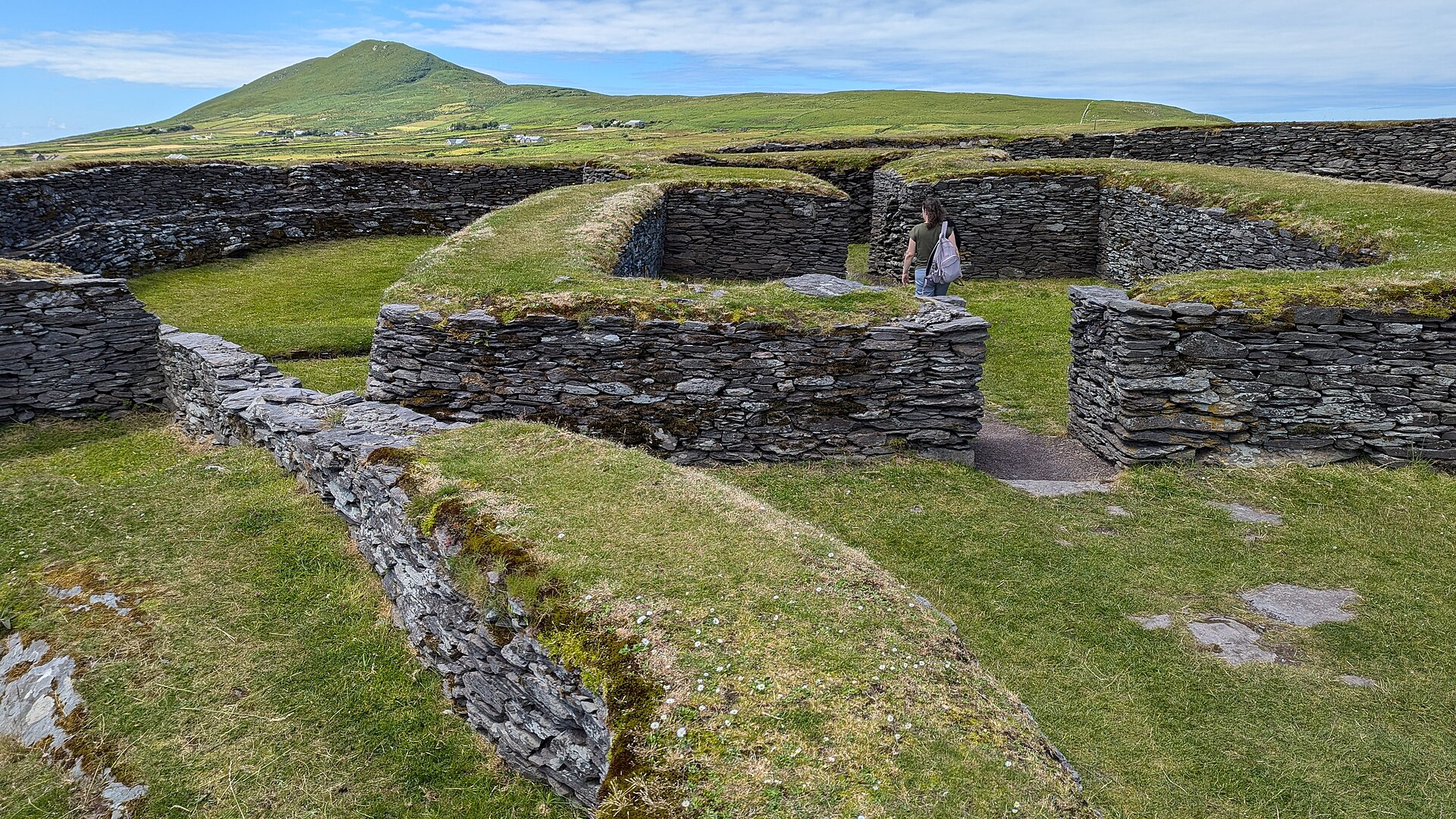
Stone versions of ring forts, called cashels or cahers, are particularly well preserved in Connacht and Munster, where dry-stone walls replaced earthen banks. These look strikingly different from the grassy mounds of the midlands — more visible, more imposing, easier to imagine as a real home.
Where to See the Best Ring Forts in Ireland
You do not need to go looking — they will find you. But if you want the most striking examples, three sites stand apart.
The Hill of Tara, Co. Meath, is the ritual heart of ancient Ireland. The Ráith na Ríogh — the Fort of the Kings — is a massive ring fort enclosing two older burial mounds. Standing at the centre, you are inside one of the most contested earthworks in Irish history.
Grianan of Aileach, Co. Donegal, is a stone cashel perched on a hilltop with views across three counties. The circular dry-stone walls, partly restored in the 1870s, are some of the most complete in the country.
Rathcroghan, Co. Roscommon, is a complex of over 60 monuments spread across open farmland — the legendary seat of Connacht’s ancient kings and queens. It is subtle, understated, and extraordinary.
If you are planning a trip to explore ancient Ireland in depth, the Ireland trip planning guide is the best place to start.
There is something quietly powerful about a ring fort. It has survived a thousand years of Irish weather, centuries of farming, and repeated waves of development. It is still there in the middle of the field, untouched, ringed by a ditch the plough still stops short of.
Not always because of heritage law. Often because of something much older than law — a feeling passed down through generations that these circles belong to a world that runs deeper than ours.
Next time you drive through an Irish field, notice the circular mound. Notice the gap where the furrows stop. Ireland has never quite let go of its oldest places. And perhaps that is exactly the right instinct.
☘️ Your Irish family has a story waiting to be found.
Discover where your Irish ancestors came from — their county, their name, their story. Our free step-by-step guide walks you through every record, DNA tool, and ancestry archive. Join 64,000+ readers staying connected to Ireland.
Claim Your Free Irish Ancestry Guide →Get the free guide
Enter your email and we will send you straight to the download.
Love more? Join 43,000 Scotland lovers → · Join 30,000 Italy lovers → · Join 7,000 France lovers →
Free forever · · Unsubscribe anytime
Tours & experiences you might love


Powered by Viator. Some links are affiliate links — we may earn a small commission at no extra cost to you.
Secure Your Dream Irish Experience Before It’s Gone!
Planning a trip to Ireland? Don’t let sold-out tours or packed attractions spoil your journey. Iconic experiences like visiting the Cliffs of Moher, exploring the Rock of Cashel, or enjoying a guided walk through Ireland’s ancient past often sell out quickly—especially during peak travel seasons.

Booking in advance guarantees your place and ensures you can fully immerse yourself in the rich culture and breathtaking scenery without stress or disappointment. You’ll also free up time to explore Ireland’s hidden gems and savour those authentic moments that make your trip truly special.
Make the most of your journey—start planning today and secure those must-do experiences before they’re gone!
Subscribe Free