

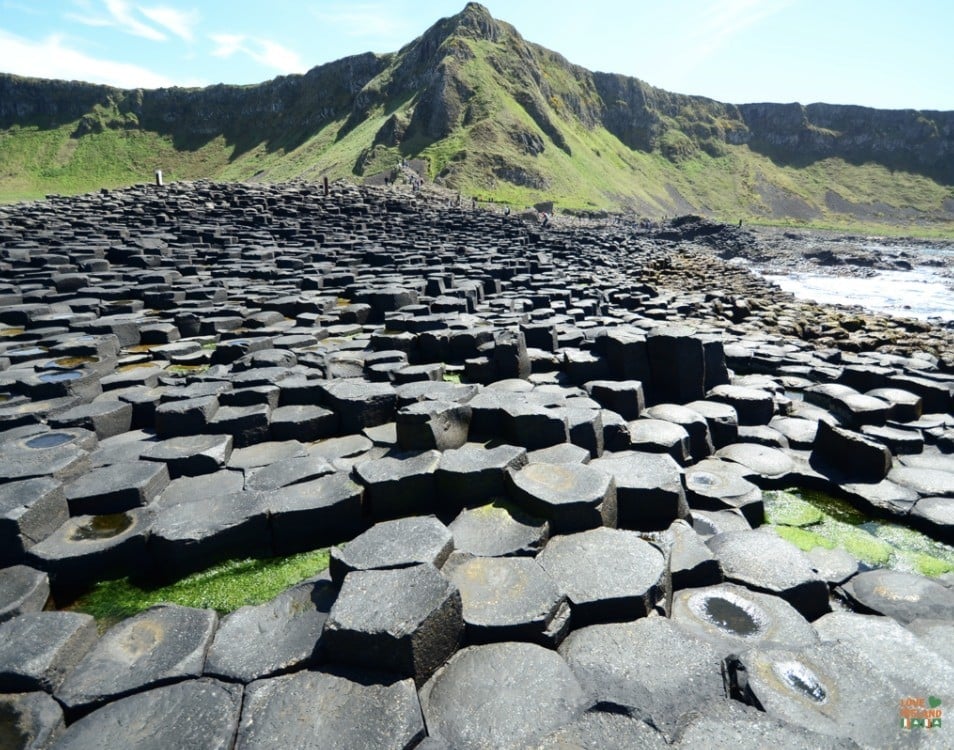
There is a moment — and almost every visitor knows it — when you crest the path above the Giant’s Causeway and see it properly for the first time. The thousands of hexagonal basalt columns, slick and dark and geometrically perfect, descending in great stair-steps toward the North Atlantic. The ocean churning beyond them. The sky pressing in from every direction. And you, standing there, suddenly aware of just how extraordinarily small you are.
It is not an unpleasant feeling. Quite the opposite. The Giant’s Causeway experience is one of those rare moments Ireland delivers with startling regularity — the kind where the world recalibrates itself around you, and all the clutter of ordinary life simply falls away. This is what 600,000 visitors a year come to find. And nearly all of them agree: no photograph, no matter how skilful, fully prepares you for the real thing.
An Ancient Force That Refuses to Be Ignored
The Giant’s Causeway was born approximately 60 million years ago, during a period of intense volcanic activity that tore across what is now the North Antrim coast. As vast rivers of molten basalt cooled and contracted, they fractured into the extraordinary geometric columns that remain today — roughly 40,000 of them, most five or six-sided, fitted together with an almost uncanny precision.
Sixty million years is a number that the human mind cannot truly process. We know it intellectually, but standing on those columns — running your fingers along the cold, perfectly-angled edges — is the closest most of us will ever get to truly feeling it. These stones were here before mammals had properly got going. Before the Atlantic existed in its current form. Before anything recognisably Ireland-shaped occupied this patch of the Earth.
That weight of time is part of what makes the Giant’s Causeway experience so distinctly humbling. You are not just looking at a pretty rock formation. You are standing inside a geological event that dwarfs all of human history by an almost incomprehensible margin.
The Sensation of Stepping Outside Time
☘️ Your Irish family has a story waiting to be found.
Discover where your Irish ancestors came from — their county, their name, their story. Our free step-by-step guide walks you through every record, DNA tool, and ancestry archive. No experience needed.
Claim Your Free Irish Ancestry Guide →Walk down to the columns themselves and the full effect begins. The path curves round the headland and deposits you onto the lower causeway, where the columns are closest to sea level and the Atlantic comes in hard against the rocks. The sound is constant — a deep, rhythmic percussion that seems to rise from the stone itself. The spray catches the light. The black basalt is slippery underfoot in all the best ways, demanding your full attention at every step.
There is no phone signal here worth speaking of. The wind tends to make conversation difficult. And somehow, in this enforced quiet and presence, visitors find something they hadn’t realised they were looking for. The Giant’s Causeway experience strips away the noise and returns you — briefly, beautifully — to the simple fact of being a person standing in a remarkable place.
For the Irish diaspora who come home to County Antrim, this feeling carries an additional layer. There is something deeply rooted about this landscape — the grey-green Atlantic light, the rugged coast, the sense that Ireland has always been exactly this wild and exactly this extraordinary. Coming here feels less like tourism and more like recognition.
Finn MacCool and the Story the Stones Tell
The science is remarkable. But Ireland being Ireland, science never quite gets to have the last word.
Local legend holds that the columns are the remains of a causeway built by the giant Finn MacCool, who constructed it to stride across the water and meet his Scottish rival Benandonner. The story — involving considerable guile, a disguise as a baby, and the kind of creative problem-solving the Irish have always excelled at — is told in vivid detail across the county. Read the full legend here — it adds another dimension to the columns that no geology textbook can provide.
What the myth does, beautifully, is give scale to the incomprehensible. If the columns are a giant’s stepping stones, then of course you feel small standing on them. You were always going to. That is the point. The story encodes the emotional truth of the place in a form humans can carry home with them.
How to Experience the Giant’s Causeway at Its Most Awe-Inspiring
The Giant’s Causeway experience can vary dramatically depending on when you visit. At peak summer midday, the lower causeway fills with visitors and the sense of solitude can be hard to find. Come at the right time, though, and you will have stretches of this ancient landscape almost entirely to yourself.
The Best Times to Visit
Early morning is the single best choice for the most humbling experience. Arrive before 9am and you will often find the lower causeway quiet, the light soft, and the Atlantic delivering its full drama without a crowd between you and it. Late evening in summer is equally rewarding — the long Northern Irish dusk turns the basalt columns extraordinary shades of amber and grey.
Shoulder season — April, May, and September — offers the best of everything: reasonable weather, manageable crowds, and a landscape that feels genuinely untamed rather than stage-managed. October visits, for the brave, are unforgettable in an entirely different way: the Atlantic in autumn is a force entirely unto itself.
Walk Further Along the Causeway Coast
Most visitors spend their time on the lower causeway, which is wonderful. But the headland path above offers something different: the full sweep of the Antrim coast laid out before you, the columns visible below, and a sense of the broader drama of this extraordinary stretch of coastline. County Antrim’s coast extends in both directions with equal ferocity — the Causeway is the headline act, but the surrounding landscape is the supporting cast that makes it all make sense.
Enjoying this? Get Ireland stories like this every morning ☘️
Join 64,000 readers who wake up to the best of Ireland — history, hidden places, culture — delivered free.
The full Causeway Coast Way stretches from Ballycastle to Portstewart and takes experienced walkers two to three days to complete. Even a short section — walking west from the Causeway toward the dramatic Organ Pipes or east toward Benbane Head — reveals why this coastline was designated an Area of Outstanding Natural Beauty.
Plan Your Visit
The Giant’s Causeway is managed by the National Trust and there is an entrance fee for the visitor centre and car park, though the causeway itself is free to access on foot. The visitor centre provides excellent context for both the geology and the legend, and the café is a welcome refuge after a windswept walk on the columns.
Getting there from Belfast takes roughly an hour and a half by car, or you can take the Translink Ulsterbus service from Belfast Europa Bus Centre. The scenic Causeway Coastal Route makes the drive an experience in its own right.
For more help planning your Irish adventure — from where to stay to how to build the perfect itinerary around the north coast — our Ireland travel planning hub is the perfect starting point. The Giant’s Causeway deserves more than a rushed afternoon. Build the time in. It will repay you many times over.
The Gift of Feeling Small
There is a particular kind of freedom in feeling genuinely, properly small — not diminished, but humbled in the most life-affirming sense. The Giant’s Causeway delivers this gift with extraordinary generosity. Stand there long enough and something shifts. The columns, the ocean, the volcanic history locked in every hexagonal edge, the story of the giant and the stepping stones: all of it adds up to something that is almost impossible to articulate but immediately, unmistakeably felt.
Ireland has many extraordinary places. The Giant’s Causeway stands alone. It is not simply a UNESCO World Heritage Site or a tick on a travel list — it is an encounter with something so ancient and so vast that it has the power to genuinely reset your perspective. That rugged, beautiful, humbling stretch of the North Antrim coast does not care how busy your life is, how many emails are waiting, or what you thought mattered before you arrived. It simply is. And, for a little while, so are you.
Thinking about it seriously?
If you’ve started actually planning a move, our complete the full Move to Ireland guide walks through every step, every cost, and the paperwork that catches most people out.
Tours & experiences you might love


Powered by Viator. Some links are affiliate links — we may earn a small commission at no extra cost to you.
Secure Your Dream Irish Experience Before It’s Gone!
Planning a trip to Ireland? Don’t let sold-out tours or packed attractions spoil your journey. Iconic experiences like visiting the Cliffs of Moher, exploring the Rock of Cashel, or enjoying a guided walk through Ireland’s ancient past often sell out quickly—especially during peak travel seasons.

Booking in advance guarantees your place and ensures you can fully immerse yourself in the rich culture and breathtaking scenery without stress or disappointment. You’ll also free up time to explore Ireland’s hidden gems and savour those authentic moments that make your trip truly special.
Make the most of your journey—start planning today and secure those must-do experiences before they’re gone!
Subscribe Free