

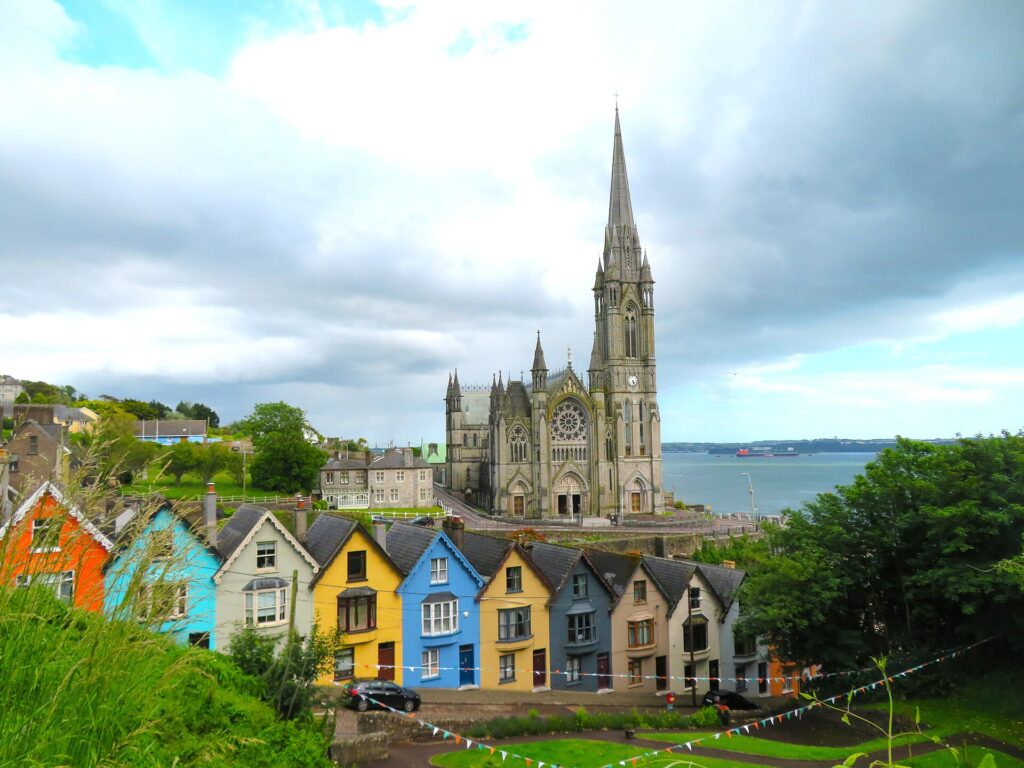
Every year, thousands of visitors arrive in Cobh — pronounced “Cove” — and step out onto a waterfront that carries more history than most towns could hold. The colourful terraced houses, the harbour, the steep climb up to the cathedral. It looks charming. But stand long enough, and the weight of the place begins to press in.
This was the last port of call for the Titanic in April 1912. It went on to become Ireland’s busiest emigration port, with over two million people departing between 1848 and 1950 — most of them long after the Great Famine itself had ended. And it was here that survivors of the Lusitania sinking were brought ashore in 1915. Cobh did not earn its place in history gently.
Love Irish history and travel?
Get our free weekly newsletter with stories from across Ireland — straight to your inbox. Subscribe here →
The Story of St. Colman’s Cathedral
St. Colman’s Cathedral sits at the highest point in Cobh, visible from the harbour and from ships far out in Cork Harbour. Construction began in 1868, and the building was not completed until 1919 — a span of 51 years that saw the cathedral rise gradually above a town still recovering from famine and emigration.
The cathedral was built in the French Gothic style, designed by Edward Welby Pugin and later completed by George Ashlin. Its spire reaches 91 metres into the sky, making it the tallest church building in Ireland. The limestone exterior was quarried locally, and the building was funded largely through donations from the Irish diaspora — including emigrants who had left Cobh and never returned.
That detail matters. The cathedral was partly paid for by people who left through the very port visible from its windows. They sent money back to build something permanent in a place they had been forced to leave. There is no cleaner expression of what Cobh means to the Irish diaspora than that.
Inside, the cathedral contains 49 bells — the largest carillon in Ireland and one of the largest in the British Isles. The bells ring out across the harbour regularly, and the sound carries far enough that you can hear them from the water. The stained glass windows were installed at various points throughout the 20th century, many of them depicting Irish saints and scenes from the Gospels.
The Great Famine and the Emigrant Ships
Between 1845 and 1852, Ireland lost roughly one quarter of its population to famine and emigration. The Great Famine killed approximately one million people and drove another million to leave, with many departing through what was then called Queenstown — the name Cobh carried under British rule until 1920.
The ships that left Cobh during those years were often referred to as coffin ships. They were overcrowded, poorly provisioned, and the crossings to North America could take weeks. Mortality rates on some voyages ran as high as 30 per cent. The people who boarded those ships had already survived famine. Many did not survive the journey.
For those who did arrive — in New York, Boston, Liverpool, Montreal — the port they had left became a fixed point in family memory. Generations later, the descendants of those emigrants still identify with Cobh, even if they have never visited. It is one of the reasons the town draws so many Irish-American visitors today.
The Cobh Heritage Centre, located in the restored Victorian railway station on the waterfront, documents this history in detail. It covers the famine emigrations, the Titanic’s final stop, and the Lusitania disaster. It is not a light visit, but it is an honest one, and it provides the context that makes the rest of the town make sense.
Stories like this one, every week
Our free newsletter covers Irish history, travel, and culture — from Cobh to Connemara. Join thousands of readers here →
Annie Moore and the Ellis Island Connection
On the Cobh waterfront, a bronze statue stands at the water’s edge. It shows a young woman with two younger brothers at her side. This is Annie Moore, a 17-year-old girl from County Cork who sailed from Cobh in 1891 and, on 1 January 1892, became the first immigrant to be processed at the newly opened Ellis Island in New York.
Annie Moore was one of approximately 2.9 million Irish people who emigrated to the United States between 1820 and 1900. An identical statue of her stands at Ellis Island, representing the link between the place of departure and the place of arrival. The Cobh statue was unveiled in 1993, a century after her crossing.
The statue is a natural starting point for any visit to Cobh. From there, the town rises steeply — the terraced houses climbing the hill, the cathedral visible from almost anywhere on the waterfront. The geography of the place reflects its history: the port at the bottom where people left, and the cathedral at the top, built partly with their money from abroad.
The Titanic’s Last Port of Call
On 11 April 1912, RMS Titanic anchored in Cork Harbour and took on 123 passengers from Cobh — then Queenstown. They were brought out to the ship by tender, because the Titanic was too large to dock at the quay. For most of those 123 passengers, it was the last time they would set foot on Irish soil.
The Titanic Experience Cobh occupies the original White Star Line offices on the waterfront — the building where those passengers would have checked in and boarded the tenders. The exhibition focuses on the Cobh connection specifically, tracing the stories of the passengers who boarded here and what happened to them. Of the 123 passengers who boarded at Queenstown, only 44 survived.
One of the last known photographs of the Titanic still afloat was taken from Cobh as she steamed out of Cork Harbour. The image shows the ship at full scale against the horizon — a size that made her seem unsinkable. Three days later, she was gone.
Visiting Cobh: What You Need to Know
Cobh is located on Great Island in Cork Harbour, connected to the mainland via Belvelly Bridge to neighbouring Fota Island, and a causeway from there. It is approximately 23 kilometres from Cork city, and the train journey from Cork Kent Station takes around 25 minutes. The service runs regularly throughout the day, and the train station in Cobh is directly adjacent to the Cobh Heritage Centre.
The town itself is walkable. The main visitor sites — the Annie Moore statue, the Cobh Heritage Centre, the Titanic Experience, and St. Colman’s Cathedral — are all within reasonable walking distance of the station, though the climb to the cathedral is steep. Allow at least half a day to cover the main sites without rushing.
St. Colman’s Cathedral is open to visitors throughout the day. There is no admission charge, though donations are welcomed. The carillon’s main public recital is on Sunday afternoons (seasonally, May to September), with occasional special recitals through the year — check locally for the current schedule. The views from the cathedral grounds back down over the harbour give you the best sense of the town’s geography.
The waterfront has a good selection of cafes and restaurants. For a town of its size, Cobh has a surprising range of options, and it is easy to extend a half-day visit into a full day by taking your time over lunch and spending the afternoon at the heritage sites.
Why Cobh Stays With You
Most Irish towns have a history. Cobh has a history that is still actively remembered by people who were never there. The millions of descendants of famine-era emigrants who live in the United States, Canada, Australia, and elsewhere — many of them carry Cobh somewhere in their family tree, even if the name was forgotten two generations back. If that sounds like you, our guide to planning an Irish heritage trip is a good place to start.
St. Colman’s Cathedral, visible from the harbour and built partly with emigrant money, is a fitting monument to that connection. It did not open until 1919 — years after most of the emigration it commemorates. But it stands on a hill above the port where those ships left, and it was built by the community that remained and funded by those who had gone. That is as Irish a story as any.
If you visit Cobh and find yourself standing on the waterfront looking out at Cork Harbour, try to hold two things at once: the town as it looks today, colourful and walkable and full of good coffee, and the town as it was — a place where millions of people said goodbye to Ireland and meant it. The cathedral above you was built by both versions of that place.
Explore more of Ireland with us
From Cobh to the Wild Atlantic Way, our free weekly newsletter covers the best of Irish travel, history, and culture. Subscribe for free →
Thinking about it seriously?
If you’ve started actually planning a move, our complete the full Move to Ireland guide walks through every step, every cost, and the paperwork that catches most people out.
Tours & experiences you might love


Powered by Viator. Some links are affiliate links — we may earn a small commission at no extra cost to you.
Secure Your Dream Irish Experience Before It’s Gone!
Planning a trip to Ireland? Don’t let sold-out tours or packed attractions spoil your journey. Iconic experiences like visiting the Cliffs of Moher, exploring the Rock of Cashel, or enjoying a guided walk through Ireland’s ancient past often sell out quickly—especially during peak travel seasons.

Booking in advance guarantees your place and ensures you can fully immerse yourself in the rich culture and breathtaking scenery without stress or disappointment. You’ll also free up time to explore Ireland’s hidden gems and savour those authentic moments that make your trip truly special.
Make the most of your journey—start planning today and secure those must-do experiences before they’re gone!