

Every spring, something remarkable happens on a tiny island off the Kerry coast. Atlantic puffins return to Skellig Michael — not just to the island, but to the exact same burrow they used the year before. Some birds have been returning to the same patch of rocky ground for decades. It is one of the most reliable wildlife events in Ireland, and one of the most accessible for visitors who make the trip.
Skellig Michael is best known as a UNESCO World Heritage Site and, more recently, as a filming location for Star Wars — read our full guide on whether Skellig Michael is worth visiting for the bigger picture. But for wildlife watchers, the real draw is the puffin colony that occupies the island’s grassy upper slopes from late spring through to late summer. With strict visitor limits in place, this remains one of the most intact seabird colonies in western Europe.
Join thousands of Ireland lovers getting our free weekly newsletter. Subscribe to Love Ireland here →
The Puffin Colony at Skellig Michael
Atlantic puffins (Fratercula arctica) breed on Skellig Michael in significant numbers. At peak season — typically late May through to late July — thousands of breeding pairs occupy burrows across the island’s upper grassy areas. The colony is one of the largest and healthiest on the Irish Atlantic coast, and the birds show remarkably little fear of people.
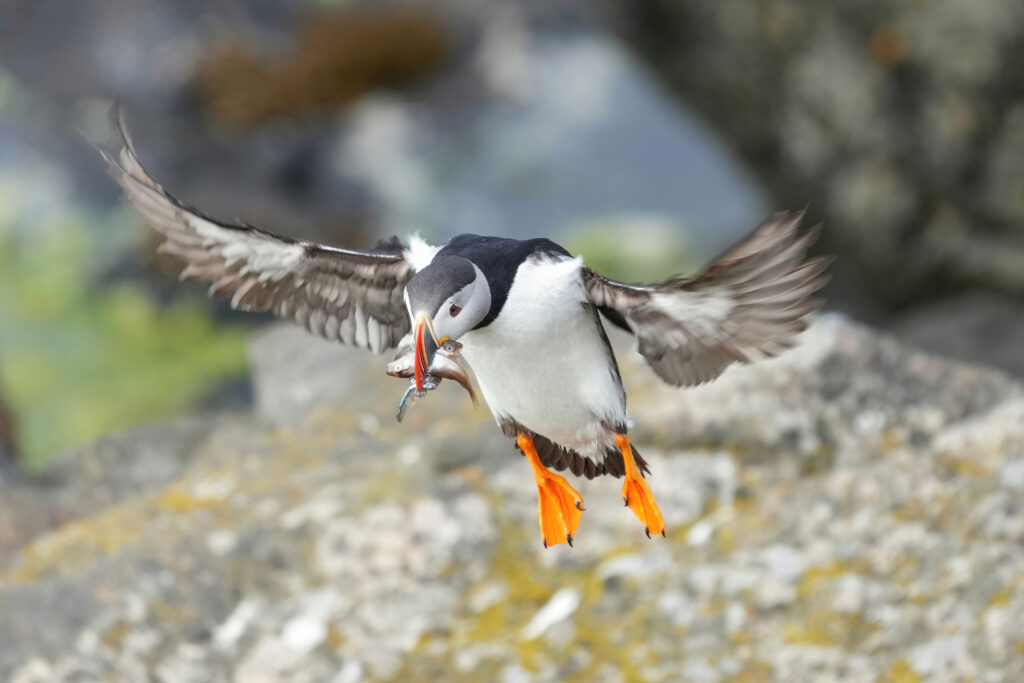
Visitors regularly encounter puffins at distances of one to two metres. The birds walk calmly across the paths, stand at burrow entrances watching the world go by, and return from fishing trips carrying beakfuls of sand eels. It is genuinely unusual to be this close to wild seabirds without disturbing them — a result of both the puffin’s natural curiosity and the controlled visitor numbers that prevent the colony from becoming stressed.
Puffins nest in burrows — either digging their own into the soft peaty soil or taking over old rabbit holes. They return to the same site year after year, often pairing with the same mate. Research on marked birds has shown individuals returning to Skellig Michael for 20 years or more. The island is not just a stopping point for these birds; it is a fixed point in their annual lives.
When Do Puffins Arrive and Leave?
Puffins are winter sea birds for most of the year, spending months far out in the Atlantic on open water. They come ashore only to breed. At Skellig Michael, the first birds typically arrive in late April, with numbers building through May. Peak viewing is from late May to mid-July, when both adults are active at the burrow and the colony is at its busiest.
By early August, most adults have left. Puffin chicks — called pufflings — leave the burrow at night to avoid predators, heading straight out to sea without any guidance from their parents. By September, the island is largely empty of puffins until the following spring.
The best months to visit specifically for puffins are June and July. The days are long, the weather on the Kerry coast is at its most settled, and the colony is fully active. Skellig Michael landing tours run under an OPW permit season from May to the end of September, weather permitting, so the timing lines up well for most visitors planning an Irish summer trip.
How to Get to Skellig Michael
Skellig Michael sits about 12 kilometres off the coast of County Kerry, accessible only by boat from ports including Portmagee, Ballinskelligs, and Derrynane. The crossing takes roughly 45 minutes to an hour depending on the departure point and sea conditions.
Boat trips must be booked in advance, and demand significantly outstrips supply during peak season. Most operators open bookings in January or February, and popular slots — particularly on calm-weather weekends in June and July — fill within days. If you are planning a visit, book as early as possible.
Sea conditions in this part of the Atlantic can change quickly. Trips are frequently cancelled due to wind and swell, and operators make the final call on the morning of departure. It is sensible to allow a few days in the area to improve your chances of getting across. Portmagee and the Skellig Ring road make for a worthwhile stay even if the boat does not go out.
The island itself is steep. Once ashore, visitors climb approximately 600 steps — many of them original medieval stonework — to reach the monastery and the upper puffin areas. There are no handrails on some sections. The climb takes around 45 minutes at a steady pace. Anyone with significant mobility difficulties should consider this carefully before booking.
Our free weekly newsletter covers the best of Ireland — practical tips, hidden spots, and seasonal guides. Sign up free here →
Visitor Limits and Conservation
The Office of Public Works (OPW) manages access to Skellig Michael and limits daily visitor numbers to around 180 people, spread across a small number of licensed boat operators. This cap is one of the main reasons the puffin colony remains in such good health.
Visitors are asked to stay on marked paths, keep voices low near the colony, and not approach nesting burrows. The puffins themselves often make this difficult to enforce in the other direction — they are quite happy to walk directly towards you and stand at close range. The key rule is not to reach out to touch them or block a burrow entrance.
Skellig Michael has no café, no gift shop, and no facilities beyond basic toilets near the landing area. There is no fresh water on the island. Bring everything you need, including food, water, sun protection, and warm layers — the wind on the island can be significant even on warm days.
Other Places to See Puffins in Ireland
Skellig Michael gets the most attention, but it is not the only place to see Atlantic puffins in Ireland. Several other coastal sites host breeding colonies, and some are considerably easier to reach.
The Cliffs of Moher in County Clare are home to Ireland’s largest mainland puffin colony — around 1,400 adults nest on Goat Island, a grassy promontory just below the clifftop. The birds are best viewed from the South Platform near the visitor centre, looking down and out towards Goat Island, rather than from the O’Brien’s Tower end further along the cliff path. See our Cliffs of Moher visitor guide for the practical details. A pair of binoculars makes a big difference here.
Horn Head in County Donegal supports one of the largest seabird colonies in the country, with puffins among the species present from May onwards. The headland is accessible by car, and the cliffs can be viewed from the coastal road. The colony is not as close-up as Skellig Michael, but the scale of the seabird numbers at Horn Head is impressive.
The Aran Islands, particularly Inis Mór, have occasional puffin sightings along the western cliffs during breeding season, though numbers are lower than the dedicated colonies further north and west.
For dedicated puffin watching without the boat journey, the Cliffs of Moher offer the best accessible alternative. For the full experience of standing at close range with a large colony, Skellig Michael has no rival in Ireland.
What to Bring on a Skellig Michael Visit
The island has no facilities beyond a landing jetty and basic toilets. Pack for a half-day trip in variable conditions.
- Water — at least one litre per person. There is none available on the island.
- Food — a packed lunch or snacks. Most boat trips are two to three hours on the island.
- Wind-proof layer — even in July, the Atlantic wind on exposed cliffs is considerable.
- Good footwear — the steps are uneven and can be slippery when wet. Avoid flip-flops or sandals.
- Binoculars — useful for spotting gannets, razorbills, and other seabirds on the crossing and around the island.
- Camera — the puffins allow close approach. A standard smartphone camera works well at these distances.
- Sea sickness medication — if you are prone to motion sickness, take it before departure. The crossing can be rough.
A Wildlife Encounter That Is Hard to Match
Atlantic puffins are not endangered — globally, the population is in the tens of millions. But that does not make a close encounter with them any less striking. These are birds that spend most of their lives on the open ocean, flying thousands of kilometres between seasons, navigating back to a single burrow on a remote Kerry island with extraordinary precision.
Standing a metre away from one on Skellig Michael, watching it carry a beak full of sand eels back to its chick, is one of those wildlife moments that is genuinely difficult to forget. The island earns its reputation — for its history, for its views, and for the small, brightly billed birds that have been coming back to it for millions of years.
The Love Ireland newsletter is free and covers hidden gems, seasonal highlights, and practical travel tips across the island. Join the community here →
Image credit: Shutterstock
☘️ Join 64,000+ Ireland Lovers
Every weekday morning, get Ireland’s hidden gems, local secrets, and travel inspiration — the kind you won’t find in any guidebook.
Subscribe free — enter your email:
Get the free guide
Enter your email and we will send you straight to the download.
📲 Know someone who’d love this? Share on WhatsApp →
Love more? Join 43,000 Scotland lovers → · Join 29,000 Italy lovers → · Join 7,000 France lovers →
Free forever · Unsubscribe anytime
Tours & experiences you might love


Powered by Viator. Some links are affiliate links — we may earn a small commission at no extra cost to you.
Secure Your Dream Irish Experience Before It’s Gone!
Planning a trip to Ireland? Don’t let sold-out tours or packed attractions spoil your journey. Iconic experiences like visiting the Cliffs of Moher, exploring the Rock of Cashel, or enjoying a guided walk through Ireland’s ancient past often sell out quickly—especially during peak travel seasons.

Booking in advance guarantees your place and ensures you can fully immerse yourself in the rich culture and breathtaking scenery without stress or disappointment. You’ll also free up time to explore Ireland’s hidden gems and savour those authentic moments that make your trip truly special.
Make the most of your journey—start planning today and secure those must-do experiences before they’re gone!