

County Sligo is one of Ireland’s most underrated destinations. Visitors often head straight for Kerry or Galway, bypassing a county that holds some of the island’s most striking landscapes. Among those landscapes, the Gleniff Horseshoe Drive stands out as a genuinely impressive route — a 10-kilometre loop that takes you through a steep glacial valley surrounded on three sides by the Dartry Mountains.
If you are looking for a drive that delivers big scenery without a big crowd, this is it.
Want more hidden corners of Ireland like this? Subscribe to our free newsletter and we’ll send the best of Ireland straight to your inbox every week.
What Is the Gleniff Horseshoe Drive?
The Gleniff Horseshoe is a circular road route in the Dartry mountain range in north County Sligo, not far from the village of Grange. The name comes from the shape of the valley itself — three mountain walls rising up around a flat green floor, creating a natural horseshoe form when viewed from the air.
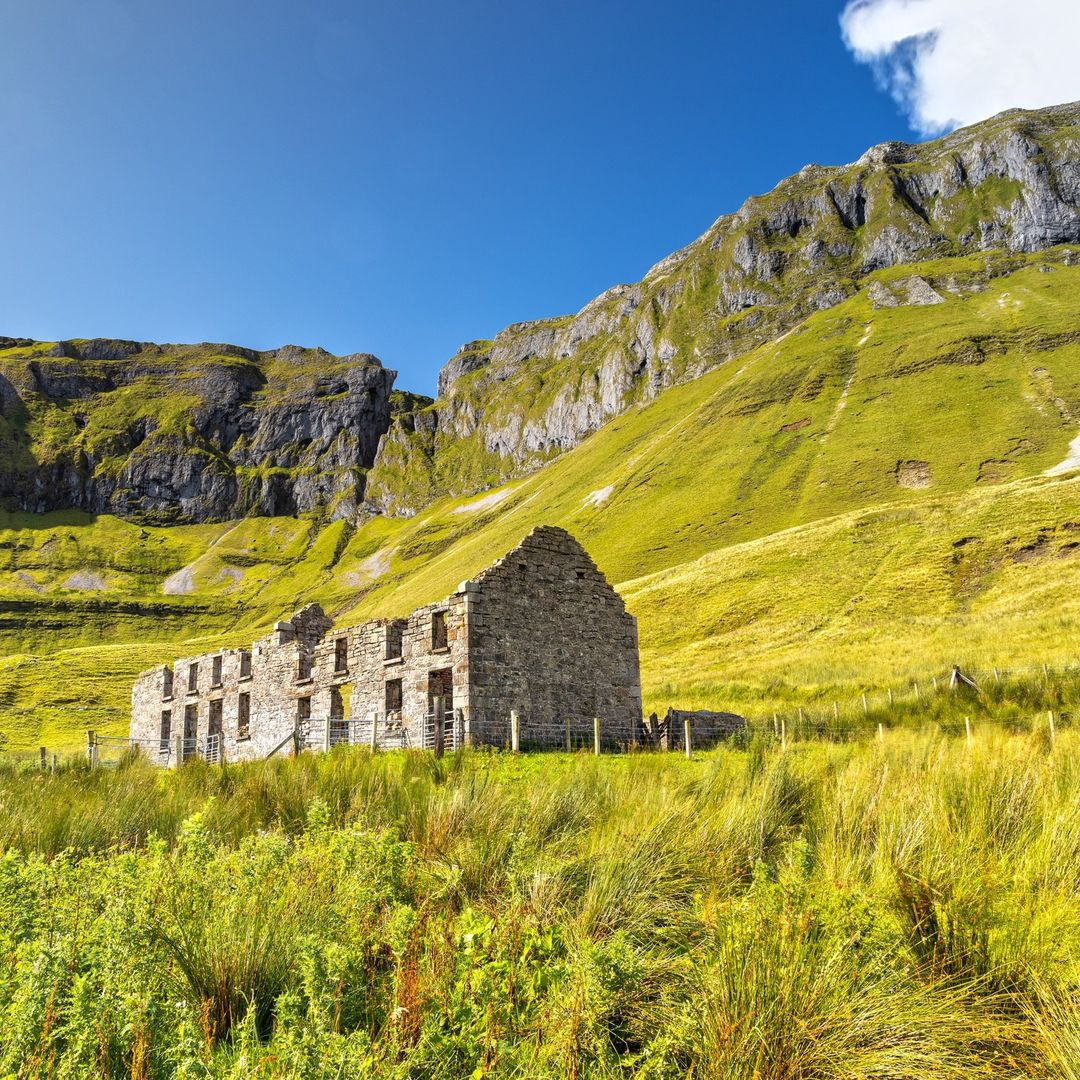
The road through the horseshoe is narrow and mostly single-track, so it is not a high-speed route. That suits the scenery perfectly. You are meant to slow down here. The mountains on either side climb steeply, with the limestone cliffs of Benbulben and its neighbouring peaks forming the backdrop. Stone ruins of old farm buildings dot the valley floor, remnants of the families who once worked this land before emigration and the decline of upland farming emptied it out.
The route is roughly 10 kilometres if you complete the full loop starting and finishing near Grange. Allow at least 90 minutes — more if you plan to stop and walk any section of it.
How to Get There
The Gleniff Horseshoe is located in north County Sligo, about 9 kilometres south-east of Grange village and roughly 20 kilometres from Sligo town.
From Sligo town, take the N15 north towards Bundoran. After passing through Grange, watch for the signs to Gleniff — they are brown tourism signs and easy to spot once you are in the right area. The entry to the horseshoe road is just south of Grange off the L2604.
Rural addresses like this do not always have a precise standalone Eircode for sat-nav purposes. Google Maps works reasonably well here once you search directly for “Gleniff Horseshoe,” though as with many rural Irish routes you may need to navigate by landmarks for the last kilometre or two.
Car parking is limited and informal. There is a small gravel area near the entrance to the loop where most visitors leave their vehicles. It fits around eight to ten cars. If this is full, do not block the road — farm vehicles use this route regularly.
What You Will See on the Drive
The views change as you progress around the loop. Coming in from the south, the valley opens up gradually. The limestone cliffs above you are part of the same geological formation as Benbulben — the flat-topped mountain that W.B. Yeats wrote about and that has become one of Sligo’s defining images.
The stone ruins scattered across the valley floor are a common sight in this part of Ireland. Many date from the 19th century or earlier. Some were abandoned during the Famine years; others were left behind as younger generations emigrated or moved to towns throughout the 20th century. They are a quiet reminder of a very different way of life in this landscape.
Wildlife is present if you take the time to look. Peregrine falcons have been recorded nesting on the limestone cliffs above the horseshoe. Red grouse inhabit the upland heath. If you visit in summer, the valley floor and lower slopes carry wildflowers including heather, tormentil, and bog asphodel. In autumn, the bracken turns a deep rust-orange that sets off the grey rock above it.
The road itself is an attraction. Passing through the narrow gap between the mountains, you get the sense of being inside the landscape rather than looking at it from a distance.
Walking Options in the Horseshoe
If you want to get out of the car, there are informal walking routes in the valley. The most straightforward is simply to park near the entrance and walk along the road itself — traffic is light enough that this is comfortable, and the road surface is generally reasonable underfoot.
More serious walkers use the horseshoe as a base for routes up into the Dartry Mountains. The terrain is rough and unmarked above the valley floor, so you need a map, compass, and the experience to use them. The OS Discovery Series Map 16 covers this area. Do not attempt the high ground in poor visibility — the cliffs above the valley are significant and the weather in this part of Sligo can change quickly.
For families or anyone who just wants a short stroll, the valley floor is flat and approachable. The ground can be boggy in places, particularly after wet weather, so waterproof footwear is worth having.
When to Visit
The Gleniff Horseshoe can be visited year-round, but the experience varies significantly by season.
Spring (March to May) brings longer days and fewer visitors. The vegetation is starting to green up and the low-angle light makes the cliffs look particularly dramatic. This is one of the quieter times to visit.
Summer (June to August) offers the best weather odds, though “best” in the Irish west coast context means you should still pack a waterproof layer. The valley can be busy on fine weekends, particularly in July and August, when the car park fills up by midday.
Autumn (September to November) is arguably the most photogenic time. The bracken and heather turn colour across the hillsides, and the crowds thin out noticeably after the August bank holiday. September particularly offers a good balance of reasonable weather and quiet roads.
Winter (December to February) is quiet and often cold. Frost can make the road surface slippery, and the days are short — you may only have four or five hours of useful daylight. That said, if you catch a clear winter day with low cloud on the peaks, the light can be remarkable.
What to Combine It With Nearby
The Gleniff Horseshoe sits in one of the richest corners of Sligo for things to do and see. A few places worth adding to the same day out:
Benbulben: The famous flat-topped mountain is visible from much of the horseshoe drive and is located just to the west. There are walking routes to the plateau top, though these are for experienced hillwalkers only. The mountain is most dramatic viewed from the road below.
Mullaghmore Head: Around 15 kilometres north-west of Gleniff, Mullaghmore is a small harbour village with a shingle beach and views across to Classiebawn Castle on its peninsula. Big-wave surfers use the break here when the Atlantic swells are running. It is a good spot for lunch if you are visiting the horseshoe in the morning.
Drumcliffe Churchyard: W.B. Yeats is buried in the churchyard at Drumcliffe, a few kilometres south of Grange on the N15. The headstone carries the famous epitaph he wrote himself. The church and surrounding area are open to visitors and it takes no more than 30 minutes to visit properly.
Creevykeel Court Tomb: One of the finest Neolithic monuments in the country, Creevykeel sits on the N15 just north of Cliffoney. It dates from around 4,000 BC and is freely accessible. Most people drive past it without stopping, which means you will likely have it almost to yourself.
Practical Tips Before You Go
- Road width: The road through the horseshoe is narrow. Be prepared to reverse for oncoming traffic, particularly farm vehicles. Drive slowly and be patient.
- Fuel: Fill up in Grange or Sligo town before heading out. There are no petrol stations in the immediate area.
- Mobile signal: Weak or absent for much of the route. Download any maps you need before you arrive.
- Facilities: There are no public toilets or cafes at the horseshoe itself. Grange has basic facilities including a pub.
- Gates: You may encounter farm gates on or near the road. Leave them as you find them — open if open, closed if closed.
- Dogs: Keep dogs on leads near farmland and livestock. Sheep graze on the lower slopes of the valley.
Discover more of Ireland’s great drives and hidden routes. Join our free weekly newsletter for guides like this one, delivered directly to you.
Why County Sligo Deserves More Attention
Sligo has a strong literary and artistic heritage — Yeats was born here and returned repeatedly — but tourism has traditionally focused on the county’s connection to the poet rather than its landscapes. The Gleniff Horseshoe, Benbulben, the wild beaches of Strandhill and Enniscrone, and the archaeological richness of the Carrowmore and Carrowkeel tomb complexes make Sligo a genuinely rewarding destination in its own right.
The county sees a fraction of the visitor numbers that Clare or Kerry receive, which means roads are quieter, car parks emptier, and the experience of being in the landscape more immediate. For travellers who have already done the main tourist circuits and are looking for somewhere less trodden, Sligo offers real rewards.
The Gleniff Horseshoe is a good example of what makes the county special. It is not on most people’s list. It does not have a visitor centre or a gift shop. What it has is a dramatic piece of natural landscape that you can drive through at your own pace, stop wherever you like, and leave without having queued for anything.
That, in Ireland, is increasingly rare.
Like this guide? Subscribe to our free newsletter for weekly travel inspiration from across the island of Ireland.
Featured image: Photo by Mike Searle / Wikimedia Commons (CC BY-SA 2.0).
☘️ Join 64,000+ Ireland Lovers
Every weekday morning, get Ireland’s hidden gems, local secrets, and travel inspiration — the kind you won’t find in any guidebook.
Subscribe free — enter your email:
📲 Know someone who’d love this? Share on WhatsApp →
Free forever · Unsubscribe anytime
Tours & experiences you might love


_-_geograph.org.uk_-_5829893.jpg)
Powered by Viator. Some links are affiliate links — we may earn a small commission at no extra cost to you.
Secure Your Dream Irish Experience Before It’s Gone!
Planning a trip to Ireland? Don’t let sold-out tours or packed attractions spoil your journey. Iconic experiences like visiting the Cliffs of Moher, exploring the Rock of Cashel, or enjoying a guided walk through Ireland’s ancient past often sell out quickly—especially during peak travel seasons.

Booking in advance guarantees your place and ensures you can fully immerse yourself in the rich culture and breathtaking scenery without stress or disappointment. You’ll also free up time to explore Ireland’s hidden gems and savour those authentic moments that make your trip truly special.
Make the most of your journey—start planning today and secure those must-do experiences before they’re gone!