

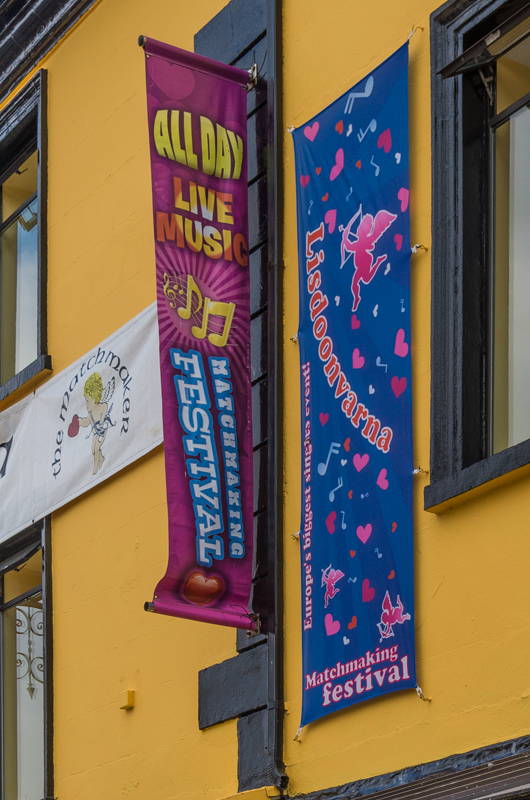
Lisdoonvarna Matchmaking Festival: How Ireland’s 160-Year-Old Singles Event Actually Works Today
Every September, something improbable happens to a small town in County Clare. Lisdoonvarna — population around 800, sitting at the edge of the Burren where the limestone plateaus finally give way to Atlantic air — floods with people. Not hundreds. Tens of thousands. For the entire month, every pub fills, every hotel books out, and the roads into town back up with cars carrying people who have driven from Dublin, flown from New York, or bused in from Cork for essentially the same reason: they want to fall in love, and someone told them this is where that still happens.
It is not, strictly speaking, an app. The mechanism at the centre of all of it is a man named Willie Daly, who is in his early eighties, who raises donkeys on a farm outside town, and who owns a leather-bound book — yellowed, worn, over 160 years old — that he says will get you married within six months if you press both palms to its cover, close your eyes, and think about love for at least seven seconds.
The surprising thing is not that such a man exists. It is that every word of this is true.
The Waters Came First
To understand why Lisdoonvarna does what it does, you have to go back to the mineral springs.
The town’s sulphur and iron-rich waters were first noted for their therapeutic properties in 1751. An official spa opened in 1845, and the Victorians — with their characteristic enthusiasm for combining convalescence with social performance — built a pump-house in 1867 and a grand bath-house in 1875. By 1895, visitor numbers had reached 20,000 in a single year. Remarkable for a settlement in the west of Ireland.
The visitors who came for the waters tended to be what the era called “genteel” — city-dwelling, marriageable, and looking for September air that did something useful for the liver. And in September, a different class of visitor also began to arrive: bachelor farmers who had just brought in the harvest and had, for the first time all year, both leisure time and something to offer a prospective spouse.
This collision — the health resort with its city visitors and the country farmers with their post-harvest freedom — was not planned. Nobody sat down and designed a matchmaking festival. It emerged from the gap between two social worlds meeting in the same small town at the same time of year. And once the pattern was established, it perpetuated itself. September in Lisdoonvarna was when you went if you were looking. Everybody knew it. So everybody went.
What the town also produced, in those years when matchmaking was a serious economic and social institution, was professional matchmakers. Every town in rural Ireland once had one — someone who knew the land holdings, the family histories, the unspoken requirements on both sides. By the late twentieth century, they had almost entirely vanished, replaced first by the dance hall and later by the dating column and eventually the swipe.
Willie Daly did not vanish.
The Third Generation
He thinks he was born on the first of April, 1943, though he cannot be entirely certain: the priest who recorded the date, he has said, was “very fond of the drink.” He lives, today, on a farm in Kilshanny — roughly halfway between Lisdoonvarna and Ennistymon — next door to the three-hundred-year-old cottage where he grew up. He raises donkeys, horses, cows, and lambs. And he has been making matches since he was a teenager.
His grandfather was a matchmaker. His father was a matchmaker. Willie grew up watching both of them work — reading people, keeping notes, maintaining the book — and somewhere in his early years he started doing it himself. His first match, by his account, came after he noticed a young man at church watching a woman he was too shy to approach. Willie made the introduction. He did not take it up formally again until his twenties, but once he did, it became the work of a lifetime. Over roughly sixty years of matchmaking, he estimates he has brought more than 3,000 couples together.
The book is the physical record of all of it. A leather-bound ledger, passed through three generations of the Daly family, containing the particulars of everyone they ever attempted to match — names, locations, what they were looking for, what they had to offer. It has been in continuous use for over 160 years. When Willie stands beside a roaring pub fire during the September festival and holds the book out to the queue waiting to touch it, he is holding something that contains the romantic history of the Clare countryside stretching back to the 1860s.
He wrote a memoir about all of this — The Last Matchmaker, published in multiple editions — which is part personal history and part account of what sixty years of watching people teach you about why they choose each other. He believes, he has said, that there is still nothing to replace the personal intervention of a matchmaker who brings “a mixture of experience, humour and hope” to the proceedings.
He also charges €20 to write your name in the book.
The Month That Owns September
The festival runs from the first day of September to the last. Thirty days. Not a weekend. Not a long bank-holiday weekend. The entire month.
Lisdoonvarna on an ordinary Tuesday in March is a quiet few streets with a post office, some pubs, and a population in the hundreds. During September, it takes in somewhere between 40,000 and 60,000 visitors — sources vary by year — with accommodation booked months in advance, live music running nightly in every pub and hotel, and céilí dancing going late into the evenings across the town. There is no festival gate, no wristband, no single venue to buy a ticket for. The festival is the town itself. You arrive, and September receives you.
The economic reality of that scale in a settlement that size is not a manageable side note — it is a substantial portion of the local commercial year. When the festival was cancelled in 2020 and again in 2021 during the COVID-19 pandemic, the estimated loss to the local economy across both years ran to over €5 million. Its return in September 2022 was described, with some accuracy, as the release of “dormant emotions.” Which is also, when you think about it, a reasonably good description of what the festival has always been.
The event has, in the meantime, accumulated layers of international recognition that earlier generations of visitors would not have predicted. It has been referenced in television series. It gets regular coverage in American travel media as evidence that the Irish approach to romance operates on an entirely different frequency from Silicon Valley’s. For a certain cohort of visitors — typically those who have been on the dating apps long enough to find them exhausting — Lisdoonvarna in September carries a genuine appeal that is not entirely ironic. The festival now claims to be Europe’s largest singles event. Based on what it draws to a town of 800, that claim is not hard to credit.
How It Actually Works
If you want Willie Daly to match you, the process is not complicated. You find the Matchmaker Bar in Lisdoonvarna. You queue. You pay €20. He records your details — what you are looking for, something of who you are — in the book. He may ask questions. He will observe you carefully. He has said that even outside the formal consultation he is always watching, always assessing which person in the room might fit with which other one.
The book brings luck, by the old account. You press both palms to it, close your eyes, hold it for a count of seven, and think about love. The six-month window is what the tradition promises. Whether you attribute the outcomes to the ritual or to the more mundane magic of being in a room full of people who all want the same thing, the effect is real enough that people keep coming back. Some of them bring children who are now old enough to need the book themselves.
His daughter Elsha has extended the practice into a more structured, year-round service — a fourth generation of the Daly matchmaking line, operating with a more formal model alongside her father’s low-tech version. Whatever Willie’s fears about being the last of his kind, the family has not yet let it end.
What Willie carries that no current algorithm replicates is sixty years of watching people under pressure. He has seen who arrives at the festival projecting confidence and who is, in fact, frightened. He has seen which people tidy themselves up for September and which ones don’t bother. He has seen which couples he brought together return to the same pub, years later, to shake his hand. That history lives in the book, and some portion of it lives in him, and you cannot download either one.
The Last One Standing
Willie Daly has said, more than once, that he worries he may be the last. He is not being dramatic. Until recently, there was one other traditional matchmaker still operating in Ireland — a man in Co Kerry named Dan Paddy Andy O’Sullivan, who reportedly made around 400 matches in his lifetime before he was gone. Willie is now the only one left of a profession that once had practitioners in every county in the country.
The survival of Lisdoonvarna is, from one angle, a story about tourism infrastructure — a festival that has been promoted, connected to the Burren and the Wild Atlantic Way, and sustained by the appeal of Clare itself. The month of September there is now a small industry.
But from another angle, it is a story about something the matchmaking tradition understood long before modern psychology had a vocabulary for it: that finding a partner is not primarily a search problem. It is a presence problem. You have to actually be somewhere, at a particular time, with particular people who have also made the effort to show up. The festival is, at its structural core, a mechanism for making showing up happen. The music, the dancing, the book, the €20 — these are permission structures. They give people a reason to be in the same room, in the same mood, in the same moment.
Willie Daly has been building that room for sixty years. The farm is still in Kilshanny. The donkeys are still there. The book — worn, yellowed, accumulated with names across three generations — is still there. And every September, when the harvest has come in and the Atlantic starts to show its autumn temper, a town of 800 does something improbable all over again.
Ireland has held onto a lot of old things that turned out to be worth keeping. That a man with a 160-year-old book still sits with it every September, still watches, still makes introductions across a town that fills up because of him — it feels, against all odds, like one of the better ones.
☘️ Join 64,000+ Ireland Lovers
Every weekday morning, get Ireland’s hidden gems, local secrets, and travel inspiration — the kind you won’t find in any guidebook.
Subscribe free — enter your email:
📲 Know someone who’d love this? Share on WhatsApp →
Love more? Join 43,000 Scotland lovers → · Join 29,000 Italy lovers → · Join 7,000 France lovers →
Free forever · Unsubscribe anytime
Tours & experiences you might love


Powered by Viator. Some links are affiliate links — we may earn a small commission at no extra cost to you.
Secure Your Dream Irish Experience Before It’s Gone!
Planning a trip to Ireland? Don’t let sold-out tours or packed attractions spoil your journey. Iconic experiences like visiting the Cliffs of Moher, exploring the Rock of Cashel, or enjoying a guided walk through Ireland’s ancient past often sell out quickly—especially during peak travel seasons.

Booking in advance guarantees your place and ensures you can fully immerse yourself in the rich culture and breathtaking scenery without stress or disappointment. You’ll also free up time to explore Ireland’s hidden gems and savour those authentic moments that make your trip truly special.
Make the most of your journey—start planning today and secure those must-do experiences before they’re gone!