

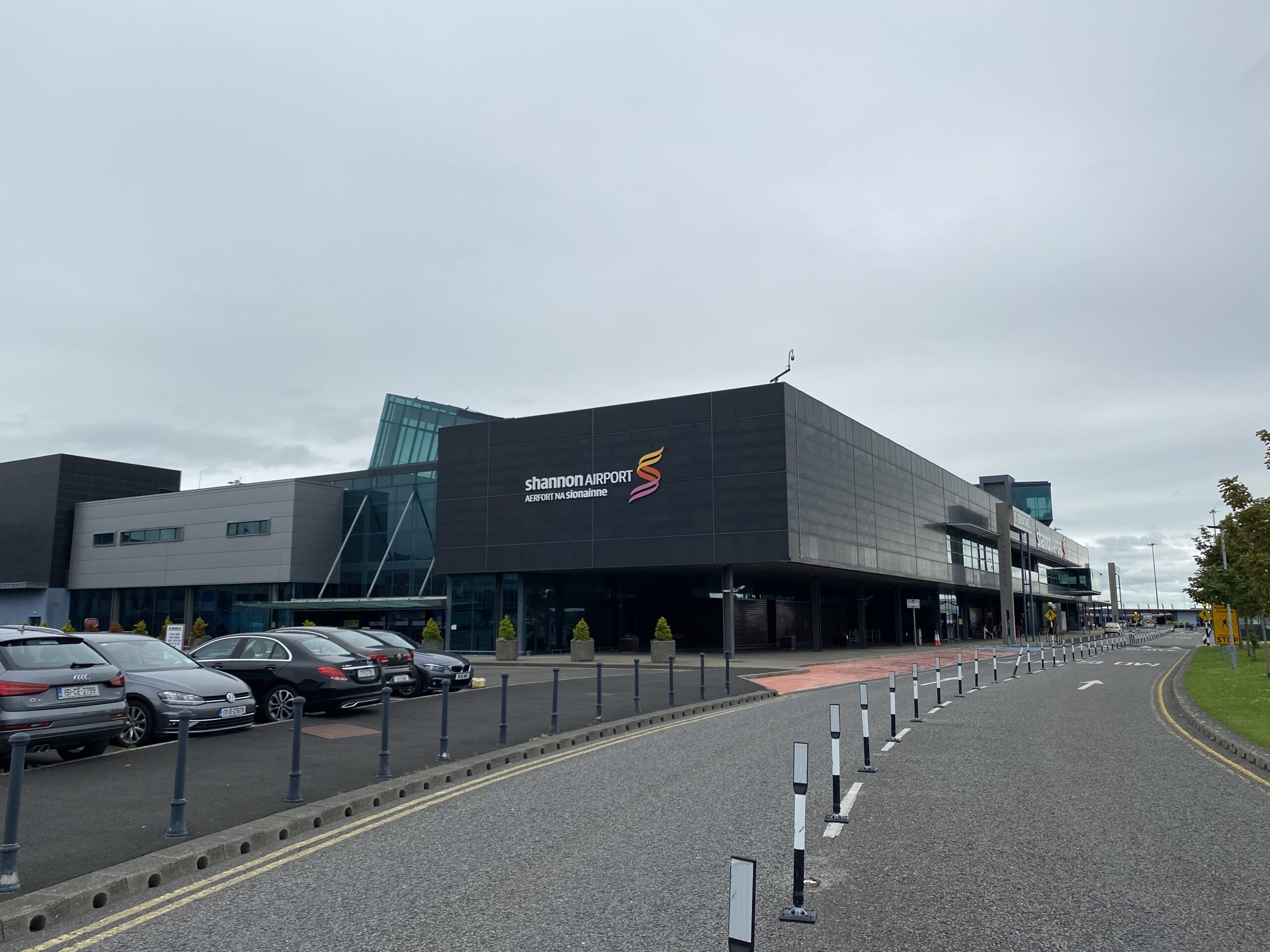
Shannon Airport: The World’s First Duty-Free Shop and How It Changed Global Travel Retail
Somewhere between passport control and your gate, you’ve probably lost a little money to duty-free. A bottle of whiskey, maybe. A perfume you didn’t strictly need. One of those enormous Toblerones you absolutely didn’t need. This particular habit — the airport shopping detour — has become so embedded in how we travel that it barely registers as a choice. It is simply what happens at airports.
What almost nobody knows is that the whole concept was invented by one man, at one airport, in one corner of County Clare, in the years just after World War II.
His name was Brendan O’Regan. He was born in 1917 in Sixmilebridge. He was a catering manager. And the idea he had — first formalised in law in March 1947, first realised as a proper shop in May of that year — quietly became one of the most imitated retail innovations of the twentieth century.
The Edge of the World
To understand why Shannon Airport was the place this happened, you have to understand what Shannon Airport was in the mid-1940s. Sitting on the western coast of Ireland, it was the closest land in Europe to the United States — a geographic fact that, in the era of propeller-driven aircraft, made it obligatory. Every transatlantic commercial flight stopped here to refuel. The new Lockheed Constellations and Douglas DC-4s couldn’t make the crossing otherwise. Passengers — Americans, British, and the occasional Irish emigrant going home to visit — would stream into the terminal for two or three hours while the tanks were topped up. They had time. They had money. And there was very little for them to do.
O’Regan had arrived at Shannon in 1945, transferred from the nearby Foynes flying boat base where he’d been running catering for the seaplanes that preceded the airliners. He was already a perceptive operator — the kind of man who read the situation and asked the next question.
The situation at Shannon was this: hundreds of transatlantic passengers arriving in Ireland with sterling, dollars, and francs they couldn’t easily convert or take home, spending their layover staring at the walls. O’Regan saw the captive audience and started thinking about how to give them a reason to open their wallets.
The Act That Made It Possible
The legal breakthrough came first. O’Regan recognised that the Shannon Airport transit zone occupied an unusual regulatory position: passengers passing through hadn’t technically entered Ireland. They existed, for a few hours, in a kind of customs limbo — between nations, between tax systems. If that space could be formally declared outside Ireland’s excise regime, goods sold there could be priced free of import duties.
He made the case to government. On March 18, 1947, Dáil Éireann passed the Customs Free Airport Act. Shannon Airport’s transit area was legally designated a duty-free zone.
Within weeks, the first shop opened. It was operated by a local woman named Kitty Downes — the industry’s first retail employee, working out of what amounted to a kiosk selling Irish souvenirs, linen, and locally-made goods to passengers who had never before encountered the concept of an airport shop, let alone a duty-free one.
It was modest. But it worked. Transit passengers bought things. The model was real.
The Eureka Moment on the Water
The kiosk at Shannon was selling souvenirs. O’Regan had bigger ambitions — specifically, he wanted to sell spirits. Full duty-free liquor, at prices genuinely dramatic compared to what passengers could find at home. But that required a further step: specific Cabinet approval for spirits sales.
The moment that unlocked his thinking came not at Shannon but on the Atlantic Ocean.
In 1950, O’Regan was crossing from the United States on the SS America — one of those transatlantic liner crossings that still existed before aviation made them obsolete. Wandering the ship, he found himself in the vessel’s duty-free shop, where goods were being sold free of both American and British duties. The logic hit him immediately.
“On the SS America,” he later recalled, “I saw the shop that was selling duty-free goods, and my brain said to me: ‘If they can do it when you are crossing the sea in a boat, you can surely be able to do it when you land for the first time.’”
Ocean liners operated outside any nation’s territorial waters. Shannon’s transit zone operated outside Ireland’s customs territory. The same legal gap that allowed duty-free whiskey on the high seas should, in principle, allow duty-free whiskey in a County Clare airport lounge. O’Regan came home from that voyage and pushed hard for Cabinet approval.
In June 1950, with the backing of Taoiseach John A. Costello, the Cabinet agreed. A full duty-free spirits operation would open at Shannon.
On March 16, 1951, it did. The Shannon Airport transit lounge now had the world’s first airport duty-free shop selling spirits and cigarettes. Irish whiskey was priced at around ten shillings and sixpence duty-free — against roughly thirty shillings in a regular Irish shop. For American passengers with dollars and a long flight home ahead of them, this was a genuinely compelling proposition. The shop became an immediate success.
The Copycats
Word travels fast in the aviation world. Within a few years of Shannon’s spirits operation opening, other airports were paying attention. Amsterdam’s Schiphol Airport opened its first duty-free operation around seven years after Shannon. London Heathrow followed. So did Copenhagen’s Kastrup, Miami International, and Frankfurt — all in the period between 1956 and 1960.
The concept spread so quickly because the underlying logic was watertight and the revenue was obvious. Airports already existed in customs limbo. Passengers were demonstrably willing to spend. Governments faced no strong argument against capturing that commerce. What Shannon had done was demonstrate, with real numbers from real transactions, that the model worked.
Back in County Clare, O’Regan kept refining his operation. By 1954, Shannon had added a mail-order service — passengers could pre-order Irish crystal, china, clothing, and jewellery to collect duty-free on departure. Brands that had initially been reluctant to supply an airport kiosk were now competing to be stocked. The selection expanded from Irish souvenirs to Rosenthal porcelain and Leica cameras. What had begun as a handful of items on a small counter was becoming something that looked recognisably like modern retail.
In 1954, O’Regan also presented a formal proposal for duty-free stores to the New York Convention on International Travel — an explicit invitation to the world to copy what Shannon had built.
The Man Who Turned Shannon’s Idea Into Billions
Not everyone who noticed what was happening at Shannon was just passing through on their way somewhere else.
Chuck Feeney, a New Jersey-born entrepreneur, co-founded Duty Free Shoppers (DFS) with Robert Miller in 1960. The company grew into one of the world’s largest luxury retailers, primarily by selling duty-free goods to American tourists in Hawaii and across Asia — building enormous stores at major Pacific airports and becoming the definitive heir to the model Shannon had developed.
Feeney himself widely acknowledged that the Shannon Duty Free operation provided the business model from which his fortune grew. He had seen the same logic O’Regan had: the transit passenger, the captive audience, the tax-free gap. DFS scaled it into a business estimated to have made Feeney a billionaire.
Then, in one of the more remarkable philanthropic decisions of the twentieth century, Feeney gave almost all of it away. His Atlantic Philanthropies foundation distributed more than eight billion dollars over his lifetime — to universities, health systems, and civic institutions, much of it in Ireland and the United States. He died in 2023 having successfully reduced himself to near-zero wealth, having stated that as his explicit goal. Libraries, cancer research facilities, university buildings across Ireland — some of them trace their funding, in a direct line, back to the kiosk Kitty Downes operated at Shannon Airport in 1947.
The Irish Export That Built Dubai
The most striking downstream chapter of the Shannon story played out not in New York or Amsterdam but in the Arabian Gulf.
In 1983, the director general of Dubai International Airport, Mohi-din Binhendi, flew to County Clare. Dubai was developing its aviation infrastructure and needed to build a duty-free operation from scratch. Shannon’s managing company, Aer Rianta, had spent decades running the world’s original duty-free shop and was widely regarded as the authority. Binhendi wanted to learn from them.
He left Shannon with an agreement: a ten-person Aer Rianta team would come to Dubai on a six-month consultancy contract. One of that team was Colm McLoughlin, a man from Ballinasloe in County Galway who had been Shannon Duty Free’s general manager and who carried the full weight of the Shannon tradition with him.
Dubai Duty Free opened on December 20, 1983. It took US$44,000 in that first day. In its first full year, it did $20 million in sales.
McLoughlin’s six-month contract stretched to 41 years. He stayed on as Executive Vice Chairman and Chief Executive, overseeing the operation’s growth from that $20 million opening year to — by the time he finally stepped down in May 2024 — annual revenues close to $2.2 billion. When McLoughlin died later that year, the tributes from the UAE government were extraordinary for a man from the west of Ireland: testimony to what a Shannon-trained operator had built in the Gulf desert, over four decades, starting from a Clare template.
One thread of professional knowledge, from one airport in County Clare, helped create one of the world’s great retail operations on the other side of the earth.
The Man Behind All of It
Brendan O’Regan didn’t stop at duty-free. The same imagination that had spotted the retail opportunity in a transit lounge kept generating ideas for decades.
In 1951 — the same year the first spirits operation opened — he founded the Shannon College of Hotel Management, which trained hospitality professionals from across the world for generations. He transformed Bunratty Castle, which had been falling apart, into one of Ireland’s most visited tourist attractions, opening it to the public in 1960. He was instrumental in creating the Shannon Free Zone in the early 1960s, declared by the Irish government to be the world’s first free trade zone. That model has since been replicated in approximately 2,600 locations globally, and those zones today employ more than 60 million people.
In 1979, O’Regan founded Co-operation North — now Co-operation Ireland — devoted to building connections across the Irish border. He spent his later decades as a peace advocate. His honours included a CBE, honorary doctorates from three universities, and the Freedom of the City of Limerick. A bronze bust was unveiled at Shannon Airport in 2017, on the centenary of his birth. A full life-size statue followed in his hometown of Sixmilebridge in 2023.
He had died in 2008, aged 90, having watched the retail concept he sketched out in a County Clare transit zone turn into a fixture of every major airport on earth.
The Scale of What Grew from That Kiosk
The global duty-free and travel retail industry today generates tens of billions of dollars in annual sales — a figure that has grown steadily alongside international air travel. Asia-Pacific is now the dominant region, with airports in Seoul, Singapore, Beijing, and Dubai among the world’s largest duty-free operations. Mid-1990s estimates had the model operating in more than 80 countries. The trajectory has only continued upward.
All of it, in some direct genealogical sense, traces back to the Customs Free Airport Act that Dáil Éireann passed on March 18, 1947, and to the kiosk Kitty Downes opened the following May, and to the man who connected those two moments — the catering manager from Sixmilebridge who noticed, on a boat in the middle of the Atlantic, that someone was already doing this on the water and asked why on earth airports weren’t doing it too.
Shannon Airport still carries the “World’s First Duty Free” distinction in its terminal — the sign is there if you know to look for it. The whiskey is still better value than on the high street. And somewhere in the founding logic of that small county Clare kiosk is a lesson that keeps repeating: the most consequential retail ideas often come not from the big established players, but from someone standing in an airport, looking at a bored passenger, and asking a slightly more ambitious question than anyone else had thought to ask yet.
☘️ Join 64,000+ Ireland Lovers
Every weekday morning, get Ireland’s hidden gems, local secrets, and travel inspiration — the kind you won’t find in any guidebook.
Subscribe free — enter your email:
📲 Know someone who’d love this? Share on WhatsApp →
Love more? Join 43,000 Scotland lovers → · Join 29,000 Italy lovers → · Join 7,000 France lovers →
Free forever · Unsubscribe anytime
Tours & experiences you might love


Powered by Viator. Some links are affiliate links — we may earn a small commission at no extra cost to you.
Secure Your Dream Irish Experience Before It’s Gone!
Planning a trip to Ireland? Don’t let sold-out tours or packed attractions spoil your journey. Iconic experiences like visiting the Cliffs of Moher, exploring the Rock of Cashel, or enjoying a guided walk through Ireland’s ancient past often sell out quickly—especially during peak travel seasons.

Booking in advance guarantees your place and ensures you can fully immerse yourself in the rich culture and breathtaking scenery without stress or disappointment. You’ll also free up time to explore Ireland’s hidden gems and savour those authentic moments that make your trip truly special.
Make the most of your journey—start planning today and secure those must-do experiences before they’re gone!