

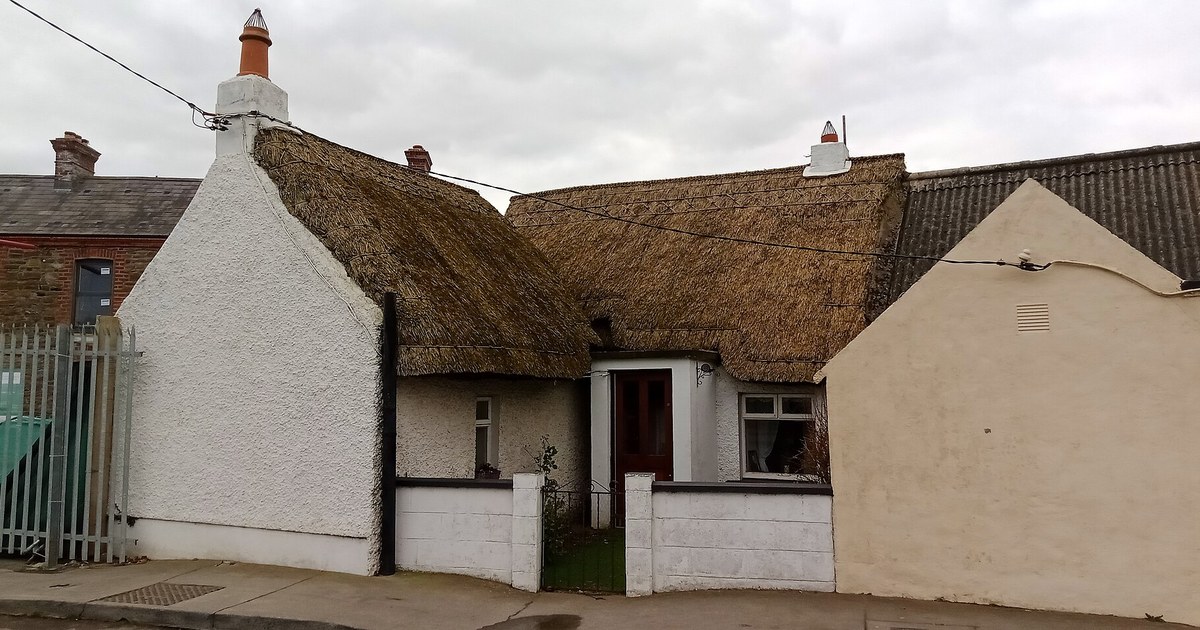
Ireland Built Laws to Save Thatched Cottages. Then Made Them Nearly Impossible to Keep.
When Stuart Carolan bought The Morning Star pub in County Louth in 2015, the insurance cost around €5,000 a year. He accepted that as the price of owning a building with a roof that predated the state it sat in. He and his co-owner invested €300,000 in improvements. He called it “more of a labour of love than an investment opportunity.” He was at peace with that.
By 2024, the annual insurance bill had reached nearly €20,000.
“We can’t afford to pay it,” Carolan told RTÉ. And here is where the trap closes: he can’t easily pull the thatch off and replace it with slate either. The building is a protected structure, and removing the thatch without planning permission carries penalties under Irish law of up to €12.7 million and two years in prison. Stuart Carolan is caught — by a heritage designation that legally requires him to maintain the roof, and by an insurance market that has all but stopped serving buildings with that kind of roof.
His situation is not unusual. It is, increasingly, the normal experience of owning a thatched building in Ireland.
From Every Lane to Almost Nowhere
The scale of what has been lost is worth sitting with for a moment. In 1851, census takers counted 135,589 fourth-class dwellings in Ireland — the single-room thatched cabins that housed much of the rural population. By 1901, that number had collapsed to fewer than 10,000. The Famine, emigration, and the slow economics of better building materials had done their work. A 2005 Department of the Environment report estimated around 1,300 thatched dwellings surviving in the Republic. The Thatch Insurance Action Group, which has become the main advocacy body for owners of these properties, estimates that roughly 20 to 25 per cent of those have been lost in just the past two decades. Today, somewhere around 1,000 thatched buildings are estimated to remain across the island of Ireland.
These are not simply old buildings. They represent four distinct regional thatching traditions — rope thatch along the Donegal coast, water reed favoured across Munster, wheat and rye straw more common further north — adapted over generations to specific materials, climates, and techniques. Many sit on the Record of Protected Structures, which means their owners carry significant legal liability for any alteration. They are what Ireland’s tourism industry reaches for when it wants to show visitors what the country looks like. The state has an obvious interest in keeping them standing.
What the state has not managed to do is make them affordable to own.
The Insurance Implosion
In 2015, six insurance companies were willing to cover thatched buildings in Ireland. By 2022, there were two. By the time an Oireachtas committee convened that autumn to hear evidence on the crisis, the market had effectively narrowed to one company that owners could actually reach through normal broker channels. Brexit played a significant role: UK underwriters who had been filling the gap in the Irish market withdrew after 2020. Domestic insurers — including FBD Insurance and OBF — stopped offering new thatched home policies, citing what they described as a “lack of risk appetite.”
The fire statistics are not invented. Research presented to the committee showed an average of 14 fires per year in thatched buildings in the five years to October 2022, and Ireland’s rate of fire in thatched buildings ran approximately eight times higher than the equivalent rate in England. The majority of those fires originated from improper chimney maintenance and solid fuel stoves. In a building where the roof is the most combustible element, those numbers matter. Some insurers began requiring homeowners to remove open fires and wood-burning stoves as a condition of any policy at all.
Jimmy Lenehan, a professional thatcher with more than thirty years of experience who has been involved in advocacy efforts on the insurance issue, describes the market bluntly: “You can’t really shop around, you have to take whatever you can get.”
What you can get varies sharply. Domestic premiums now range from around €1,500 to €5,000 a year for those lucky enough to find cover. Áine McGarry pays €11,000 annually to insure Trohanny Cottage, a thatched property she purchased and restored in County Meath in 2000. She runs the cottage through Airbnb to offset the costs — overseas guests come specifically to sleep under the roof — and frames the situation with a certain stoic clarity: “You’re the custodian of an amazing, protected structure. You feel very much on your own.”
Others have stopped trying. Seán McLaughlin, 78, from Malin Head in County Donegal, lost his coverage in 2007 when his underwriters withdrew from the market and has lived uninsured since. Coleman Stack in Cork is in a similar position: “Thatched houses are disappearing very quickly,” he told IrishCentral. For commercial properties, the premiums dissolve into territory that most businesses simply cannot sustain — The Morning Star’s near-€20,000 quote sits at one extreme, but five-figure annual premiums are not unusual for any building combining thatch with trade.
Martin Browne, chair of the Oireachtas committee, warned that without intervention, thatched homes would survive only “on a postcard.” Senator Fintan Warfield went further: “The State will own them, but nobody will live in them.”
The Grant That Hasn’t Moved in Thirty-Five Years
If insurance is the immediate wall, maintenance costs are the one behind it. A thatched roof needs to be replaced approximately every ten to fifteen years. The current cost for a full rethatching runs between €20,000 and €30,000 for a standard dwelling — and significantly more for a larger or structurally complex property, with some restoration estimates running to €130,000. On top of that, applications of bluestone copper sulphate to treat algae and moss can cost around €700 a year. Annual general upkeep adds further. The whole financial picture, stacked against what is typically a rural property with modest market value, rarely makes conventional economic sense.
The State offers a Thatching Grant to help. The amount is €3,800. It has not changed since the grant was introduced in 1990.
There are additional routes for larger projects — the Built Heritage Investment Scheme, the Historic Structures Fund, which can provide up to €50,000 on a discretionary basis — but these are competitive programmes with limited allocations. For the majority of thatched homeowners facing a bill of €20,000-plus every decade or so, the maths are punishing, particularly when insurance is already running to thousands a year.
Madeline Harbison, who owns a thatched property in Donore, told the Meath Chronicle that she may have “no choice but to have the roof completely slated if costs continue to rise.” She is not being melodramatic. She is doing arithmetic.
The Last Thatchers
Even for the homeowners who can make the financial case to keep their roofs, there is now a supply problem that operates entirely independently of money. Across the island of Ireland, estimates suggest somewhere between 15 and 20 trained working thatchers remain — around 35 if you count all practitioners at various levels of activity. In Northern Ireland, roughly nine thatchers operate across six businesses. In the Republic, the effective number is thinner than any register suggests: many of those listed as registered thatchers are retired or deceased.
Philip Doran came to the trade unusually. He was an engineering technician who bought a derelict cottage in County Laois around 1999, discovered it had a thatched roof, and decided to learn the craft himself. He completed a FÁS training course in 2006 and spent nearly four years with the Brereton Family Thatchers in Kildare before setting up independently in 2008. He is now, in his own words, “the only registered thatcher between counties Laois, Offaly and Tipperary.” His assessment of the broader situation is unambiguous: “I cannot over emphasise how alarming the shortage of thatchers around the country is for cottage owners and for our heritage. There are simply no new people coming into the trade. That needs to be addressed, otherwise this industry does not have a future.”
The craft was never designed to be taught institutionally. It passed for generations within families — the Irish phrase for it is ó ghlúin go glúin, from knee to knee — a regional and seasonal knowledge specific to material, technique, and place. You learned by watching someone who already knew, which meant you had to be born into or near the right network. That transmission chain has broken down across most of the country.
The last formal FÁS thatching course in the Republic ran in 2009. For the fifteen years that followed, anyone seeking structured training had to travel to Knuston Hall in Northamptonshire, England. Waiting lists for repair work across the active thatchers who remain run to roughly a year — not because demand is booming, but because supply is so depleted that even modest demand overwhelms capacity.
The Straw Problem Nobody Discusses
There is a materials dimension to this that receives far less public attention than the insurance debate but is equally structural. Traditional thatching requires long-stemmed straw — wheat or rye grown with specific nutrient ratios, less nitrogen and more potash than standard commercial crops, and harvested in a way that preserves the stalk intact rather than crushing it. Modern combine harvesters are not designed for this. Modern agricultural incentives are not arranged around it.
The straw that contemporary Irish farming produces in abundance is largely unsuitable for thatching. Some practitioners import Chinese water reed, considered among the highest quality and most durable thatching materials available. Others source heritage grain varieties from specialist growers at significant cost and lead time. The supply chain for the most distinctively Irish of building traditions turns out to run, in substantial part, through import markets and specialist suppliers abroad.
Forty-Two Weeks in Kilkenny
On January 20, 2025, fourteen students arrived at a property in County Kilkenny for the first full-time thatching course in Ireland in fifteen years. The programme runs forty-two weeks, is delivered by the Heritage Council in partnership with the Kilkenny and Carlow Education and Training Board, and is led by Brian Simpson, an experienced thatcher. Six of those weeks involve placement with a working practitioner. There are no entry requirements. The Heritage Council provides bursaries for participants not receiving social welfare payments.
Among the first cohort: a chimney sweep from Clonmel looking to extend into seasonal thatching work, an architect from Enniscorthy drawn to vernacular building materials, a former fisherman from Skerries seeking a new full-time trade. Brian Simpson, who teaches the course, states the situation without ceremony: “There definitely aren’t enough thatchers in Ireland — there is a one-year waiting list on most jobs.”
Virginia Teehan, the Heritage Council’s chief executive, framed the broader stakes when the course was announced: “The shortage of skilled thatchers means the future of Ireland’s iconic thatched houses is under serious threat.”
The course is the right response to one part of the problem. Whether forty-two weeks in Kilkenny — however well-taught — can outrun a market simultaneously losing insurable properties, burning through a grant structure frozen since 1990, and watching the materials get harder to source is a question the course itself cannot answer. Three years of additional apprenticeship after the formal programme are typically needed before a new thatcher can work independently. The pipeline, even if it holds, takes time.
The Full Picture
The calculation a thatched cottage owner makes today is not romantic. It is: annual insurance at €1,500 to €11,000 or considerably more, for those who can find cover at all; a full rethatching every ten to fifteen years at €20,000 or more; a government grant of €3,800 that has not changed in thirty-five years; a pool of perhaps a few dozen active thatchers across the island with waiting times of a year; materials that increasingly have to be sourced from abroad; and the knowledge that if the numbers don’t work and you consider removing the thatch, the law may fine you more than the building is worth.
The cottages being lost are not all falling into ruin. Many are being slated — roof replaced efficiently, building preserved, tradition ended. The owners making that decision are not careless about heritage. They are people who did the sums and could not make them balance.
Ireland’s thatched roofs were never going to survive unchanged — too much has shifted in farming, in the insurance market, in how skills get transmitted, in what buildings are expected to cost to maintain. But there is a difference between change and disappearance, and the gap between those two outcomes is still open. It will take more than a postcard to close it.
There is still time to see these roofs as they have looked for centuries — the deep gold of fresh wheat straw in County Meath, the tidier profile of water reed along a Munster lane, the rope-bound ridges of a Donegal coast cottage holding firm against the Atlantic. They are still there. The question is not whether we value them, but whether the systems around them — insurance markets, grant funding, skills training, agricultural policy — can be made to work together before the last few thatchers retire and the last few owners do the maths one final time.
☘️ Join 64,000+ Ireland Lovers
Every weekday morning, get Ireland’s hidden gems, local secrets, and travel inspiration — the kind you won’t find in any guidebook.
Subscribe free — enter your email:
📲 Know someone who’d love this? Share on WhatsApp →
Love more? Join 43,000 Scotland lovers → · Join 29,000 Italy lovers → · Join 7,000 France lovers →
Free forever · Unsubscribe anytime
Tours & experiences you might love


Powered by Viator. Some links are affiliate links — we may earn a small commission at no extra cost to you.
Secure Your Dream Irish Experience Before It’s Gone!
Planning a trip to Ireland? Don’t let sold-out tours or packed attractions spoil your journey. Iconic experiences like visiting the Cliffs of Moher, exploring the Rock of Cashel, or enjoying a guided walk through Ireland’s ancient past often sell out quickly—especially during peak travel seasons.

Booking in advance guarantees your place and ensures you can fully immerse yourself in the rich culture and breathtaking scenery without stress or disappointment. You’ll also free up time to explore Ireland’s hidden gems and savour those authentic moments that make your trip truly special.
Make the most of your journey—start planning today and secure those must-do experiences before they’re gone!