

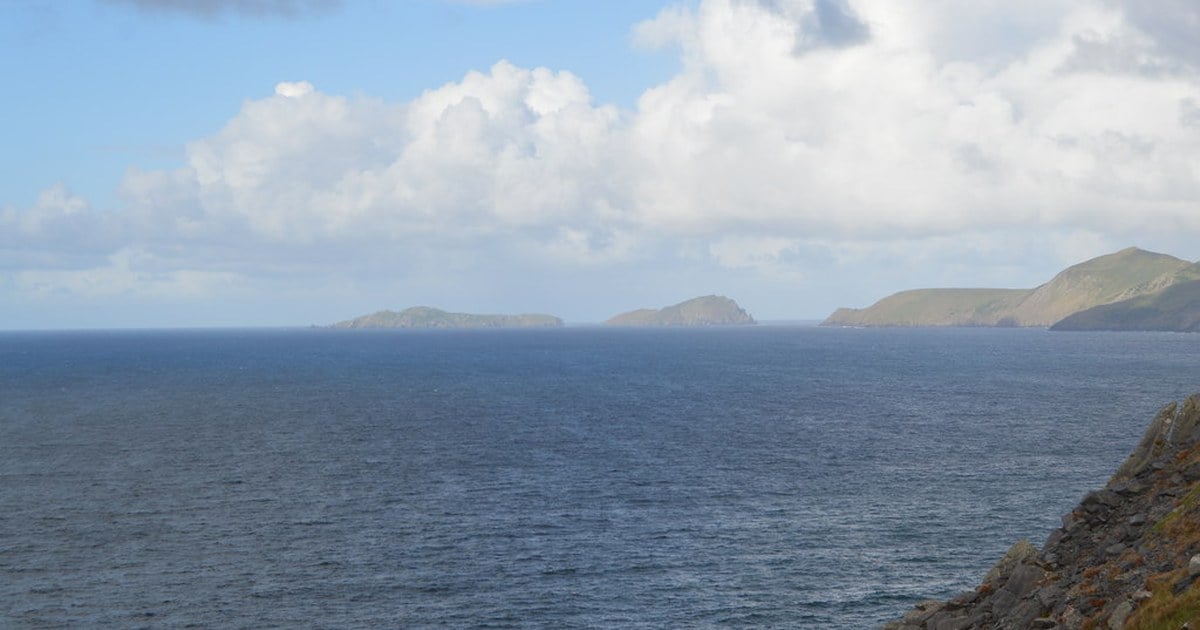
‘The Like of Us Will Never Be Again’: The Last Days of the Great Blasket Island
In 1929, a fisherman named Tomás Ó Criomhthain finished writing a book. He was a self-taught man who had spent his life on a small island three miles off the Kerry coast, and the project had taken years of encouragement from a rotating cast of visiting scholars who kept crossing the water to find him and telling him that the life he was living was worth recording. He didn’t need much convincing. He already understood what was coming.
The last lines of An tOileánach — published in Irish in 1929 and translated into English as The Islandman five years later — have been quoted ever since: “I have written minutely of much that we did, for it was my wish that somewhere there should be a memorial of it all, and I have done my best to set down the character of the people about me so that some record of us might live after us, for the like of us will never be again.”
He was right. Twenty-four years after Ó Criomhthain wrote those words, the Irish government removed the last residents of the Great Blasket Island from their homes. Not in a crisis. Not after a disaster. The remaining islanders — a small, dwindling community that had watched its young people leave for decades — wrote to Taoiseach Éamon de Valera and asked to go.
The government agreed. The island has been uninhabited ever since.
A Place That Scholars Kept Finding
The Great Blasket sits in the Atlantic off the tip of the Dingle Peninsula in County Kerry. It is not a small island by Irish standards, roughly five kilometres long, but getting on and off it has always been an act of faith. The seas are unpredictable. Boats could not always get through. The community that lived there spoke Irish as their first and only language — not unusual in the nineteenth century, but remarkable by the twentieth, and increasingly rare as the decades went on.
The scholars came, and kept coming. A visiting linguist named Carl Marstrander arrived in 1907 to study the dialect. The scholar Robin Flower became a regular presence, developing a deep relationship with the island over many years. George Thomson, a Cambridge academic who specialised in ancient Greek, showed up and fell in love with the place, eventually learning Irish himself. They were not sightseers. They understood that something was ending, and they wanted to see it whole before it did.
What we know, looking back, is that this pattern of scholarly visitation set off a chain of literary events that nobody on the island could have entirely anticipated — and that nobody who studies twentieth-century Irish writing would dream of ignoring now.
Three Books That Should Not Exist
A man from Killarney named Brian Ó Ceallaigh began corresponding with Tomás Ó Criomhthain. He sent him books — Maxim Gorky, the Russian writer who had built a career documenting the lives of ordinary working people; Pierre Loti, the French novelist whose work drew on seafaring communities. He told Ó Criomhthain: you should write like that. Write about your own life. Write about the island.
Ó Criomhthain did. He sent his daily letters and observations to Ó Ceallaigh, who forwarded them to the Irish-language editor Pádraig ‘An Seabhac’ Ó Siochfhradha for shaping and publication. The result was first Allagar na hInise (Island Cross-Talk), published in 1928, and then An tOileánach in 1929. Robin Flower translated the latter into English as The Islandman, published in 1934. It remains in print. The closing line — “for the like of us will never be again” — has become one of the most widely quoted phrases in Irish literature.
Then came Muiris Ó Súilleabháin. George Thomson, the Greek professor who had learned Irish partly in order to read the island’s oral literature, persuaded him to write his memoirs. Thomson prepared a basic translation into English himself; the scholar Moya Llewelyn Davies polished the prose. Fiche Bliain ag Fás — Twenty Years a-Growing in English — was published simultaneously in both languages in 1933. Oxford University Press has kept the English edition in print for decades.
And then Peig Sayers, who could not read or write Irish at all.
Peig had come to the Great Blasket as a young woman after marrying into it, and by the time scholars were documenting the island she was its most celebrated storyteller — someone of extraordinary oral fluency, capable of holding any room for hours in a tradition that stretched back through generations. She could not write her story down. So she dictated it to her son, Mícheál Ó Gaoithín, who transcribed it by hand. Máire Ní Chinnéide, a Dublin teacher who visited the island regularly, edited the transcription and prepared it for publication. Peig appeared in Irish in 1936. Bryan MacMahon’s English translation, with an introduction by Eoin McKiernan, followed in 1974.
Three autobiographies. From the same small island. Within less than a decade of each other. All of them the product of outsiders who grasped, before the islanders fully did, what was about to disappear — and who persuaded the islanders to record it themselves before it did. The books exist because visitors recognised an ending and decided the right response was to ask the people living through it to describe what it felt like.
The Death That Changed Everything
By the 1940s the Great Blasket was already emptying. Emigration had been pulling the young off the island for years — to the mainland, to Springfield, Massachusetts, where a substantial community of former islanders had settled. The people who remained were fewer and increasingly isolated, dependent on a ferry connection that Atlantic weather could cut for weeks at a stretch.
On 9 January 1947, a young man named Seán Carney died of meningitis on the island. He was twenty-four years old.
No doctor could reach the island. No priest could reach the island. His brother Michael Carney — who would later write his own memoir, From the Blasket to America — put it plainly: “My younger brother Seán died on 9 January 1947, at age of just twenty-four.” Accounts of that period describe a community that had been holding on through sheer will, and that, with this one unrescuable death, stopped wanting to hold on. The isolation had always been a fact of life on the Blasket; now it was something else. It was a reason to leave.
Michael Carney petitioned Taoiseach de Valera. He asked for the remaining islanders to be moved to the mainland.
It would take six more years for the evacuation to happen.
The Government Decision
The Irish government’s official position, when the evacuation finally came in 1953, was precise and somewhat bureaucratic in its phrasing: the government had decided “that it could no longer guarantee the safety of the remaining but rapidly declining population.” That word guarantee is doing a great deal of work. The islanders had never been guaranteed safety before. What had changed was that the state had accepted the responsibility — and now, formally, acknowledged that it could not meet it.
The Irish Land Commission sent an official named Dan O’Brien to handle the logistics. He reportedly went ashore under difficult sea conditions to obtain the necessary signatures. In November 1953, the last residents of the Great Blasket Island left.
For the full account of that final morning, see The Last People to Leave the Great Blasket Island.
There was no single dramatic moment of forced removal — just the completion of a process that had been set in motion by a young man’s death in a January storm six years earlier, and before that by the slow departure of a generation, and before that by the particular arithmetic of island life, where a community needs to stay above a certain size to function, and the Blasket’s had not done that for a very long time.
What the Island Wrote, and What It Left
We tend to reach for tragedy when we tell this story, and it is not wrong, exactly, to find grief in it. A living language community, a fishing culture, a way of life shaped by the Atlantic over centuries — all of it gone within living memory. The roofless stone houses are still visible on the hillside, and the silence around them is real.
But the Great Blasket’s story is also something rarer: a place that knew what it was losing and documented it, carefully and in its own words, while there was still time. Tomás Ó Criomhthain wrote in 1929 what translates from Irish as: “One day there will be none left in the Blasket of all I have mentioned in this book — and none to remember them.” He was writing that sentence while people were still living around him, while children were still being born on the island, while the community still had decades left. He was not writing elegy. He was writing prophecy, in the only form available to him — literature.
The Great Blasket Centre now stands on the mainland at Dún Chaoin, dedicated to the island’s history and the community that lived there. During the summer months it is possible to cross the water by boat and walk among the ruins. The three books — An tOileánach, Fiche Bliain ag Fás, Peig — are still in print, still studied, still argued about. Ó Criomhthain, Ó Súilleabháin, and Sayers wrote them in a language that was itself in decline, about a place that was already disappearing, at the prompting of scholars who came from the outside world to find something worth preserving.
That is the surprising thing, in the end. Not that the island was evacuated — that was probably inevitable. But that the people who lived there left behind a body of work substantial enough to anchor an entire strand of Irish literary culture. They wrote it down. They knew it mattered. They were right.
The Blasket Islands rest off the Kerry coast, most clearly visible on the kind of still Atlantic evening when the light stays long and the water goes flat. Whatever else they are now — protected, uninhabited, visited by boat in summer — they remain the place that produced three of the most closely observed documents of Irish life ever written. For a community that spent its final decades asking to be remembered, that is not a bad outcome.
☘️ Join 64,000+ Ireland Lovers
Every weekday morning, get Ireland’s hidden gems, local secrets, and travel inspiration — the kind you won’t find in any guidebook.
Subscribe free — enter your email:
Get the free guide
Enter your email and we will send you straight to the download.
📲 Know someone who’d love this? Share on WhatsApp →
Love more? Join 43,000 Scotland lovers → · Join 29,000 Italy lovers → · Join 7,000 France lovers →
Free forever · Unsubscribe anytime
Tours & experiences you might love


Powered by Viator. Some links are affiliate links — we may earn a small commission at no extra cost to you.
Secure Your Dream Irish Experience Before It’s Gone!
Planning a trip to Ireland? Don’t let sold-out tours or packed attractions spoil your journey. Iconic experiences like visiting the Cliffs of Moher, exploring the Rock of Cashel, or enjoying a guided walk through Ireland’s ancient past often sell out quickly—especially during peak travel seasons.

Booking in advance guarantees your place and ensures you can fully immerse yourself in the rich culture and breathtaking scenery without stress or disappointment. You’ll also free up time to explore Ireland’s hidden gems and savour those authentic moments that make your trip truly special.
Make the most of your journey—start planning today and secure those must-do experiences before they’re gone!