

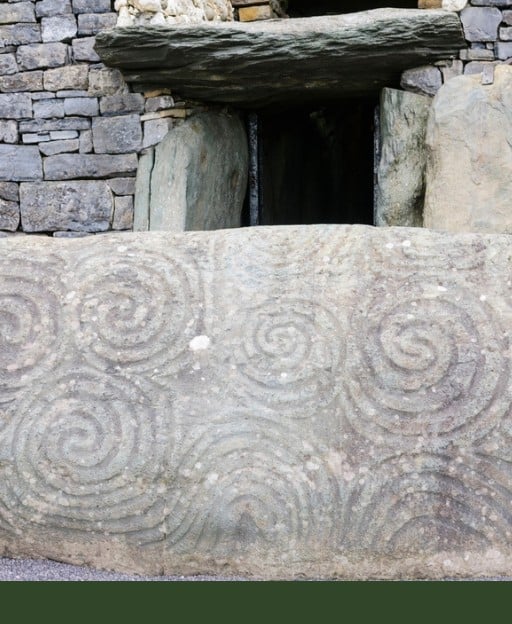
The triple spiral is a 5,200-year-old Celtic symbol carved into the entrance stone at Newgrange in County Meath. It is one of the oldest religious symbols in the world, predating the Egyptian pyramids by around 500 years. The symbol shows three interlocking spirals that radiate from a single centre point. Scholars believe it represented the cycle of life, death, and rebirth to the people who built Ireland’s passage tombs.
What Is the Triple Spiral?
The triple spiral — known in Irish as the triskelion — is a symbol made of three connected spirals flowing outward from a single point. Kerbstone 1, the large stone at the entrance to the Newgrange passage tomb in County Meath, carries the most famous example. Neolithic people carved this stone somewhere between 3,200 and 3,000 BCE. The carving measures roughly 40 centimetres across.
Unlike many ancient symbols where meaning is pure guesswork, the triple spiral at Newgrange sits in a very specific context. Builders designed the tomb so that sunlight enters only during the winter solstice, illuminating the interior chamber for exactly 17 minutes. This deliberate astronomical alignment strongly suggests the symbol had something to do with the movement of the sun, the seasons, and the cycle of death and renewal.
The Irish triple spiral is not the same as the triskelion in Manx heraldry or on the Sicilian flag, though all three are related. The Irish version at Newgrange is the oldest and most complete, and it became the ancestor of the Celtic knotwork tradition that spread across Europe over the following millennia.
Where to See the Triple Spiral in Ireland
The original and most significant example stands at Newgrange. UNESCO listed the site in 1993 as a World Heritage Site, along with the nearby passage tombs at Knowth and Dowth. The Brú na Bóinne Visitor Centre opens to visitors year-round, and adult admission ranges from €10 (Newgrange Tour + Exhibition, outside peak season) up to €18 for the full Brú na Bóinne Tour with Newgrange Chamber access (27 February–5 November). Winter solstice entry runs by lottery only — recent draws have seen anywhere from around 16,000 to 30,000 entries competing for only a few dozen places inside the chamber across the five solstice-week dawns.
Here are the best places to see the triple spiral and related Celtic spiral art across Ireland:
- Newgrange, County Meath — The original. Kerbstone 1 at the entrance carries the most famous tri-spiral in existence. The passage tomb interior also has triple spirals on the back wall of the central chamber.
- Knowth, County Meath — Part of the same Brú na Bóinne complex, Knowth holds more megalithic art than any other site in Europe. Neolithic carvers decorated its kerbstones with spirals, chevrons, and lozenges.
- The National Museum of Ireland, Dublin — The Ardagh Chalice and Tara Brooch, on display at the National Museum of Ireland: Archaeology on Kildare Street, show how the spiral tradition evolved into Celtic metalwork. Entry is free.
- Clonmacnoise, County Offaly — The high crosses at this 6th-century monastic site blend the Christian cross with the older Celtic spiral tradition. Conservators moved the original crosses inside to protect them from weather; replicas stand outside.
- The Rock of Cashel, County Tipperary — The 12th-century Romanesque carvings here show Celtic spirals integrated into Christian architecture, demonstrating how the symbol moved from prehistoric to medieval Ireland.
What Does the Triple Spiral Mean?
Nobody alive today can say with certainty what the triple spiral meant to the Neolithic people who carved it at Newgrange. They left no written records. Archaeologists can look at the context, the mathematics, and the physical structure of the sites where the symbol appears, and draw reasonable conclusions.
The most widely accepted interpretation holds that the three spirals represent the three great cycles that ancient Irish people observed in the natural world: the three phases of the moon, the three seasons of the Neolithic calendar (growth, harvest, and winter), and the progression from birth through life to death. The symbol sits at the entrance to a tomb aligned with the winter solstice light — the day light begins to return — which strongly supports a meaning connected to renewal after death.
Later Celtic tradition expanded the meaning further. By the time of the La Tène culture, which flourished in Ireland between roughly 300 BCE and 100 CE, the triple spiral had become associated with three connected realms: the land, the sea, and the sky. In early Irish mythology, these are the three domains that the Tuatha Dé Danann divide among themselves when they retreat beneath Ireland’s hills and lakes. The triple spiral, in this reading, is a map of the universe as ancient Irish people understood it.
When Christianity arrived in Ireland in the 5th century CE, the triple spiral gained a new layer of meaning. Missionaries and monks saw in the three spirals a natural image for the Holy Trinity — Father, Son, and Holy Spirit. This made it easier to bring the older symbol into a Christian framework. That is why spiral motifs appear in the Book of Kells, the illuminated gospel manuscript created around 800 CE and now held at Trinity College Dublin. The monks did not invent the symbol — they adopted it because it already carried deep meaning for the people they converted.
The Triple Spiral Versus Other Celtic Spirals
☘️ Enjoying this? 64,000+ Ireland lovers get stories like this every week. Subscribe free →
Ireland’s ancient stonework contains several different spiral forms. It is worth knowing what makes each one distinct:
- Single spiral — The simplest form, found on many Neolithic stones. It represents movement and the passage of time, and scholars often connect it to the sun’s daily journey across the sky.
- Double spiral — Two spirals joined at the centre. Kerbstone 1 at Newgrange also carries a double spiral alongside the triple. Many scholars connect it to the two solstices — the longest and shortest days of the year.
- Triple spiral (tri-spiral) — Three spirals joined together, the most complex form. This is the one most closely tied to Newgrange and to Irish Celtic heritage broadly.
- Running spiral — A wave-like series of connected spirals that appears on Bronze Age pottery and metalwork, particularly between 1,500 and 500 BCE.
- Celtic knotwork spirals — These appear from around 300 BCE onward. Unlike earlier megalithic spirals, they have no beginning and no end, symbolising eternity. They became the basis for the illuminated manuscript tradition in Irish monasteries.
Why the Triple Spiral Still Matters in Irish Culture Today
The triple spiral never disappeared. It runs continuously through Irish artistic and cultural life across more than 5,000 years, and today it appears on Irish passports, on the signage of heritage organisations, and in the work of jewellers and craftspeople across the country.
For the Irish diaspora — the estimated 70 million people worldwide with Irish ancestry — the triple spiral has become one of the most recognisable markers of Celtic heritage. It appears in Irish-American family crests, in tattoo culture, and in the logos of Irish organisations from Boston to Sydney. The symbol carries a specific emotional weight for people of Irish descent because it connects them to a lineage stretching back not just to the Famine generation of the 1840s, or the great wave of emigration in the 18th century, but to people who built astronomical monuments in Ireland 2,000 years before Rome existed as a city.
Modern Irish jewellers frequently use the triple spiral in gold and silver work. Shops throughout the Brú na Bóinne visitor centre and in Dublin’s cultural quarter sell handcrafted pieces inspired directly by the Newgrange carvings. Many Irish diaspora visitors travel to Newgrange specifically because they have worn a triple spiral pendant or ring for years and want to stand in front of the original stone that inspired it.
The Archaeology Behind the Symbol
The carving of the triple spiral at Newgrange was not a casual act. Kerbstone 1 — the entrance stone — is one of 97 kerbstones that form the outer ring of the passage tomb. Archaeologist Michael J. O’Kelly led the first systematic excavation of Newgrange between 1962 and 1975. He documented the carvings in detail and identified the technique the carvers used: pecking with a hard stone tool, probably flint or quartzite, to slowly abrade the softer limestone surface. The spirals at the entrance show clear advance planning — O’Kelly found faint guidelines scratched into the stone beneath the finished carvings.
O’Kelly’s work also confirmed the alignment of the passage tomb with the winter solstice sunrise. He published his findings in 1982 in Newgrange: Archaeology, Art and Legend, which remains the definitive academic study of the site. The passage points at exactly 136.8 degrees — the precise bearing of the winter solstice sunrise as it appeared from that location around 3,200 BCE, accounting for the slight change in Earth’s axial tilt over five millennia.
This level of precision tells us that the people who built Newgrange were sophisticated astronomers. They had no metal tools, no writing, and no wheels. The triple spiral they carved at the entrance was not decoration — it was the central statement of what the monument meant.
Planning Your Visit to Newgrange
Newgrange sits in the Boyne Valley in County Meath, approximately 50 kilometres north of Dublin. Here is the practical information you need:
- Getting there — Drive from Dublin via the M1 motorway north, then the N51 toward Drogheda. The Brú na Bóinne Visitor Centre sits just outside the village of Donore. Several coach tours depart daily from Dublin city centre if you prefer not to drive.
- Opening hours — Hours shift by season: 9am–5:45pm from May to September, 9:30am–4:45pm in March and April, and 9am–4:15pm from January–February and October–December. The site is closed 24–27 December and 1 January.
- Tickets — Adults pay from €10 up to €18 depending on season and tour type, with discounted rates for students, seniors, and children. Every visitor, including infants, needs a ticket — there is no free entry for young children. Book online in advance, especially in July and August when morning slots fill quickly.
- The tour — Visitors travel by shuttle bus from the visitor centre to the monument. Tours inside the passage take approximately 30 minutes. The entrance stone with the triple spiral sits in full view from outside the mound, so you can see the symbol without entering the passage.
- Winter solstice lottery — Entry to the chamber at dawn on 19–23 December runs by annual lottery. Applications open each autumn at worldheritageireland.ie. Recent draws have seen anywhere from roughly 16,000 to 30,000 entries competing for only a few dozen places across the five solstice-week mornings. For more on the astronomical engineering behind the alignment itself, see our guide to Newgrange’s winter solstice sunrise.
Whether you visit in summer sunshine or on a grey November day, standing in front of Kerbstone 1 and looking at the triple spiral carved by a Neolithic hand 5,200 years ago is one of the genuinely moving experiences Ireland offers. It is the oldest artistic symbol in continuous cultural use on the island, and it connects every visitor to the very beginning of what it meant to live, think, and build here.
What does the triple spiral symbol mean in Irish culture?
The triple spiral at Newgrange is believed to represent the cycle of life, death, and rebirth. The three spirals connect to the three phases of the sun (sunrise, midday, and sunset), the three seasons of the Neolithic Irish calendar, and later the three realms of Celtic cosmology — land, sea, and sky. When Christianity arrived in the 5th century CE, the triple spiral also became linked to the Holy Trinity.
How old is the triple spiral at Newgrange?
Neolithic carvers created the triple spiral at Newgrange between approximately 3,200 and 3,000 BCE, making it around 5,200 years old. This predates the Egyptian pyramids at Giza by roughly 500 years and makes it one of the oldest known religious symbols in the world.
Where can I see the triple spiral in Ireland?
The most famous triple spiral sits on Kerbstone 1 at the entrance to Newgrange in County Meath, part of the UNESCO World Heritage Site of Brú na Bóinne. You can also find related spiral carvings at Knowth (also part of Brú na Bóinne), at the National Museum of Ireland in Dublin, on the high crosses at Clonmacnoise in County Offaly, and throughout the Book of Kells at Trinity College Dublin.
Is the triple spiral the same as the triskelion?
People often use the terms interchangeably, but they refer to slightly different things. The triskelion is a broader category of three-legged or three-armed rotational symbols found across many cultures. The Irish triple spiral specifically refers to the Neolithic form at Newgrange, where three spirals join at a central point. The Irish version is the oldest and the ancestor of the broader triskelion tradition in European art.
☘️ Join 64,000+ Ireland Lovers
Every weekday morning, get Ireland’s hidden gems, local secrets, and travel inspiration — the kind you won’t find in any guidebook.
Subscribe free — enter your email:
📲 Know someone who’d love this? Share on WhatsApp →
Love more? Join 43,000 Scotland lovers → · Join 29,000 Italy lovers → · Join 7,000 France lovers →
Free forever · Unsubscribe anytime
Tours & experiences you might love


Powered by Viator. Some links are affiliate links — we may earn a small commission at no extra cost to you.
Secure Your Dream Irish Experience Before It’s Gone!
Planning a trip to Ireland? Don’t let sold-out tours or packed attractions spoil your journey. Iconic experiences like visiting the Cliffs of Moher, exploring the Rock of Cashel, or enjoying a guided walk through Ireland’s ancient past often sell out quickly—especially during peak travel seasons.

Booking in advance guarantees your place and ensures you can fully immerse yourself in the rich culture and breathtaking scenery without stress or disappointment. You’ll also free up time to explore Ireland’s hidden gems and savour those authentic moments that make your trip truly special.
Make the most of your journey—start planning today and secure those must-do experiences before they’re gone!