

Ask someone this question and watch them pause. They will run through a mental map — Dublin, Galway, Cork — and realise quickly that they do not actually know. It is one of those questions that sounds simple but requires you to think seriously about how Ireland is laid out on the page.
The answer comes down to geography. Counties along Ireland’s long, ragged coastline naturally share fewer borders, because the Atlantic Ocean or the Irish Sea does part of the boundary work for them. Landlocked counties, by contrast, have to share a border in every direction.
So which county wins — or loses, depending on how you look at it? The answer is Kerry — the only county in Ireland with just two neighbouring counties. The runner-up, Down, isn’t far behind with three.
Enjoy stories like this?
Join thousands of readers who get the best of Ireland delivered to their inbox every week. Subscribe free to the Love Ireland newsletter.
Why Kerry Has Just Two Neighbouring Counties
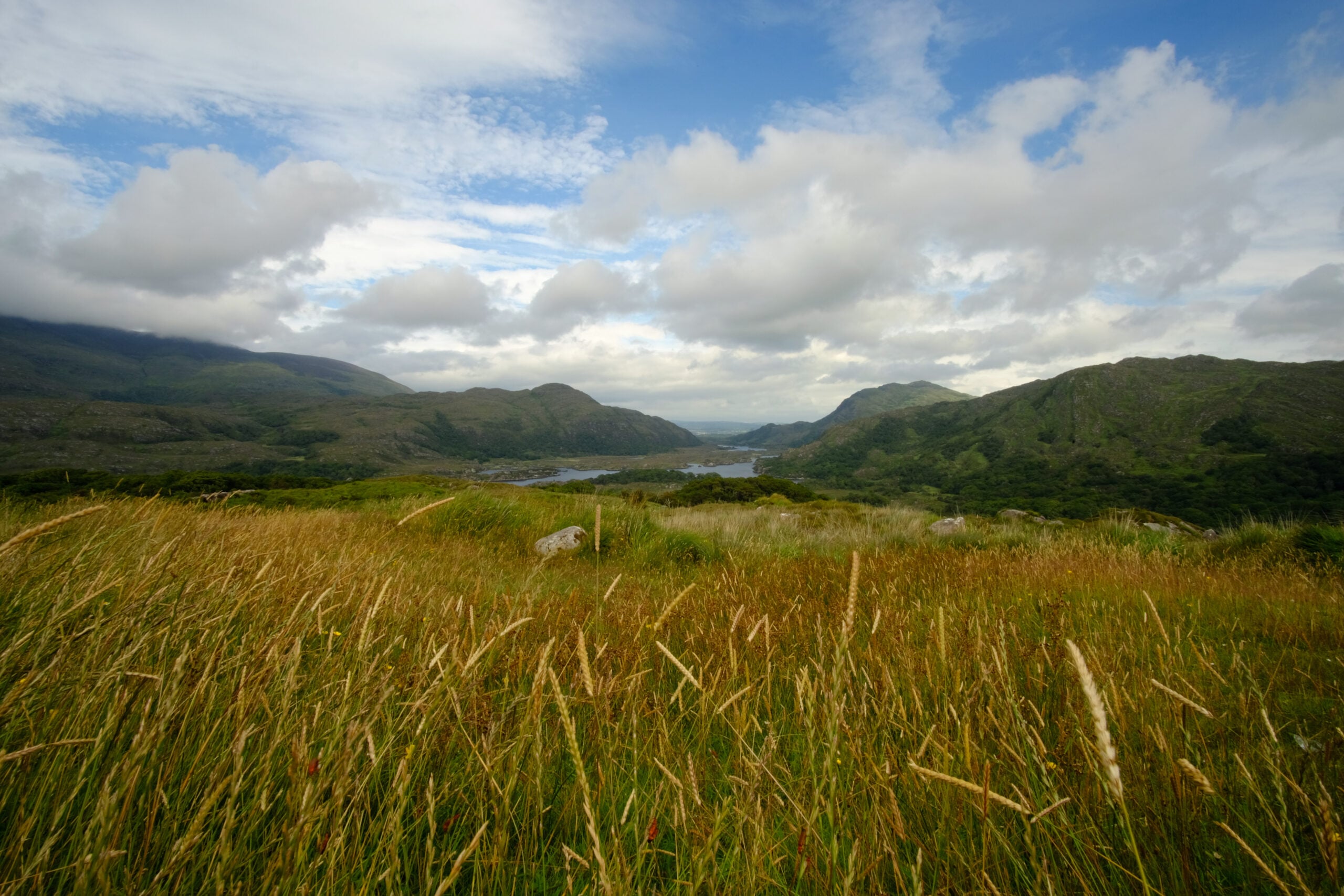
Kerry is one of Ireland’s most recognisable counties, known for the Ring of Kerry, the Dingle Peninsula, and the Skellig Islands. But look at it on a map and you will notice something unusual: it is almost entirely surrounded by water.
The Atlantic Ocean borders Kerry to the west and south. Tralee Bay and the Shannon Estuary sit to the north. That leaves only two land borders:
- Cork to the east and southeast
- Limerick to the northeast
That is it. For a county of Kerry’s size — the largest in Munster and the fifth largest in Ireland by area — having only two neighbours is remarkable. It is a consequence of the two great peninsulas that reach out into the Atlantic: the Iveragh Peninsula (home to the Ring of Kerry) and the Dingle Peninsula. Together they create hundreds of kilometres of coastline, leaving Kerry almost no room to share land borders.
If you drive into Kerry, you enter either from Cork on the N22 through Killarney, from Limerick over the mountains on the N21, or on the N23 further south. Every other direction is sea.
Down: Not Far Behind, With Three Neighbours
County Down, in Northern Ireland, comes close behind Kerry with three neighbouring counties. It is bounded on multiple sides by water:
- The Irish Sea to the east
- Strangford Lough to the east and centre (a large sea inlet)
- Carlingford Lough to the south, which Down shares with County Louth in the Republic
Down’s three neighbouring counties are Armagh to the southwest and west, Antrim to the north, and Louth, across Carlingford Lough to the south.
Like Kerry, Down’s shape on the map is dominated by water. The Ards Peninsula in the east stretches down into the Irish Sea. The Mourne Mountains rise in the south. The result is a county of considerable size that still borders just three of its neighbours.
Down is home to Bangor, Newry, Downpatrick (the traditional burial place of St Patrick), and the coastal town of Newcastle at the foot of the Mournes. Its limited number of borders does nothing to limit what it contains.
Other Counties With Few Neighbours
Kerry is the outright winner, but a group of six counties — including Down, above — tie for second place with three neighbouring counties each.
Clare borders Galway, Tipperary, and Limerick. The Shannon River forms a natural boundary to the south and east, while the Atlantic and Galway Bay handle the rest. Clare feels like a county reaching out into the ocean — Doolin, the Cliffs of Moher, and Loop Head sit at the far western edge of Europe.
Dublin borders just three counties: Meath to the north, Kildare to the west, and Wicklow to the south. The Irish Sea accounts for its entire eastern boundary. Despite being the smallest county in Ireland by area, its coastal position limits its land borders to just three.
Mayo also has three neighbours: Sligo to the northeast, Roscommon to the east, and Galway to the south. Mayo has one of the longest and most dramatic coastlines in Ireland — Achill Island, Clew Bay, and the cliffs at Downpatrick Head — and all of that coastline means fewer land borders to count.
Waterford rounds out the three-neighbour group, bordered by Kilkenny, Tipperary, and Wexford, with the rest of its boundary formed by the Celtic Sea and Waterford Harbour.
Sligo also has three neighbours: Mayo to the west, Roscommon to the south, and Leitrim to the northeast. As with the others in this group, a long Atlantic coastline and Donegal Bay account for the rest of its boundary.
Enjoy stories like this?
Join thousands of readers who get the best of Ireland delivered to their inbox every week. Subscribe free to the Love Ireland newsletter.
Which County Has the Most Neighbours?
The opposite end of the scale is equally worth knowing. Tipperary holds the record for the most neighbouring counties in Ireland, sharing borders with eight others:
- Cork (south)
- Waterford (southeast)
- Kilkenny (east)
- Laois (northeast)
- Offaly (north)
- Galway (northwest)
- Clare (west)
- Limerick (southwest)
This is a direct consequence of Tipperary’s position at the centre-south of the island. It has no coastline and sits at the crossroads of Munster and Leinster, which means that almost every direction brings you to a different county. The old song “It’s a Long Way to Tipperary” captured the county’s reputation for being central and seemingly unreachable — surrounded on all sides, far from the coast.
Despite having no coastline of its own, Tipperary has plenty to see — from the Rock of Cashel to the Glen of Aherlow. See our complete guide to County Tipperary for more.
Other well-connected counties include Galway (five neighbours: Mayo, Roscommon, Offaly, Tipperary, and Clare), Fermanagh in Northern Ireland (six neighbours: Tyrone, Leitrim, Cavan, Monaghan, Armagh, and Donegal), and Meath (seven neighbours).
A Quick Summary of County Border Counts
Here is how the 32 counties of Ireland break down by number of neighbours:
Two neighbours — fewest on the island: Kerry
Three neighbours: Clare, Down, Dublin, Londonderry/Derry, Mayo, Sligo, Waterford
Four to five neighbours: Antrim, Carlow, Cork, Donegal, Galway, Kilkenny, Limerick, Longford, Louth, Wexford, Wicklow
Six to seven neighbours: Armagh, Cavan, Fermanagh, Kildare, Laois, Leitrim, Meath, Monaghan, Offaly, Roscommon, Tyrone, Westmeath
Eight neighbours — most on the island: Tipperary
What the Map Tells You About Ireland
There is something worth pausing on here. The counties with the fewest neighbours tend to be the ones that feel most distinctly themselves — geographically set apart, strongly connected to the sea, and with a clear sense of local identity that does not blur easily into surrounding counties.
Kerry is the obvious example. The Ring of Kerry, the Dingle Peninsula, Killarney and its lakes — these places feel like a world apart, not just culturally but physically. The fact that Kerry only touches two other counties on the map is part of the reason for that feeling. If you are in Kerry, you are far from almost everywhere else in Ireland.
Down, similarly, sits at Ireland’s northeastern corner with the Irish Sea on one flank and the Mourne Mountains along its southern edge. It is defined as much by its relationship with the water as with any land neighbours.
Tipperary’s eight borders, by contrast, make it a county of connections — a meeting point where roads, rivers, and traditions from across Munster and Leinster converge. That is a different kind of character, and no less interesting for it.
The shape of the island, the position of the mountain ranges, the course of the River Shannon, the way the Atlantic has carved deep into the western counties — all of these forces are written into the map through the simple act of counting borders.
So now you know. Kerry stands alone with just two neighbours, Down and five others follow close behind with three each, and all that water does the rest of the work.
If you enjoyed this, you might also like our look at what shape Ireland actually is and what a straight line across the island would pass through.
Enjoy stories like this?
Did you know? Below the county level, Ireland is divided into around 60,000 townlands — the smallest and oldest units of Irish geography. If you have Irish ancestry, there’s a good chance your family’s records are filed under a specific townland. See our Irish Townlands Ancestry Research Guide to find yours.
Join thousands of readers who get the best of Ireland delivered to their inbox every week. Subscribe free to the Love Ireland newsletter.
☘️ Join 64,000+ Ireland Lovers
Every weekday morning, get Ireland’s hidden gems, local secrets, and travel inspiration — the kind you won’t find in any guidebook.
Subscribe free — enter your email:
📲 Know someone who’d love this? Share on WhatsApp →
Love more? Join 43,000 Scotland lovers → · Join 29,000 Italy lovers → · Join 7,000 France lovers →
Free forever · Unsubscribe anytime
Tours & experiences you might love


Powered by Viator. Some links are affiliate links — we may earn a small commission at no extra cost to you.
Secure Your Dream Irish Experience Before It’s Gone!
Planning a trip to Ireland? Don’t let sold-out tours or packed attractions spoil your journey. Iconic experiences like visiting the Cliffs of Moher, exploring the Rock of Cashel, or enjoying a guided walk through Ireland’s ancient past often sell out quickly—especially during peak travel seasons.

Booking in advance guarantees your place and ensures you can fully immerse yourself in the rich culture and breathtaking scenery without stress or disappointment. You’ll also free up time to explore Ireland’s hidden gems and savour those authentic moments that make your trip truly special.
Make the most of your journey—start planning today and secure those must-do experiences before they’re gone!