

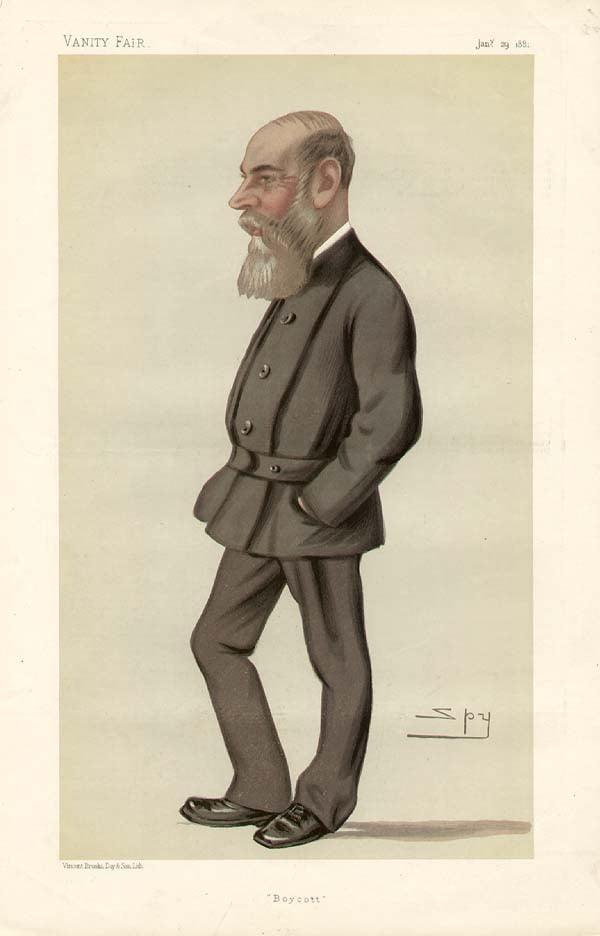
Captain Boycott: The Man Who Accidentally Gave His Name to Every Language on Earth
In French it is boycotter. In Russian, boĭkottīrovat. In German, boycottiren. In Japanese, boikotto. One word, drawn from one man’s surname, absorbed into nearly every written language on earth within a generation of the events that created it. The speed of its adoption was, one contemporary observer noted, remarkable even in the age of the telegraph.
That word is boycott. And it leads directly to one man — a retired British Army officer named Captain Charles Cunningham Boycott — and to two extraordinary months on a Mayo estate in 1880 that nobody present would ever fully recover from, including the English language itself.
A Captain With a Flair for the Petty
Charles Boycott was born on 12 March 1832 in Burgh St Peter, Norfolk, the son of an Anglican rector. His family was of Huguenot descent — Protestant refugees who had fled France in 1685 — and had carried the surname “Boycatt” until Charles was nine, when the family upgraded the spelling to “Boycott.” Nobody could have known how significant that one altered vowel would become.
His military career was unremarkable. He entered the Royal Military Academy at Woolwich in 1848, was discharged the following year after failing an exam, then purchased a commission in the 39th Foot regiment for £450. He served in Belfast, Newry, and Dublin before selling up in 1853. He had, by this point, discovered something he liked more than soldiering: Ireland.
In 1854, Boycott moved to Achill Island on Mayo’s Atlantic coast, subleasing land from the Irish Church Mission Society and farming it for seventeen years. He was not, by most accounts, a man who gave much thought to the feelings of those beneath him. His biographer Joyce Marlow described him as someone who believed in “the divine right of the masters,” given to imposing excessive fines for minor infractions and treating his tenants with the casual contempt that seemed to come naturally to a certain kind of Victorian Englishman abroad.
By 1873, he had moved east to the mainland, taking up residence at Lough Mask House near the village of The Neale, and accepting work as land agent for John Crichton, the 3rd Earl of Erne. The arrangement was financially comfortable: Boycott earned £500 a year, a 10 percent cut of all rents collected on the Earl’s 1,500-acre estate. His job, in plain terms, was to collect money. That job was about to become very complicated.
The Land Was the Problem
To understand what happened next, you need to understand how Irish land worked in 1880. Most of Mayo’s farming families did not own the land they worked. They rented it from absentee English landlords — in this case, the Earl of Erne, who sat comfortably in Fermanagh while Boycott managed his Mayo affairs. These tenants had no security of tenure, no right to compensation for improvements they made to the land, and no meaningful ability to resist rent increases.
The late 1870s had been catastrophic. Harvests failed repeatedly. Families that had been clinging on were now falling off the edge. Into this crisis stepped Michael Davitt and his Irish National Land League, established in 1879, which had three demands: fair rent, fixity of tenure, and free sale — the right for tenants to sell their interest in a farm when they left it. These became known as the Three Fs.
Charles Stewart Parnell, then building his extraordinary political career on Irish nationalism, was the Land League’s president. On 19 September 1880 — six weeks before the story of Lough Mask would make headlines around the world — Parnell delivered a speech in Ennis, County Clare, that set out the League’s strategy. He did not call for violence. He called for something more surgical.
“When a man takes a farm from which another has been evicted,” Parnell told the crowd, “you must shun him on the roadside when you meet him, you must show him your detestation of the crime he has committed by isolating him from the rest of his country, as if he were the leper of old.”
He did not yet have a word for this tactic. He would have one within days.
The Women of Lough Mask
The crisis at Lough Mask House began in September 1880. Lord Erne’s tenants, facing poverty after another failed harvest, asked for a 25 percent reduction in their rents. Lord Erne offered 10 percent. The tenants rejected this. Boycott, as agent, issued eviction notices against those who had fallen into arrears.
On September 22, a process-server arrived with RIC constables to formally serve the eviction papers. He was met by a crowd of local women who drove him off with stones, mud, and manure. The eviction notices were never served.
The following day, approximately 100 people arrived at Boycott’s farm and ordered his employees — his labourers, his herders, his house staff — to quit their work. They did. In the days that followed, the campaign spread beyond the farm. Shopkeepers in nearby Ballinrobe were warned not to supply Boycott. They refused his custom. The blacksmith declined to shoe his horses. The laundress turned away his linen. The postman became unreliable.
By early October, Boycott was effectively marooned inside his own estate. His crops were unharvested and rotting. His household could not obtain basic provisions. He could not move safely through the surrounding countryside. The campaign against him was not random or opportunistic — it was organised, sustained, and spreading.
The Dinner That Named It
On the evening of September 22 — the same day the process-server was pelted with manure — an American journalist named James Redpath sat down to dinner with Father John O’Malley, the parish priest of The Neale and president of the Ballinrobe branch of the Land League.
Redpath was not a typical foreign correspondent. He was a committed radical: an anti-slavery activist who had championed John Brown before the Civil War and helped make Mark Twain a household name as a lecture promoter. In 1880 he was in Ireland reporting simultaneously for the New York Tribune, the Chicago Inter-Ocean, and the Boston Pilot. He was the kind of journalist who arrived with a point of view and sharpened it on contact with events.
That evening, the conversation turned to what to call what was happening to Boycott. “Ostracise” was the obvious candidate — the ancient practice of social exclusion, named after the Athenian habit of writing names on pottery shards. But Father O’Malley had a practical objection. His parishioners, he pointed out, would never be able to remember “ostracise.” He needed something simpler. Something they already knew.
The priest looked at the journalist across the table. “How would it do,” he said, “to call it ‘to boycott him’?”
Redpath published the word in the Chicago Inter-Ocean on 12 October 1880. Two days later, Captain Boycott himself — apparently unaware that he was already a verb — sat down and wrote his famous letter to The Times of London.
The Letter That Brought the World to His Door
Boycott’s October 14 letter was, in retrospect, one of the more self-defeating pieces of Victorian public relations. His account of his predicament — written in the aggrieved tone of a man genuinely bewildered that the world was not arranging itself to his convenience — was vivid. “My blacksmith has received a letter threatening him with murder,” he wrote. His crops were “trampled upon, carried away in quantities, and destroyed wholesale.” No one would serve him. No one would work for him.
The letter’s effect was not quite sympathy. It was attention — and attention brought the story to an entirely different audience: Protestant Ulster.
The Dublin Daily Express proposed a relief fund on October 29. Newspapers including the Daily Telegraph and Daily News raised £2,000. A “Belfast Boycott Relief Fund” was established. The plan: send a party of volunteer labourers to harvest Boycott’s crops before winter destroyed them entirely. In early November 1880, approximately 50 men — mostly Orangemen from County Cavan and County Monaghan — boarded trains south to County Mayo. They came to harvest turnips.
£10,000 to Save £350 Worth of Crops
What greeted them in Mayo was the full machinery of the British state. The government deployed a regiment of the 19th Royal Hussars and more than 1,000 men of the Royal Irish Constabulary to protect the expedition. The whole operation lasted approximately two weeks.
The crops were saved. The final accounting was staggering. The expedition cost roughly £10,000 in government expenditure and private subscription, to rescue a harvest valued at approximately £350.
That ratio — 28 pounds spent for every pound recovered — was not lost on observers at the time. Nor was the spectacle: the British Army stretched across a Mayo estate, bayonets fixed, guarding Protestant volunteers as they pulled up the land agent’s turnips while Catholic families watched from the roads.
On November 27, 1880, the volunteers and their military escort departed. Captain Boycott, his wife, and a small party were escorted from Lough Mask House by members of the Hussars and taken to Claremorris railway station. On December 1, he and his wife left Ireland by the mail-boat to Holyhead.
He had been in County Mayo for less than a decade. He would not be forgotten for a very long time.
The Word Takes Over
By November 1880, the Birmingham Daily Post had noted the new usage. By the end of that year, The Illustrated London News was describing “to Boycott” as an active verb, glossing it as meaning both “send to Coventry” and “taboo.” By 1881, The Spectator was deploying it figuratively — one article described how nature had “Boycotted London from Kew to Mile End.”
The word crossed the Channel almost immediately. French newspapers adopted boycotter in 1880, the same year it was coined. Russian followed in 1891; German and Dutch in 1893. Japanese adopted boikotto. The pattern was consistent: a transliterated version of the English verb, its ending adapted for local grammar, arriving in each language without translation — because there was no other word that meant quite the same thing.
In 1888, just eight years after Father O’Malley’s dinner-table suggestion, the word was formally included in A New English Dictionary on Historical Principles, the work that would eventually become the Oxford English Dictionary.
Words coined from personal names — eponyms — are not uncommon in English. We have cardigan, wellington, and sandwich, all drawn from aristocratic titles. But almost all such eponyms are nouns. Boycott is something rarer: a proper noun that became a transitive verb, spread beyond English with unusual speed, and has remained in active use for nearly 150 years, its meaning essentially unchanged from the night a parish priest in Mayo invented it over dinner.
What Became of the Man Himself
In August 1881 — nine months after his flight to Holyhead — Boycott quietly returned to Lough Mask House. He still held the lease. The situation had calmed enough to make this possible, though his position in Mayo was permanently destroyed.
He held on until 1886, when he sold his interest in the farm to a local man named Bernard Daly of Ballinrobe and returned to England for good. There, he found work as land agent for Sir Hugh Adair’s estate at Flixton in Suffolk — a quieter posting, with fewer tenants inclined to pelt process-servers with manure.
He visited the United States in spring 1881, registering at hotels under the name “Charles Cunningham” to avoid attracting attention. The New York Tribune recognised him anyway. The man had become too famous — or too notorious — to disappear into an alias assembled from his own given names.
His later years were not prosperous. He developed a passion for horses and served as secretary of the Bungay race committee, which suggests a certain genteel English retirement. But early in 1897 he fell seriously ill. He took a cruise to Malta in hopes of recovering his health, became worse while in Brindisi, and was brought back to England. He died on 19 June 1897 in Flixton, Suffolk. He was 65 years old, and was described in reports of the time as a “technical bankrupt.” His widow Annie faced lawsuits over unpaid funeral expenses and debts.
The Lasting Arithmetic
There is a version of this story in which Boycott is the villain — the hard-faced English agent grinding down impoverished Irish tenants in the midst of a crisis that echoed the Famine within living memory. There is another version in which he is a minor functionary doing a legal job, crushed by a mass political campaign he had no tools to withstand. Both are probably partly true.
What is undeniable is the arithmetic. The tenants of Lough Mask, by withdrawing their labour and persuading their neighbours to do the same, forced the British Army to spend £10,000 protecting a turnip harvest worth £350. They mobilised more than 1,000 police officers. And they handed a Catholic parish priest and an American abolitionist journalist the raw material — over dinner, on the same evening the process-server was sent home covered in manure — to name a political tactic that would be used against empires and injustice on every continent for the next century and a half.
Boycott returned to England and died in debt. The word he left behind is still being conjugated in French and Russian and Japanese. In County Mayo, Lough Mask House still stands near the village of The Neale. The roads around it are quiet now. The harvest comes in without incident.
☘️ Join 64,000+ Ireland Lovers
Every weekday morning, get Ireland’s hidden gems, local secrets, and travel inspiration — the kind you won’t find in any guidebook.
Subscribe free — enter your email:
Get the free guide
Enter your email and we will send you straight to the download.
📲 Know someone who’d love this? Share on WhatsApp →
Love more? Join 43,000 Scotland lovers → · Join 29,000 Italy lovers → · Join 7,000 France lovers →
Free forever · Unsubscribe anytime
Tours & experiences you might love


Powered by Viator. Some links are affiliate links — we may earn a small commission at no extra cost to you.
Secure Your Dream Irish Experience Before It’s Gone!
Planning a trip to Ireland? Don’t let sold-out tours or packed attractions spoil your journey. Iconic experiences like visiting the Cliffs of Moher, exploring the Rock of Cashel, or enjoying a guided walk through Ireland’s ancient past often sell out quickly—especially during peak travel seasons.

Booking in advance guarantees your place and ensures you can fully immerse yourself in the rich culture and breathtaking scenery without stress or disappointment. You’ll also free up time to explore Ireland’s hidden gems and savour those authentic moments that make your trip truly special.
Make the most of your journey—start planning today and secure those must-do experiences before they’re gone!