

Wood Quay Dublin: The Viking City They Bulldozed to Build Council Offices
In the spring of 1974, a 25-year-old archaeologist named Pat Wallace was assigned to assess four acres of waterlogged ground beside the River Liffey, in the shadow of Christ Church Cathedral, before Dublin Corporation built its new headquarters there. The work was meant to be a preliminary survey — a box to tick before the concrete came down. He spent the next seven years on that plot instead.
What Wallace found was a Viking city layered twelve occupation levels deep, with more than 120 house foundations on Fishamble Street alone. The excavation became the largest urban dig ever undertaken in Europe. It revealed more about tenth- and eleventh-century urban life than any other site north of the Alps. And then, in 1981, the excavation ended. The civic offices went up. The most significant Viking dig in Europe was sealed under a government building that Dubliners still broadly dislike the look of, more than forty years later.
How this happened — and what was down there — is a story about a city that has been misidentifying itself for centuries.
The Black Pool
Before Dublin was a city, before it was a settlement, it was a geographical accident: a dark, tidal pool where the River Poddle joined the Liffey on the south bank. Irish speakers called it Dubh Linn — the black pool — referring to the colour of the water where the two rivers collided. The name is centuries older than the Vikings. It described a place, not a people.
The Norse noticed the pool for the same reason any seafaring people would: it was a natural harbour, sheltered, accessible, deep enough for longships. In 841 AD, according to the Irish annals, a Norse fleet established a longphort there — a fortified ship camp, compounded from the Latin for longship and harbour, which is exactly what it was. A place to overwinter, store plunder, and launch the following season’s raids without the long sail home to Scandinavia. Viking fleets had been working Ireland’s coastlines and rivers since the 790s; the longphort at Dubh Linn was an escalation from raiding to staying.
The Irish drove the Norse out in 902. But sixty-one years of occupation had established a pattern, and in 917 the Norse returned — this time not as raiders building a seasonal camp, but as settlers building a city. They brought with them something they had absorbed during years in northern England: the concept of urbanism. Tenements were staked out. Earthen banks went up. The population grew. And the black pool’s Irish name, worn smooth by daily use, became the name of the place itself. The Norse called it Dyflinn. We call it Dublin.
What Dyflinn Actually Was
By around the year 1000, the city the Norse had made from that tidal pool had become something that sits uncomfortably with the romantic image of axe-wielding seafarers. It was a commercial city, dense and purposeful, with a hinterland the Norse had named Dyflinnar skíði — Dublinshire, in modern terms. Historians describe it as the biggest slave market in western Europe.
That last fact tends to stop people. Archaeological excavations in Dublin have recovered iron shackles and slave chains — physical corroboration of what the written sources describe: Norse raiders systematically taking Irish captives and selling them at markets in Dyflinn, where buyers came from across the Viking world’s extraordinary reach, which ran from Iceland to the Byzantine empire. Dublin sat at the western pivot of that entire trading network. The slaves who weren’t sold locally were shipped on through it.
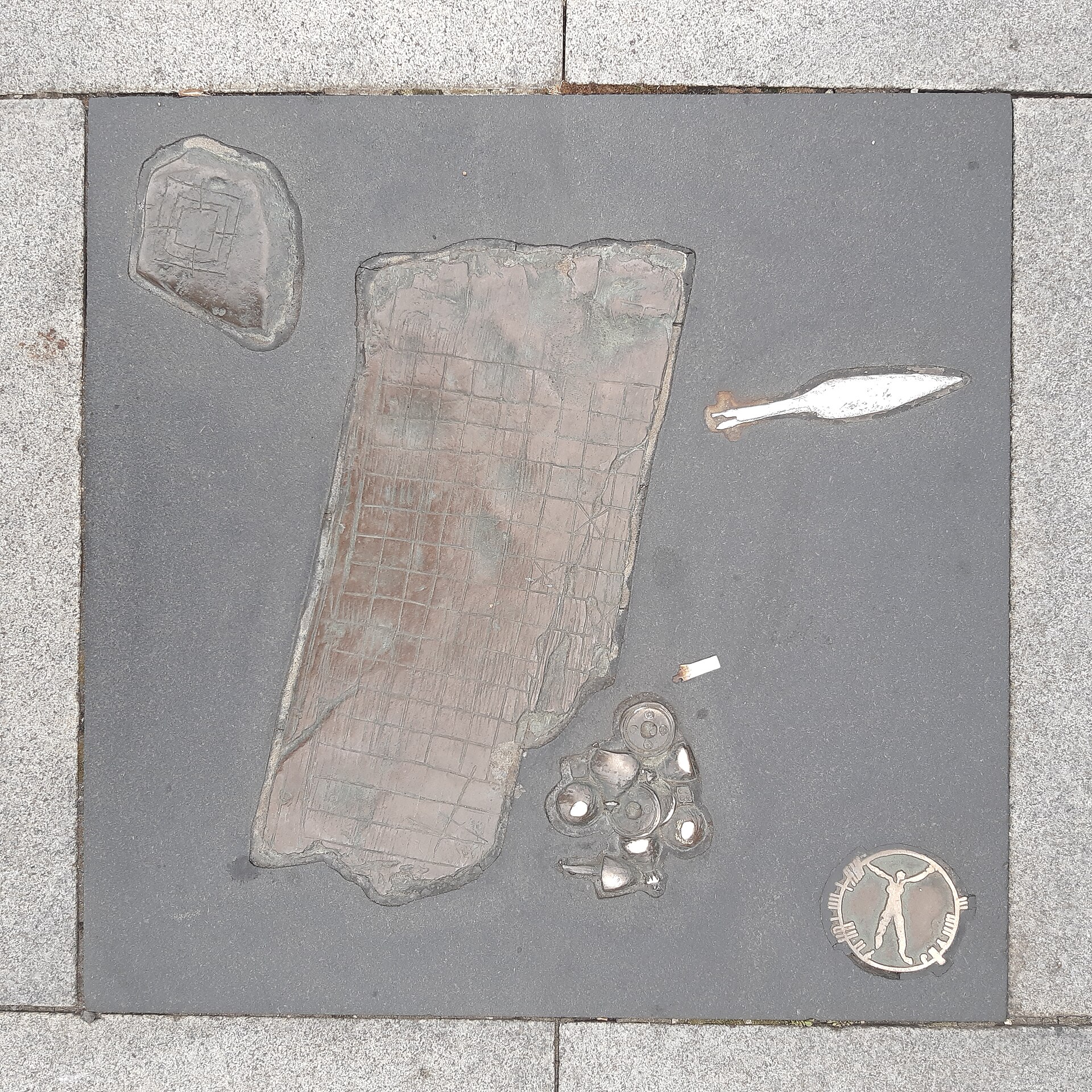
But the archaeological record also reveals something more textured than a pirate economy. The Wood Quay excavations uncovered what appears to be an amber craftsman’s workshop on Fishamble Street — its floor literally strewn with hundreds of waste flakes and tiny fragments of raw amber, alongside finished pendants, rings, and beads. Amber cross pendants in particular emerged as a distinctly Hiberno-Norse innovation: popular in Dublin, rarely seen back in Scandinavia. Other workshops produced antler combs, bone pins, lead fishing weights, and iron rivets for the shipyards. The ring pins that secured cloaks in the Viking period were manufactured in Dublin in sufficient quantities that Hiberno-Norse metalwork became a recognisable style across the wider Viking world.
The houses themselves were compact and practical: post-and-wattle construction, rectangular in plan, with a central hearth bordered by stone kerbs, raised side benches for sleeping and storage, and a doorway at each end. Plots were divided by low wattle fences. Twelve successive generations of Dubliners built and rebuilt on the same ground, each occupation layer sealing the one below it in the anaerobic conditions created by the waterlogged Liffey mud. When Pat Wallace started digging in 1974, he found organic material preserved down to the individual rush fibres on the floor of a house that had not seen daylight since the eleventh century.
The King with the Silk Beard
The single best figure through whom to understand Viking Dublin at its peak is Sitric Silkenbeard — Sitriuc Silkbeard in Irish, Sigtryggr Ólafsson Silkiskeggi in Old Norse — who ruled Dublin for more than four decades, from the late 990s until his abdication around 1036. He was, in a phrase, the perfect product of his city: born to an Irish mother from Leinster royalty, bearing a Norse name, ruling a settlement that had grown too prosperous to be called a camp and too integrated to be called a colony. He was likely multilingual, speaking Irish and Norse at minimum, and probably Latin as well.
Sitric is credited with minting Dublin’s first coins — silver pennies inscribed with the Latin legend SIHTRIC REX DYFLINN, a king’s profile on one side and a Christian cross on the other. A Viking king announcing his authority in Latin, on a Christian symbol, in a city built on a Norse raiding base with an Irish name. That is Hiberno-Norse Dublin in a single object.
In 1028, after a pilgrimage to Rome that took him through Cologne, Sitric founded the church that would eventually become Christ Church Cathedral, modelling it on the ecclesiastical architecture he had encountered on the continent. It remains one of Dublin’s oldest standing structures — built by a Viking king, still there a thousand years later.
His family politics were labyrinthine even by the standards of the period. His stepfather and father-in-law were, improbably, the same person: Brian Boru, the king of Munster whose ambitions for the high kingship of Ireland kept colliding with Sitric’s own calculations. Brian had married Sitric’s Irish mother, Gormlaith; he had also given his daughter to Sitric in marriage. In 1014, on Good Friday, the two forces met at Clontarf on the north shore of Dublin Bay. Brian’s army won. Sitric, by the saga accounts, watched from the city walls.
Brian Boru died at Clontarf. Sitric survived, was reinstated as king, and ruled Dublin for another twenty-two years before going into exile. He died around 1042. The Viking dynasty he represented would continue in Dublin for another 130 years after Clontarf, until the Anglo-Norman invasion of 1170 finally ended Hiberno-Norse control of the city. From that first longphort of 841 to the Norman arrival: well over three centuries. For comparison, the gap between the Norman conquest and the present day is roughly the same length of time. Dublin was a Viking city for a very long time.
What the Ground Held
Dublin Corporation — now Dublin City Council — had been planning its new headquarters at Wood Quay since the 1950s, long before anyone understood the significance of what lay underground. By 1967 the full site had been assembled. In May 1973, bulldozers destroyed part of it before a cease order was issued. Pat Wallace arrived the following February, at 25, to lead what had rapidly become the largest urban excavation ever undertaken in Europe.
He knew almost immediately what he had. “We were finding the origins of their city,” he said, looking back decades later. “I discovered the best evidence in Europe for town layout, how a town looked at the time of Brian Boru.”
Between 1974 and 1981, his team uncovered more than 100 houses across the four-acre site, with over 120 foundations on Fishamble Street alone — the most extensive series of tenth- and eleventh-century buildings found anywhere in Europe west of the Elbe. In total, between 1961 and 1981, the National Museum of Ireland had excavated more than 200 Viking buildings in Dublin, 150 of them at Wood Quay. The site yielded thousands of artefacts alongside the structural evidence: the amber workshop floor, the antler comb blanks, the lead weights, sketches of ships scratched into timber planks.
The waterlogged conditions had preserved everything. Rush fibres. Leather. Wood. Textile fragments. The kind of evidence that usually rots away within years of burial had been held, intact, in the anaerobic mud under the Liffey’s floodplain. Thanks to these excavations, archaeologists now know more about tenth- and eleventh-century Dublin than about any contemporary town north of the Alps. Among Viking-era sites, only York and Waterford come close.
The reason that statement feels surprising is what happened in 1978.
Operation Sitric
On 23 September 1978, approximately 20,000 people marched through Dublin to oppose Dublin Corporation’s plan to build on Wood Quay. It was, by most accounts, one of the largest public demonstrations Ireland had seen in years. The march was spearheaded by Professor F.X. Martin, an Augustinian friar and Professor of Medieval History at University College Dublin, who had established the Friends of Medieval Dublin specifically to fight for the site. Mary Robinson — then a senator, decades before the presidency — led the legal challenge. The Council of Europe registered objections. More than eighty cultural and civic organisations opposed the development. The site had by then been declared a national monument.
None of it worked. Dublin Corporation found a legal route around the national monument designation, and planning permission was confirmed. On 1 June 1979, in a final attempt to halt construction, 52 protesters occupied the site under the name Operation Sitric — named for the Viking king who had minted his city’s first coins and built its oldest cathedral. They held the ground for three weeks. On 21 June, a Supreme Court injunction forced them to leave.
The excavation continued until March 1981. The civic offices, designed by Sam Stephenson and roundly criticised by Dubliners almost from the day they opened, were completed in 1986. The first phase had cost approximately £20 million — around ten times Dublin Corporation’s estimate for the entire site in 1967.
Pat Wallace, who went on to become Director of the National Museum of Ireland and eventually published his full findings in a landmark book, said of the experience: “I knew I would never again do anything as important.”
What Remains
A section of Viking-era city wall is preserved in the basement of the civic offices that replaced Wood Quay. Thousands of artefacts from the excavation — the amber pendants, the bone pins, the antler combs, the lead weights shaped like longships — are displayed at the National Museum of Ireland. The medieval street pattern, still legible in Dublin’s city centre, reflects the Norse land division of the tenth century. Christ Church Cathedral, which Sitric Silkenbeard founded in 1028, is still standing.
And under the parts of the city that were never excavated, sealed in layers that Pat Wallace’s team never reached before the concrete came down, there is more of Dyflinn. Archaeology that nobody has seen since the twelfth century, held in the same anaerobic mud that preserved rush fibres and leather and ship sketches for a thousand years before anyone thought to look for them.
What Wood Quay established — beyond any serious dispute — is that Dublin is not a city with a Viking episode tucked into its early history. It is, in significant part, a city that the Vikings built. Irish culture eventually absorbed the Norse settlers so completely that the distinction between the two became difficult to draw; Sitric Silkenbeard himself is the proof of that. But the city’s grid, its quaysides, its first coinage, its oldest cathedral: these things came from Dyflinn, from the Norse who wintered in the black pool and stayed. The next time the walk takes you between the Liffey and Christ Church, somewhere in that corridor, the street pattern you are moving through is theirs.
☘️ Join 64,000+ Ireland Lovers
Every weekday morning, get Ireland’s hidden gems, local secrets, and travel inspiration — the kind you won’t find in any guidebook.
Subscribe free — enter your email:
📲 Know someone who’d love this? Share on WhatsApp →
Free forever · Unsubscribe anytime
Tours & experiences you might love


Powered by Viator. Some links are affiliate links — we may earn a small commission at no extra cost to you.
Secure Your Dream Irish Experience Before It’s Gone!
Planning a trip to Ireland? Don’t let sold-out tours or packed attractions spoil your journey. Iconic experiences like visiting the Cliffs of Moher, exploring the Rock of Cashel, or enjoying a guided walk through Ireland’s ancient past often sell out quickly—especially during peak travel seasons.

Booking in advance guarantees your place and ensures you can fully immerse yourself in the rich culture and breathtaking scenery without stress or disappointment. You’ll also free up time to explore Ireland’s hidden gems and savour those authentic moments that make your trip truly special.
Make the most of your journey—start planning today and secure those must-do experiences before they’re gone!