

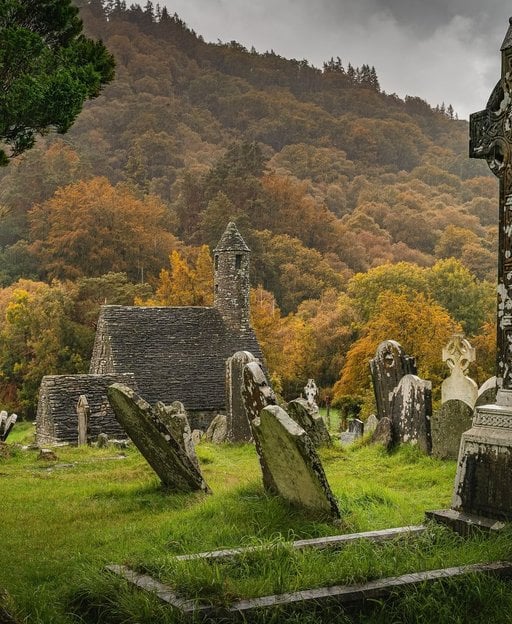
Glendalough is an early Christian monastic settlement in the Wicklow Mountains, founded by Saint Kevin in the 6th century. It contains one of the best-preserved examples of an early medieval Irish monastic city in Europe: a round tower standing 30 metres tall, two stone churches dating to the 10th and 12th centuries, a decorated gateway arch, and more than 1,000 grave markers spanning fifteen centuries. Roughly 1 million people visit each year, making it one of the most visited heritage sites in Ireland. Most of them see the round tower and leave. The site rewards more time than that.
What Is Glendalough?
The name comes from the Irish Gleann da Locha, meaning “valley of two lakes.” The settlement sits between the Upper and Lower Lakes in a glacial valley in County Wicklow, approximately 50 kilometres south of Dublin. Kevin, a monk who sought solitude in this remote valley, founded the monastery around 570 AD. By the 9th century, the community had grown into one of the most important centres of learning in early medieval Europe, drawing students and pilgrims from across Ireland and Britain. For the fuller story of the valley’s 1,400-year history, see our guide to Glendalough’s monastic valley.
The Vikings raided it at least four times between 775 AD and 1071 AD. Each time, the monks rebuilt. The Norman conquest of the 12th century began a longer decline. The English crown sacked the settlement in 1398. By the 16th century, what had once been a city of scholars and craftspeople had contracted to a simple parish church. Today, the site preserves more than 900 years of early Christian construction in a single valley.
The Round Tower: What It Was and How to Read It
The Glendalough round tower is one of approximately 65 round towers that survive in Ireland. It stands 30.5 metres tall and has a circumference of 16 metres at the base. The doorway sits 3.5 metres above ground level — a feature that has puzzled visitors for centuries.
Theories about why the doors are elevated vary. The most common explanation involves security: ladders pulled up in times of attack. Another theory suggests it is a matter of prestige — an elevated doorway signals that this was a structure of importance, not a simple store. A third theory, less dramatic, suggests it is simply a foundation design for a structure built on soft ground. Scholars still debate it.
The tower also functioned as a bell tower. The Irish word for round tower is cloigtheach, meaning “bell house.” Monks rang bells from the upper windows to call the community to prayer at each of the eight canonical hours throughout the day. The shape — tapered, with a conical cap — appears consistently across Irish examples, suggesting a shared building tradition that spread rapidly after the 8th century.
- Height: 30.5 metres (one of the tallest surviving Irish round towers)
- Door height: 3.5 metres above ground level
- Construction period: approximately 10th to 12th century
- Material: mica schist stone, quarried locally from the Wicklow Mountains
- Cap: rebuilt in 1876 using original stones that had fallen
☘️ Researching your Irish roots?
Our free step-by-step guide walks you through every record, database, and DNA tool to trace your Irish family — no experience needed.
The Churches: A Guide to Each Structure
Glendalough contains six distinct ecclesiastical structures. Most visitors focus on the main cathedral and the round tower. The others reward closer attention.
The Cathedral of St Peter and St Paul is the largest building at Glendalough, built in stages between the 10th and 12th centuries. The nave is the oldest section, dating to approximately 900 AD. The chancel and sacristy were added over the following two centuries. The cathedral stands roofless now, its walls still solid despite eight centuries of exposure. Inside, look for the carved stone heads above the doorway — a detail that persists in Irish Romanesque architecture from this period.
St Kevin’s Kitchen is the most distinctive building on the site. It is not a kitchen. The name comes from a chimney-like projection on the roof that resembles a flue. In reality it is a round tower in miniature, built directly into the roof of the church as a bell cote. The building dates to the 12th century and still carries its original roof — one of very few roofed early medieval structures in Ireland. The stone used throughout is the same dark mica schist that gives Glendalough its characteristic grey-green colouring.
St Kevin’s Cell sits above the Upper Lake, at the foot of a cliff, requiring a short walk beyond the main monastic enclosure. It is a low stone structure, partially collapsed, in a location that genuinely suggests solitude. Kevin is said to have lived here before the community grew large enough to require the valley below. The site gives the best sense of what Glendalough looked like before the monks arrived — remote, heavily wooded, and enclosed by steep valley walls.
The Gateway and the Monastic Enclosure
The double-arched stone gateway at the entrance to the main monastic enclosure is one of the few surviving examples of an early Irish monastic gate still standing. It dates to the 12th century and would have been the formal entrance through which pilgrims passed. Medieval pilgrims came to Glendalough as part of a penitential journey. A popular tradition held that seven visits to Glendalough equalled one visit to Rome — a significant claim that drove traffic to the site for centuries after Saint Kevin’s death around 618 AD.
Inside the enclosure, Glendalough’s cemetery, in continuous use for 1,400 years, is one of the most active in County Wicklow. Local families still bury their dead here. The mixture of medieval grave slabs and 20th-century headstones gives the site an unusual quality — it has been in continuous use as a burial ground for more than 1,400 years. Many of the early grave markers are simple carved slabs with incised crosses, bearing no names. Later crosses, from the 9th and 10th centuries, carry inscriptions in Irish asking passers-by to pray for the person buried beneath.
☘️ Enjoying this? 64,000+ Ireland lovers get stories like this every week. Subscribe free →
The Story of Saint Kevin
Kevin was born into a noble Leinster family around 498 AD. He rejected the inheritance that came with that birth and took orders as a monk. According to the hagiographies written after his death, he retreated to the Glendalough valley to live as a hermit. The stories that gathered around him over the following centuries are specific and detailed.
One story describes Kevin praying with his arms outstretched in the position called the crois-figheall or cross-vigil — holding the arms horizontal for extended periods as a form of physical prayer. A blackbird, finding his outstretched hand, built a nest there and laid eggs. Kevin held the position until the eggs hatched, refusing to disturb the bird. The story appears in manuscripts from the 8th century onward and became one of the defining images of Kevin’s holiness — the saint who cared equally for the creatures of the valley and the community he served.
Another tradition describes Kevin refusing to enter a house where a woman lived alone. He slept outside, covered by snow in winter, with animals gathering around him for warmth. These stories reflect the monastic values of the period — solitude, asceticism, closeness to the natural world — more than they reflect any biographical fact. But they accumulated around Kevin with enough consistency that his feast day on 3 June remained widely observed in Wicklow and Leinster for more than a thousand years.
Practical Information for Visiting Glendalough
Glendalough sits within the Wicklow Mountains National Park, approximately 50 kilometres south of Dublin city centre. The main monastic enclosure is accessible without charge. The visitor centre, operated by the Office of Public Works (OPW), charges a small admission fee and contains a permanent exhibition on the history of the site, including artefacts recovered from decades of archaeological excavation at Glendalough.
- Distance from Dublin: approximately 50 km (1 hour by car via the N11 and R755)
- Opening hours: site open daily; visitor centre hours vary seasonally (check opw.ie)
- Admission: free to enter the site; visitor centre admission applies separately
- Parking: pay and display car park at the main entrance (busy at weekends)
- Getting there without a car: St Kevin’s Bus Service (route 181) from Dublin (St Stephen’s Green North) to Glendalough (seasonal)
- Best time to visit: early morning on weekdays to avoid crowds at the round tower
The Upper Lake walk takes approximately 1.5 hours return from the main monastic enclosure. It passes through oak and birch woodland that covers the lower valley slopes — a remnant of the mixed woodland that covered Wicklow before widespread clearance in the medieval period. The path is well-marked and accessible for most walkers. Saint Kevin’s Bed, a cave in the cliff above the Upper Lake, requires a short scramble and is not accessible during busy periods. Some archaeologists argue the cave now known as St Kevin’s Bed is not a hermit’s retreat at all, but a prehistoric burial chamber that predates the monastery by centuries — Kevin, in this reading, adopted a site that was already sacred.
Is Glendalough worth visiting?
Glendalough is one of the best-preserved early Christian monastic sites in Europe and is well worth visiting. The round tower, churches, gateway arch, and cemetery occupy a compact area that can be seen in 2 to 3 hours. The surrounding Wicklow Mountains offer additional walking trails, making it practical to combine a heritage visit with a half-day hike. It is one of the few sites in Ireland where you can see the full range of early medieval monastic architecture in a single location.
How far is Glendalough from Dublin?
Glendalough is approximately 50 kilometres south of Dublin city centre, or roughly 1 hour by car via the N11 and R755. St Kevin’s Bus Service operates a seasonal route (181) from Dublin. Many visitors combine Glendalough with a stop in the village of Laragh or the market town of Wicklow, both within 20 kilometres.
When was Glendalough founded?
Saint Kevin founded the Glendalough monastic settlement around 570 AD. The site grew rapidly in the 7th and 8th centuries as a centre of learning and pilgrimage, drawing students and pilgrims from across Ireland and Britain to its scriptorium, where monks copied and illuminated manuscripts alongside their daily prayers. The standing structures date largely from the 10th to 12th centuries. Kevin died around 618 AD and the monastery continued under successive abbots. The settlement was formally dissolved as an active monastery in the 16th century during the suppression of Irish monasteries under the Tudor crown.
Can you visit Glendalough for free?
The monastic enclosure itself, including the round tower, cathedral, St Kevin’s Kitchen, and the cemetery, is free to enter. The Office of Public Works visitor centre charges a separate admission fee for its museum and exhibition. The walking trails around the Upper and Lower Lakes are free and open throughout the year during daylight hours.
☘️ Join 64,000+ Ireland Lovers
Every weekday morning, get Ireland’s hidden gems, local secrets, and travel inspiration — the kind you won’t find in any guidebook.
Subscribe free — enter your email:
Get the free guide
Enter your email and we will send you straight to the download.
📲 Know someone who’d love this? Share on WhatsApp →
Love more? Join 43,000 Scotland lovers → · Join 29,000 Italy lovers → · Join 7,000 France lovers →
Free forever · Unsubscribe anytime
Tours & experiences you might love


Powered by Viator. Some links are affiliate links — we may earn a small commission at no extra cost to you.
Secure Your Dream Irish Experience Before It’s Gone!
Planning a trip to Ireland? Don’t let sold-out tours or packed attractions spoil your journey. Iconic experiences like visiting the Cliffs of Moher, exploring the Rock of Cashel, or enjoying a guided walk through Ireland’s ancient past often sell out quickly—especially during peak travel seasons.

Booking in advance guarantees your place and ensures you can fully immerse yourself in the rich culture and breathtaking scenery without stress or disappointment. You’ll also free up time to explore Ireland’s hidden gems and savour those authentic moments that make your trip truly special.
Make the most of your journey—start planning today and secure those must-do experiences before they’re gone!