

Dunguaire Castle rises from a tidal island on the shore of Galway Bay near Kinvara in County Galway. It is one of the most photographed castles in Ireland, and one of the most story-laden. A 16th-century tower house built on a site older than the records that survive, it sits so close to the water that at high tide the sea comes to its base. At low tide, the rocks around it emerge and visitors can walk to the entrance without getting their feet wet. The castle has stood here through the plantation, the siege of Galway, the Famine, the Irish Revival, and the present day. Every generation has found something different in it.
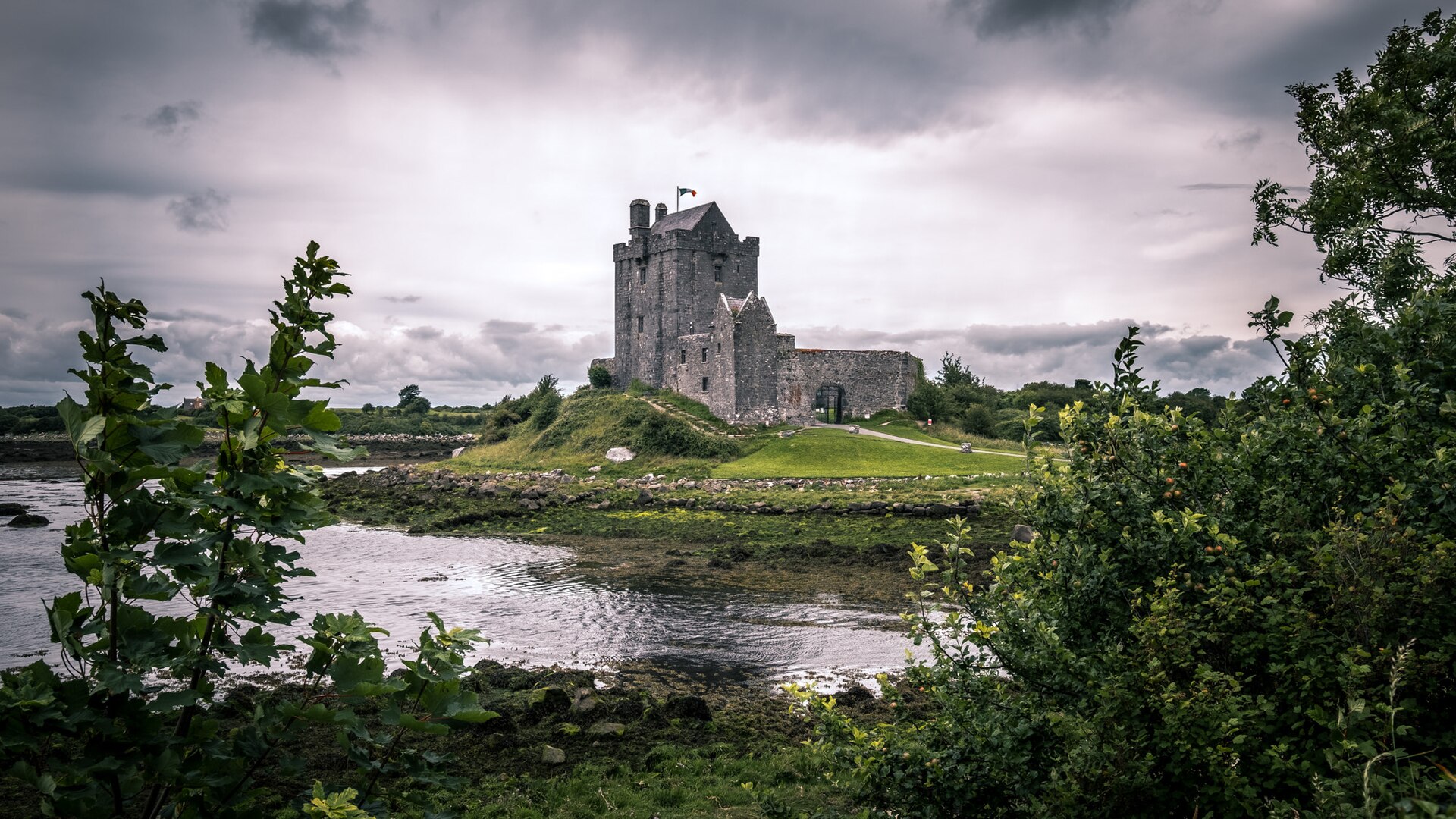
The castle takes its name from Dún Guaire, the fort of Guaire, a 7th-century king of Connacht famous in Irish legend for his extraordinary generosity. Guaire Aidhne, as he appears in the annals, was known across Ireland as a man who never refused a guest. Stories about his open-handedness accumulated over centuries until his name became synonymous with the ideal of Irish hospitality. Whether the castle sits exactly where his fortress stood is uncertain — but the name stuck, and with it the stories.
Who Built Dunguaire Castle and When
The existing tower house at Dunguaire dates to around 1520. The O’Hynes clan, chieftains who controlled the eastern shore of Galway Bay, built it — the name of the individual chieftain responsible has not survived in the historical record. The O’Hynes had held territory in this part of Connacht for centuries. They were a distinct sept within the wider network of Connacht clans, and their lands ran along the southern shore of Galway Bay between the Burren and the city of Galway.
The tower house itself follows the standard form of 16th-century Irish construction. It stands approximately 23 metres (75 feet) high across several floors, with walls over a metre thick at the base. A bawn wall — a defensive enclosure — surrounds the base of the tower. The design was functional: a residence that could be defended, a statement of power visible from the bay, and a watchtower monitoring the approaches to Galway.
☘️ Planning a trip to Ireland?
Our free 7-day road trip itinerary covers the Wild Atlantic Way from Dublin to the west — day-by-day driving guide with hidden gems, practical tips, and local secrets.
The Legend of Guaire and the Poets
The stories that cluster around Dunguaire Castle reach back far beyond the 16th-century building. The most famous involves Guaire Aidhne himself and a delegation of poets who arrived to test the limits of his generosity. In early Irish tradition, the poet class — the filí — had a special status that gave them the right to demand hospitality and gifts from rulers. A king who refused a poet risked satire, which in the Irish world had real social and spiritual consequences.
The medieval tale of Guaire describes a company of some 150 poets arriving at his fort and remaining for a year, consuming everything his household could provide. They demanded extraordinary gifts at every turn. Guaire, according to the story, never broke his commitment to hospitality even as the demands pushed his resources to the limit. When the poets finally left, Guaire’s generosity was considered so exceptional that it passed into proverb.
The detail that most struck later storytellers was small: at the end of the poets’ stay, Guaire’s arm — the one he extended constantly to give — was said to be longer than his other arm. The right hand that gave had literally stretched with the effort of giving. Whether miracle or metaphor, the image stuck in Irish literary memory for more than a thousand years.
Dunguaire and the Irish Literary Revival
In the early 20th century, Dunguaire Castle became part of the intellectual geography of the Irish Revival in a way that few castles elsewhere managed. The Revival centred largely on the west of Ireland — on its language, its landscapes, and its surviving oral tradition. The area around Kinvara and Galway Bay attracted writers, scholars, and collectors during the decades when figures like W.B. Yeats, Lady Augusta Gregory, J.M. Synge, and George Moore were reinventing Irish literature.
Lady Gregory’s home at Coole Park, approximately 11 kilometres inland, became the centre of this gathering. Writers visiting Coole would often travel to the Galway Bay coast, and Kinvara and Dunguaire were natural waypoints. The castle itself was in private hands through much of this period, but its symbolic presence — a medieval Irish tower on a tidal island, embodying precisely the kind of ancient, sea-connected Ireland the Revival celebrated — gave it an importance beyond its actual role as a residence.
In 1924, the Irish writer and surgeon Oliver St. John Gogarty bought Dunguaire Castle and carried out restoration work. Gogarty was a central figure in Dublin literary life — the model, many believe, for Buck Mulligan in James Joyce’s Ulysses — and a friend to Yeats, George Bernard Shaw, and many others. He used Dunguaire as a retreat and a gathering place, continuing in a different register the tradition of the castle as a site where writers came together.
☘️ Enjoying this? 64,000+ Ireland lovers get stories like this every week. Subscribe free →
The Folklore Around Dunguaire Castle
Beyond the documented history, Dunguaire Castle carries a body of local folklore. Several traditions attach to the site specifically:
- The tide as protection: Local accounts hold that the tidal nature of the site gave it a particular quality in Irish belief. Water in Irish tradition marked a boundary, a threshold between the ordinary world and something older. A castle sitting on an island that appeared and disappeared with the tide occupied a liminal position that folk belief took seriously. The island quality of Dunguaire at high tide — cut off from the shore — made it, in local imagination, a place where different rules applied.
- The Poet’s Well nearby: A holy well near Kinvara, within walking distance of the castle, has been associated with poets and their craft for centuries. Holy wells in Connacht often carried the names and associations of the saints or figures connected to the locality. The proximity of a poet’s well to a castle named for the most generous patron in Irish tradition reinforced the literary identity of the whole area.
- The light that burns after dark: Several accounts, some dating to the 19th century, describe a light appearing in the castle windows on certain nights when the castle stood empty. The tradition names this as the light of Guaire, still holding court. This type of folklore — the founding figure who never entirely left his hall — appears widely across Ireland in connection with pre-Norman sites, but Dunguaire’s version is unusual in specifying the light rather than sounds or visions as the phenomenon.
What You See Today at Dunguaire Castle
Dunguaire Castle today serves as a heritage attraction managed by Shannon Heritage. The organisation also runs similar properties at Bunratty and Knappogue Castle in County Clare. The castle opens seasonally, typically from April through October, with guided tours of the tower house interior and the bawn enclosure.
- The tower house interior shows the various floors of the original structure, including the great hall at the main level and the private chambers above
- Medieval banquets take place at Dunguaire during summer evenings, continuing a tradition started in the 1960s at similar castles in the region — these feature food, music, and readings from Irish literature
- The exterior of the castle and the tidal island around it are accessible without a paid ticket — visitors can walk down to the water’s edge and photograph the castle from the causeway approach at any time
- The village of Kinvara itself, 2 kilometres from the castle, has a working harbour and several traditional pubs; the annual Cruinniú na mBád regatta in August brings traditional Galway hooker sailboats to the bay
How to Get to Dunguaire Castle
Dunguaire Castle sits on the N67 road between Gort and Kinvara, approximately 22 kilometres south of Galway city. By car from Galway, the journey takes about 25 minutes. From the Burren in County Clare, the castle is accessible via the coast road through Ballyvaghan and Kinvara, making it a natural stop on a circuit that takes in the Burren and the coast.
Public transport to Kinvara is limited — Bus Éireann routes connect Galway to Kinvara on a reduced schedule. Most visitors arrive by car. Parking is free in the area around the castle approach. The closest accommodation is in Kinvara village, with hotels and B&Bs in Gort and Clarenbridge also within easy driving distance.
Why Dunguaire Stays in People’s Memory
Visitors who photograph Dunguaire Castle from the causeway at low tide are reproducing one of the most reproduced compositions in Irish landscape photography. The castle reflected in the still water of the bay, with the Burren hills visible behind and the wide sky of Connacht overhead, has appeared on more calendars and postcards than almost any other image of County Galway outside the Aran Islands.
What the photographs do not always capture is the quality of the place at different hours. In the morning, before the tourist coaches arrive, the light on the bay shifts every few minutes. At evening, especially on a clear night in summer when the sun drops slowly over the Burren, the castle turns orange and then deep red. The water reflects everything. It looks, in those moments, exactly as it must have looked when a chieftain stood at the top of that tower in the 16th century, watching the approaches from the sea.
That continuity — between the Guaire of the old tales, the O’Hynes chieftain of 1520, the Revival writers of the 1920s, and the visitors photographing from the causeway today — is what the castle actually offers. Not a reconstruction. Not a theme park. A place that has genuinely been in continuous human attention for close to 1,400 years, and that still sits where it has always sat, between the land and the tide.
Is Dunguaire Castle worth visiting?
Dunguaire Castle is worth visiting for both the exterior views from the causeway (free, always accessible) and the paid interior tours during the April to October season. The castle’s setting on a tidal island on Galway Bay is genuinely striking, and the connection to Guaire Aidhne’s legend and the Irish Literary Revival gives it historical depth that many more famous attractions lack.
When is the best time to visit Dunguaire Castle?
The best time to visit Dunguaire Castle is early morning or evening, when the light on Galway Bay is most dramatic and crowds are smallest. The castle is open for interior tours from April through October. The summer evening medieval banquets require advance booking. Sunset visits in June and July, when the sun drops over the Burren, produce the most distinctive lighting conditions.
How far is Dunguaire Castle from Galway city?
Dunguaire Castle is approximately 22 kilometres south of Galway city, a 25-minute drive by car via the N67 coastal road. The castle sits on the shores of Galway Bay near the village of Kinvara in County Galway. It makes a natural stop on a day trip that combines Galway city with the south Galway coast and the Burren.
☘️ Join 64,000+ Ireland Lovers
Every weekday morning, get Ireland’s hidden gems, local secrets, and travel inspiration — the kind you won’t find in any guidebook.
Subscribe free — enter your email:
📲 Know someone who’d love this? Share on WhatsApp →
Free forever · Unsubscribe anytime
Tours & experiences you might love


Powered by Viator. Some links are affiliate links — we may earn a small commission at no extra cost to you.
Secure Your Dream Irish Experience Before It’s Gone!
Planning a trip to Ireland? Don’t let sold-out tours or packed attractions spoil your journey. Iconic experiences like visiting the Cliffs of Moher, exploring the Rock of Cashel, or enjoying a guided walk through Ireland’s ancient past often sell out quickly—especially during peak travel seasons.

Booking in advance guarantees your place and ensures you can fully immerse yourself in the rich culture and breathtaking scenery without stress or disappointment. You’ll also free up time to explore Ireland’s hidden gems and savour those authentic moments that make your trip truly special.
Make the most of your journey—start planning today and secure those must-do experiences before they’re gone!