

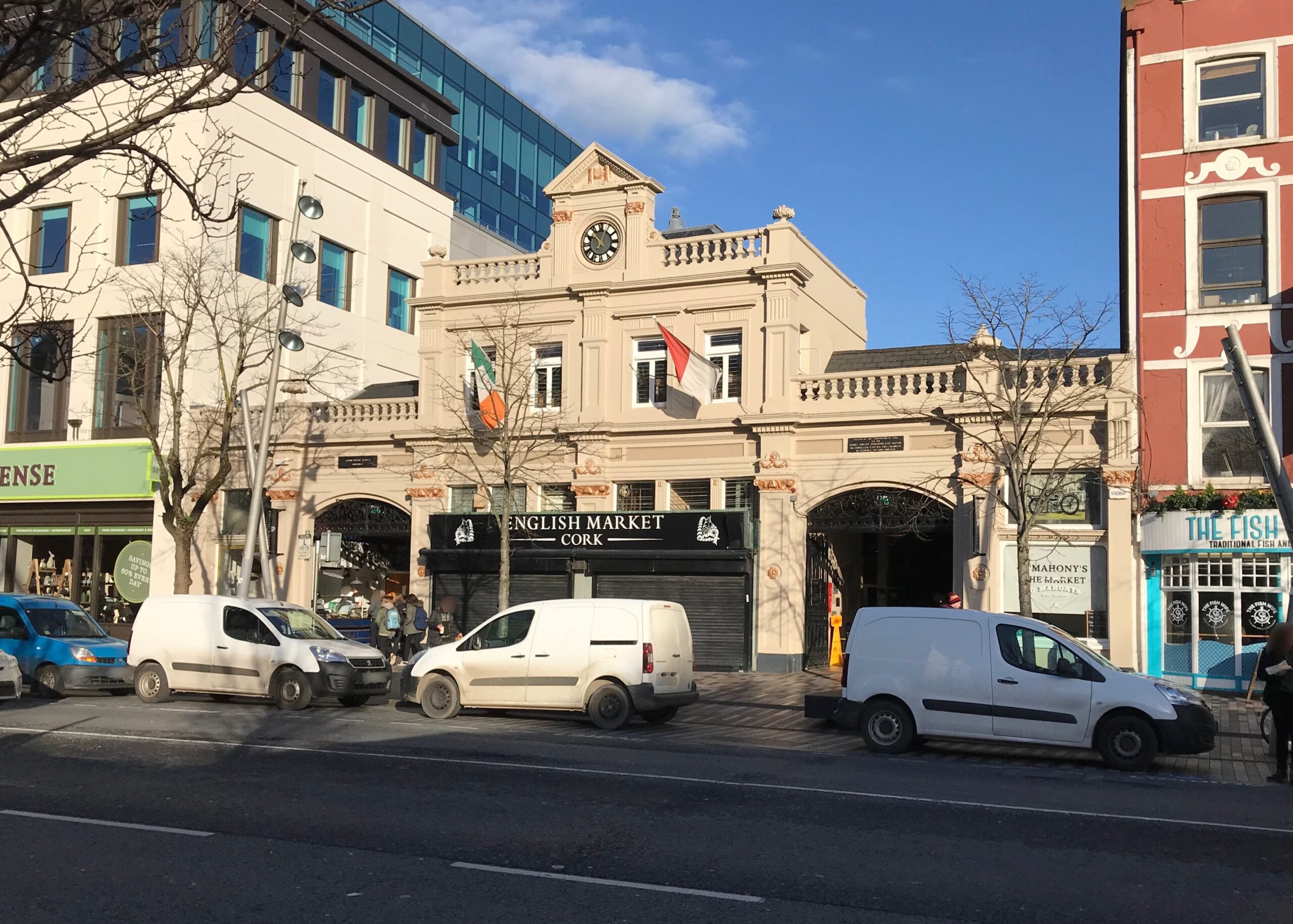
The Market With the Wrong Name: What Cork’s English Market Has Been Selling Since 1788
Pat O’Connell got to his stall at seven in the morning. The Queen wasn’t due until after two. He had seven hours to stand there and wait, which is, as it happens, not much different from a regular working day at K O’Connell Fish Merchants in Cork’s English Market — except that on this particular Tuesday in May 2011, he was also trying not to be nervous.
When Queen Elizabeth II finally came through, she paused at a monkfish. The creature has a head that looks like a bad decision. She asked what it was. O’Connell — fishmonger, market veteran, son of the woman who built the stall he works — told her they call it the mother-in-law fish in Cork. The Queen laughed, apparently with genuine delight. Photographs of that moment ran in newspapers across four continents. O’Connell was later invited to Buckingham Palace, where she picked him out the moment she entered the room. He received one of her last letters about a month before she died.
That exchange — a Cork fishmonger, a monkfish, and a monarch laughing — is the most famous thing the English Market has ever produced. But the more interesting story is why the market exists at all, what its name actually means, what nearly destroyed it in 1980, and what it still carries that no supermarket would ever bother to stock.
Not What the Name Suggests
The English Market is not named after England. This surprises almost everyone who visits for the first time, and it’s worth sitting with for a moment, because the real explanation is more interesting than a simple geographic reference.
The market’s origins trace to a charter granted under King James I in 1610, but the building that exists today was a deliberate civic project of the late eighteenth century. The foundation stone was laid on September 29, 1786, and the market opened on August 1, 1788 — a covered meat shambles built by Cork’s municipal authorities to bring order to what had been a chaotic outdoor trade. The city’s economy in this period was built largely on the provisions trade: salted beef, salted pork, and butter, exported to the West Indies and used to provision the British Navy. Cork Harbour was one of the great staging points of the Atlantic world, sheltering fleets during the American War of Independence and the Napoleonic Wars. The market was infrastructure for that trade.
The corporation that built it was the Protestant or “English” corporation — the civic body that governed Cork under the terms of the Penal Laws era, composed of the city’s Protestant settler population. When the Municipal Corporations (Ireland) Act of 1840 reformed local government and the Catholic Irish majority finally took control of Cork’s civic institutions, the new administration established its own covered market on Cornmarket Street. That market became known informally as “the Irish Market.” And the original, still operating on Grand Parade and Princes Street, became — by contrast — “the English Market.”
The Irish Market is now a bar called the Bodega. The English Market is still a market. The name, nearly two centuries old, is a political artifact of Ireland’s religious divide that now survives largely as a useful address. In Cork, nobody finds this strange.
What the Building Looked Like
By the mid-nineteenth century, the market had been significantly rebuilt. Architects John Benson and Robert Walker reconstructed the front range and its galleried interior court. The ornamental Princes Street entrance — the one with the arches and the wrought ironwork that photographs so well — was built in 1862 and was considered, at the time, one of the showpieces of Cork city.
At the centre of the covered market stood a cast iron fountain. It would matter, in 1980, that the fountain was there.
The Night It Burned
In June 1980, a gas explosion in the Princes Street section of the English Market caused a fire that engulfed the building. Six units of Cork’s fire brigade responded and brought the blaze under control within around thirty minutes. The damage, when assessed, was extensive: the Princes Street Market section was largely in ruins. The exception — the one thing that came through with only minor damage — was the cast iron fountain.
The Grand Parade section of the market had not been reached by the fire and remained functional. Building work on the Princes Street section began in January 1981 and was completed by October of the same year, at a total cost of over £300,000. The insurance compensation was £150,000; Cork Corporation borrowed the rest. The restoration, carried out by the Corporation’s own Architects Department under Jack Healy and Des Berkeley, won a Gold Medal from Europa Nostra — the European heritage federation — in 1983 for its contribution to architectural conservation.
Then, in 1986, the Princes Street section caught fire again. It was restored again.
One practical consequence of the 1980 fire was that market traders, understandably wary of losing their livelihoods to a weekly tenancy arrangement, negotiated significantly improved terms during the rebuilding phase. They secured 21-year leases with rent reviews every five years — tenure arrangements that remain in place and that gave traders the security to invest in what they were doing.
The People Who Kept Coming Back
The English Market today holds around 130 traders, open Monday through Saturday, with five entrances off Grand Parade, Princes Street, Patrick Street, New Market Lane, and Mutton Lane. The range — fresh fish, butchers, organic produce, artisan cheeses, olives, spices, bread, gift stalls — is broad enough that the market functions as a serious daily food shop for Cork residents and a destination for visitors from elsewhere. It sits an easy walk from other Cork landmarks, including Blackrock Castle, Cork’s oldest castle still in use, further along the river.
But the traders who have been there the longest are the ones worth knowing about, because their histories track almost exactly with the market’s own.
Kathleen O’Connell — known to everyone as Kay — set up a fish stall in the English Market in the early 1960s, at a time when there were more than a dozen fish traders competing in the building. Kay drove to Castletownbere on the Beara Peninsula before dawn to source fish directly — a three-hour round trip — taking her two sons, Pat and Paul, with her so they could learn how to recognise quality. She understood fish supply as a relationship problem, not a logistics problem.
K O’Connell Fish Merchants is now run by Pat and Paul. The stall stretches eighty feet in length. Of the dozen-plus fish stalls that once traded in the market, three remain. Pat’s daughter Emma has opened Kay’s Kitchen, a takeaway café directly across from the original stall, serving fresh seafood dishes sourced from her grandfather’s suppliers. The third generation is in the market, learning the same things Kay O’Connell was teaching in a car to Castletownbere sixty years ago.
Bresnan’s Butchers arrived in the market in 1898, when Michael Bresnan came from County Limerick to be apprenticed to a Cork butcher. The stall passed through four generations — Michael to Patrick to Michael to Peter — and ran for 124 years, the longest continuous unbroken presence in the English Market. The Bresnans ran a farm-to-fork beef operation sourcing from their own Cork farms and abattoir, winning multiple Bridgestone “Best in Ireland” awards along the way. Claire Bresnan, reflecting on the stall’s eventual closure in August 2022, put it plainly: “It’s amazing to know that our grandparents and our great grandparents were here, that the stall predates the War of Independence, and that no matter what’s happening in Ireland, it’s always survived.”
It didn’t survive the family running out of people who wanted to run it. Peter Bresnan said his grandfather had three sons and they all wanted different things. After 124 years, the stall came to its natural end. The family tradition continues at their butcher shop in Douglas Shopping Centre.
What Supermarkets Don’t Sell
There is a stall at the English Market that has been there since around 1910. It sells tripe and drisheen. These are the foods that Cork is most identified with and that Cork people are most amused to explain to visitors.
Tripe is the lining of a cow’s stomach. Drisheen is something else entirely — and it is not, despite appearances, the same as black pudding. Where black pudding uses whole blood, drisheen is made from blood serum. The process: you separate the serum from the blood, filter it twice, add approximately one percent salt, stir, pipe into casings, boil until the casings float, then cool rapidly. Donagh O’Reilly, who runs A. O’Reilly’s at the English Market and is the fourth generation of his family to run the stall, is the only person in Ireland still making drisheen. A serving costs €2.
Three varieties of drisheen once existed — sheep, beef, and tansy drisheen. Only beef is made today. O’Reilly’s father Maurice and uncle Stephen ran the operation until 2004. Donagh O’Reilly has been making it since, largely alone. The skill, he has noted, takes months to develop: you have to know by feel whether the casing is packed enough to hold without bursting.
The reason Cork has this tradition at all connects directly to the market’s founding context. When Cork was the provisioning capital of the Atlantic trade, the city’s slaughterhouse industry was enormous, and workers were often paid in offal rather than money. Tripe and drisheen, crubeens (pigs’ feet), pig tails, spiced beef — these are the foods of a city that made its economy out of meat and was practical about the parts that didn’t fit in the barrel. The English Market was the infrastructure for all of it. Most of those foods are gone from mainstream retail. A. O’Reilly’s is still on its stall.
The Farmgate Café, on the mezzanine level above the market’s central court with a view down over the stalls, has been serving tripe and drisheen for more than thirty years. It is one of the few places in Ireland where you can sit at a restaurant table and eat them.
What the Queen Saw
The state visit in May 2011 was the first by a British monarch to the Republic of Ireland since the country became independent in 1922. The diplomatic weight of the occasion was considerable — Queen Elizabeth II visited the Garden of Remembrance, where Ireland commemorates those who died fighting British rule, and laid a wreath. Taoiseach Micheál Martin later described the visit as “a critical step in the normalisation of relations” between the two countries.
Cork was the final stop, on May 20. Five English Market traders were selected to meet the Queen. She toured the market, unveiled a commemorative plaque near the fountain — the same fountain that had survived the 1980 fire — and was presented with a hamper of market produce. Then she paused at Pat O’Connell’s stall, looked at a monkfish, and asked what it was.
The photograph of the Queen laughing at his answer ran everywhere. It was used, in the words of people who watched the coverage, as evidence that the visit had genuinely worked — that something real had happened, not just a protocol exercise. The British Ambassador reportedly told O’Connell afterward that the Queen and Prince Philip had loved being treated as ordinary people. O’Connell, who had been there since seven in the morning, said he hadn’t been as nervous since his wedding day.
When she left the market, she crossed the Grand Parade to greet members of the public waiting behind barriers — an unscheduled walkabout that the visit’s planners had not anticipated. Cork turned out in numbers that surprised almost everyone.
What Stays
The English Market is owned by Cork City Council, as it has been since the Protestant corporation that built it handed responsibility over in the civic restructuring of the nineteenth century. The tenants hold 21-year leases — terms that the traders themselves negotiated after watching their stalls burn in 1980. The building has its Gold Medal from Europa Nostra, its Victorian ironwork, its 1862 entrance on Princes Street, and its fountain.
There are around 130 traders there today. Some have been there for four generations. Some arrived last year. One of them is Ireland’s last drisheen maker, selling €2 servings of a food Cork invented out of necessity and kept out of habit. Another is the granddaughter of a woman who drove before dawn to the west coast so her sons would know what good fish looked like.
This is what the market does that no supermarket ever will: it carries the specific knowledge of specific people, passed down across enough generations that it has become genuinely hard to replace. The fish is fresh. The meat is sourced from the farms the traders know by name. The drisheen takes months to learn to make properly. The market has burned twice and been rebuilt twice. The fountain is still there. If that kind of multi-generational thread runs through your own family, our 5-day heritage plan for tracing Cork roots is built around exactly that kind of digging.
If you go — and if you have any interest at all in the history that lives inside a food market that has been in continuous operation for nearly two and a half centuries — ask what the monkfish is called. The answer hasn’t changed.
☘️ Join 64,000+ Ireland Lovers
Every weekday morning, get Ireland’s hidden gems, local secrets, and travel inspiration — the kind you won’t find in any guidebook.
Subscribe free — enter your email:
Tours & experiences you might love


Powered by Viator. Some links are affiliate links — we may earn a small commission at no extra cost to you.
Secure Your Dream Irish Experience Before It’s Gone!
Planning a trip to Ireland? Don’t let sold-out tours or packed attractions spoil your journey. Iconic experiences like visiting the Cliffs of Moher, exploring the Rock of Cashel, or enjoying a guided walk through Ireland’s ancient past often sell out quickly—especially during peak travel seasons.

Booking in advance guarantees your place and ensures you can fully immerse yourself in the rich culture and breathtaking scenery without stress or disappointment. You’ll also free up time to explore Ireland’s hidden gems and savour those authentic moments that make your trip truly special.
Make the most of your journey—start planning today and secure those must-do experiences before they’re gone!