

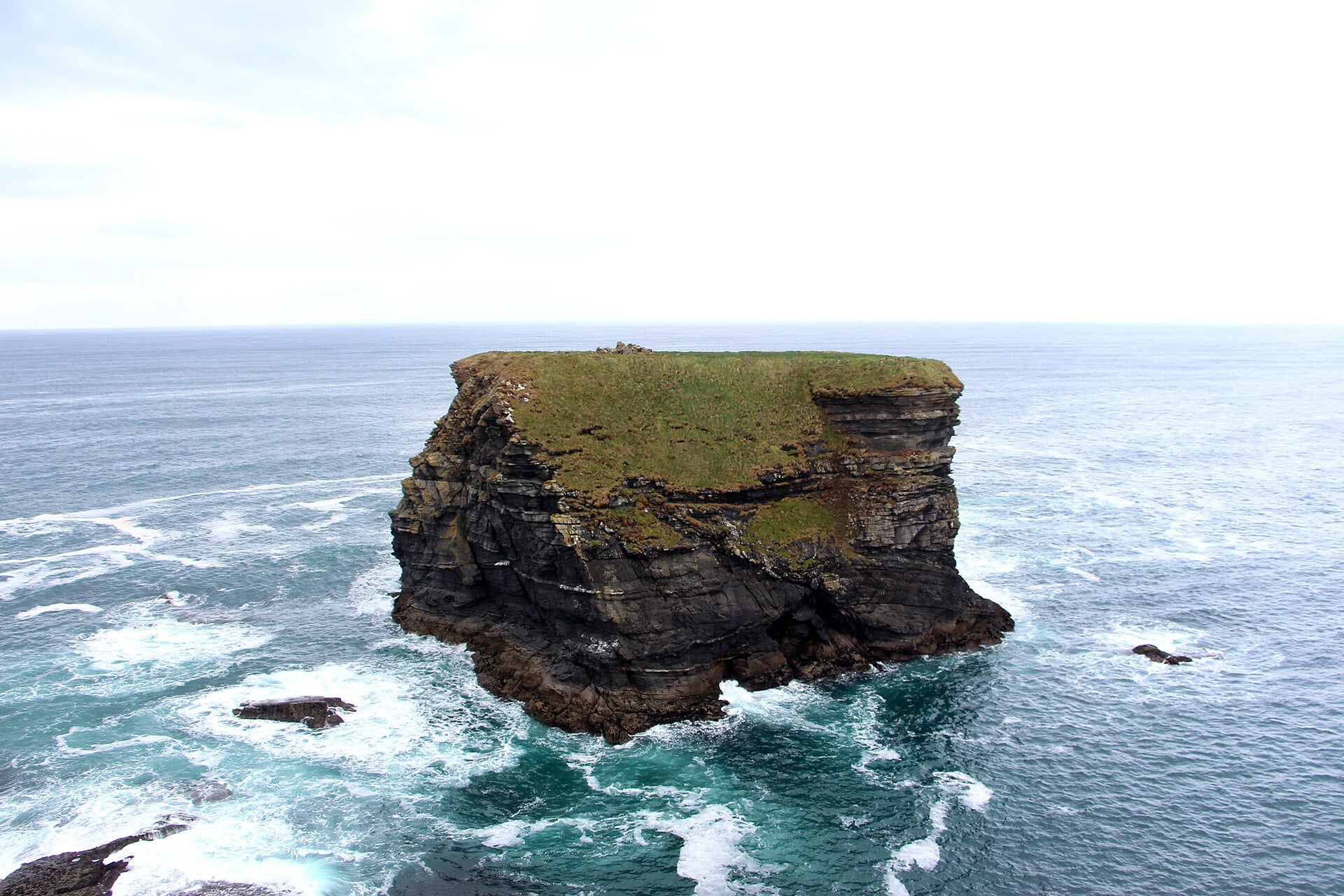
Few places sum up early Irish Christianity quite like Bishop’s Island. A small sea stack off the coast of County Clare, it lies just southwest of the seaside town of Kilkee, separated from the mainland by sheer drops and crashing Atlantic waves. On top of the island, you can still see the remains of a small stone oratory — a monastery that once sheltered a monk, or possibly a bishop, who chose one of the most inaccessible spots on the Irish coast as a place to pray.
You cannot visit it. You cannot land on it. But you can see it, and knowing what you are looking at makes the view considerably more interesting.
Want more like this? Subscribe to our free Ireland newsletter for weekly stories, travel tips, and hidden history from across the island.
Where Is Bishop’s Island?
Bishop’s Island lies around two miles (3 km) southwest of the town of Kilkee in County Clare, opposite the townland of Foohagh. It is well south of the Cliffs of Moher, which lie roughly 50 km up the coast — a distinct landmark, not the same stretch of cliffs. The island’s Irish name, Oileán an Easpaig Ghortaigh, translates as “the island of the hungry bishop.” Local tradition holds that a bishop was stranded there and starved to death, which would explain both the name and the choice of so inhospitable a refuge.
The island is a sea stack: a column of rock that was once part of the mainland cliffs but was separated over centuries by the erosive force of the Atlantic. It measures roughly 180 by 90 metres and rises about 65 metres above the water, its vertical walls dropping straight into the sea on all sides. There is no beach, no landing point, and no realistic way to get onto the island without specialist climbing equipment — and even that would be extremely dangerous.
From the Kilkee Cliff Walk, which runs south along the coast from the town’s West End, the island comes into view below the cliff path. On a clear day, the outline of the stone oratory is plainly visible on top of the stack.
The Ruins on the Island
The remains on Bishop’s Island are those of an early Christian oratory — a small stone building used for prayer. It is a dry-stone construction, meaning it was built without mortar, using carefully fitted stones that have held together on this exposed rock for over a thousand years.
Oratories of this type were built throughout Ireland during the early medieval period, roughly between the 6th and 9th centuries AD. They followed a consistent pattern: small rectangular or boat-shaped buildings with thick walls, a single doorway, and a simple interior used for private prayer. The best-known surviving example is Gallarus Oratory on the Dingle Peninsula in County Kerry, which remains almost entirely intact.
The Bishop’s Island oratory is more fragmentary — the walls have partially collapsed — but the outline of the building is still clearly legible from the cliff path and from the sea.
Who Built It, and Why?
Early Irish Christian monks had a tradition of deliberately seeking out the most remote and inhospitable locations for their monasteries. Scholars refer to this practice as peregrinatio pro Christo — exile or pilgrimage for the sake of Christ. The idea was that genuine devotion required leaving behind the comforts of settled life and choosing a place of hardship and isolation.
The Atlantic coast of Ireland provided exactly that. Islands, sea stacks, cliff edges, and mountain tops were all used. Skellig Michael in County Kerry — now a UNESCO World Heritage Site — is the most famous example, where monks built a settlement roughly 180 metres above the sea, including six beehive cells and two oratories.
Bishop’s Island fits this same tradition. Its isolation is intentional. Whoever built the oratory there was not trying to be accessible. They were choosing difficulty as an act of faith.
Local tradition credits the monastery’s founding to the 6th century, with some accounts connecting it to Saint Senan, whose main foundation was on Scattery Island in the Shannon Estuary. The “bishop” in the island’s name comes from a separate, later story — the legend of the stranded bishop described above — not from a resident of the original monastery.
How to See Bishop’s Island
You have two practical options: walk the cliff path, or take a boat tour.
Walking the Cliff Path
The Diamond Rocks Café at Kilkee’s West End is the usual starting point. From here, the signed Kilkee Cliff Walk follows the coast south, and Bishop’s Island comes into view within the first couple of kilometres.
Route options range from a short 1.8 km there-and-back to a longer 11.7 km loop, so you can tailor the walk to how much time you have. The path is well-maintained in sections but can be uneven and slippery after rain. Sturdy footwear is advisable. This is an exposed coastal route and wind can arrive quickly even in summer.
To spot Bishop’s Island, look for a flat-topped sea stack sitting slightly below the main cliff line. The stone ruins sit on top. A pair of binoculars is useful if you want to see the oratory in any detail.
Keen to explore more hidden corners of Ireland? Join our free newsletter for guides and stories delivered straight to your inbox.
Boat Tours
Boat trips along this stretch of the West Clare coast are less established than the well-known Cliffs of Moher cruises further up the coast, but seeing the stack from the water gives you a completely different view — and brings you considerably closer to Bishop’s Island than any point on the cliff path.
From a boat, you can see the full height of the sea stack and appreciate just how completely the island is cut off on all sides. It is a more immediate illustration of the monks’ isolation than any photograph taken from the top of the cliffs.
Availability depends on sea conditions and changes season to season, so check locally in Kilkee for current operators before planning a trip around one. If nothing is running, the cliff walk remains the reliable way to see the island.
Ireland’s Other Island Monasteries
Bishop’s Island is one of many early Christian sites found on islands, sea stacks, and cliff edges around the Irish coast. Together, they reflect a distinctive form of religious life that flourished in Ireland from roughly the 5th to the 10th centuries.
Skellig Michael, 12 kilometres off the Kerry coast, is the most famous example. It has been a UNESCO World Heritage Site since 1996 and receives limited visitors by boat during the summer season. The monastery there was occupied from around the 6th century until the 12th, when the monks relocated to the mainland — most likely because conditions on the rock had become untenable.
Inishmurray, off the Sligo coast, has a larger monastic settlement within a stone enclosure and can be reached by boat from Mullaghmore in fair weather. Scattery Island in the Shannon Estuary has an intact round tower and several church ruins, and is accessible by ferry from Kilrush in County Clare.
These sites survive in large part because of their inaccessibility. The very conditions that made them difficult to occupy also protected them from the interference and reuse that altered or destroyed so many mainland sites over the centuries.
Bishop’s Island sits in this company. It is not as celebrated as Skellig Michael and not as straightforward to reach as Scattery Island, but the oratory on its summit is genuine and historically significant, and it is worth knowing it is there the next time you walk the cliffs above Kilkee.
Practical Information
Getting there: Kilkee is about 90 km from Limerick via the N68 coast road, roughly a 1 hour 25 minute drive, and a similar distance from Shannon Airport. Driving is the most practical option; there is free parking at the Diamond Rocks Café, the usual starting point for the cliff walk.
Public transport: Bus Éireann route 333 connects Ennis to Kilkee via Doonbeg, with onward connections from Limerick and Shannon Airport. Check current timetables directly with Bus Éireann, as schedules vary by season.
Kilkee town: The seaside town of Kilkee has cafés, shops, and a sheltered Blue Flag beach, making it a natural base for exploring this stretch of coastline before or after the cliff walk.
Weather: The west coast of Ireland is exposed and can be wet and windy at any time of year. Even in summer, bring waterproofs and wind-resistant layers. The cliff walk is significantly more difficult in poor conditions.
Birdlife: The cliffs support large seabird colonies, including Atlantic puffins, razorbills, guillemots, and choughs. Spring and early summer — April to July — is the best period for birdwatching.
Safety: Stay on marked paths at all times. Serious incidents have occurred on exposed West Clare cliff edges as a result of visitors going beyond safety barriers. Unstaffed sections of the cliff edge are dangerous, particularly in wet or windy conditions.
Ready to discover more of Ireland’s history and hidden places? Subscribe to our free weekly newsletter and we will bring the best of Ireland straight to your inbox.
☘️ Join 64,000+ Ireland Lovers
Every weekday morning, get Ireland’s hidden gems, local secrets, and travel inspiration — the kind you won’t find in any guidebook.
Subscribe free — enter your email:
📲 Know someone who’d love this? Share on WhatsApp →
Free forever · Unsubscribe anytime
Tours & experiences you might love


Powered by Viator. Some links are affiliate links — we may earn a small commission at no extra cost to you.
Secure Your Dream Irish Experience Before It’s Gone!
Planning a trip to Ireland? Don’t let sold-out tours or packed attractions spoil your journey. Iconic experiences like visiting the Cliffs of Moher, exploring the Rock of Cashel, or enjoying a guided walk through Ireland’s ancient past often sell out quickly—especially during peak travel seasons.

Booking in advance guarantees your place and ensures you can fully immerse yourself in the rich culture and breathtaking scenery without stress or disappointment. You’ll also free up time to explore Ireland’s hidden gems and savour those authentic moments that make your trip truly special.
Make the most of your journey—start planning today and secure those must-do experiences before they’re gone!