

Stand on the cliff path just south of Kilkee, County Clare, and look out towards George’s Head. If the visibility is good and you know where to look, you will spot it: a flat-topped sea stack sitting just offshore, completely surrounded by the Atlantic Ocean, with the crumbling outline of a small stone ruin on top. That is Bishop’s Island — and most people walk straight past it without a second glance.
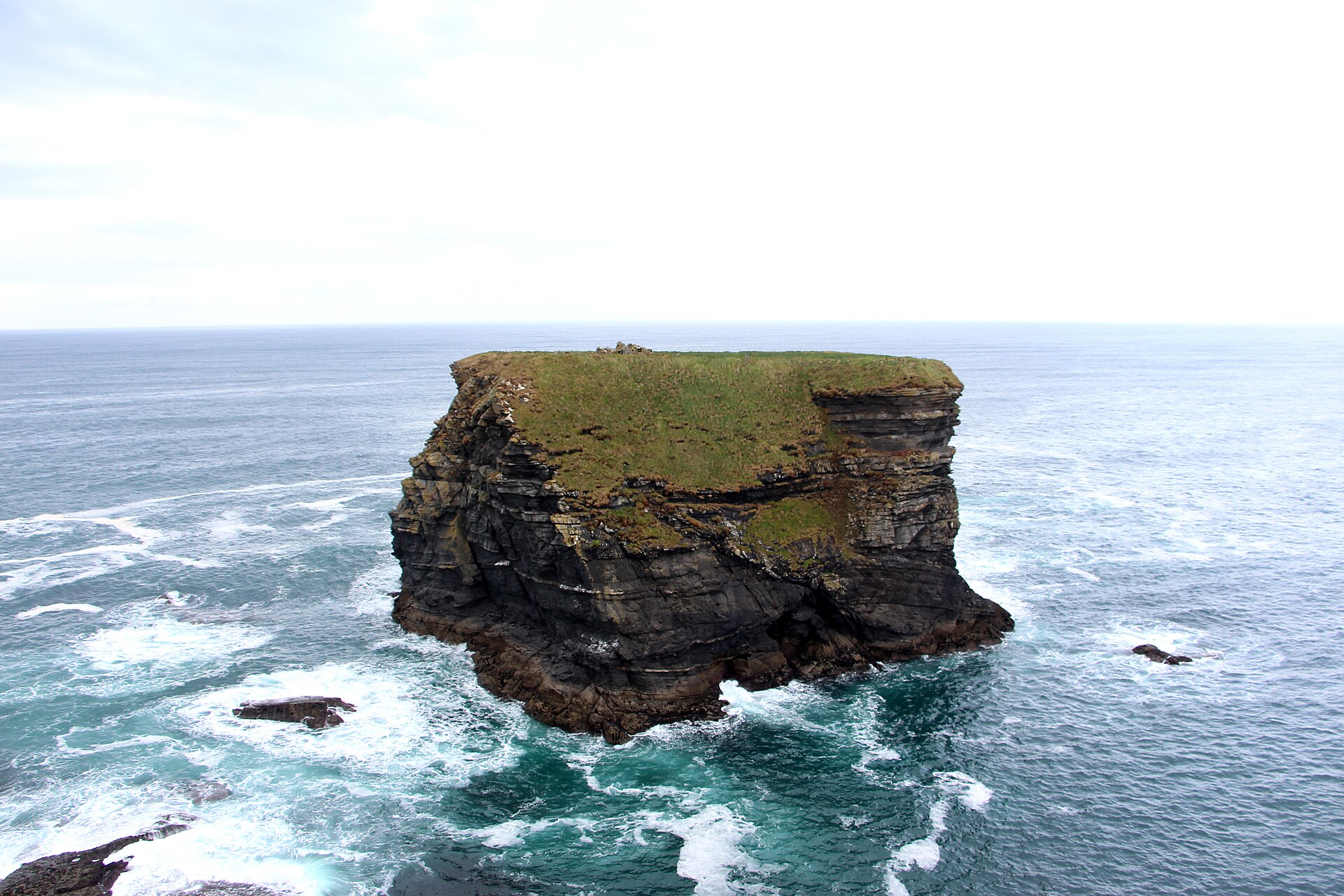
The island is not large — roughly 180 metres by 90 metres, and about 65 metres high. From the cliff path it looks almost like a stepping stone that has been separated from the mainland and left behind. But on that isolated platform, early Christian monks built a place of worship. The ruins have survived for over a thousand years, battered by Atlantic storms, visited by no one, and unreachable without equipment that most walkers simply do not carry.
It is one of the most striking sights along the Wild Atlantic Way — and one of the least talked about.
A Church Built at the Edge of the World
Bishop’s Island sits about two miles (3km) southwest of Kilkee town, just off the coastal road between Cross and Kilkee on the Loop Head Peninsula in County Clare. The sea stack rises sharply from the water, its sides too sheer and too exposed for any casual approach. On its flat, grassy summit sits the remains of an early Christian oratory — a small rectangular stone church built without mortar — along with what appear to be the foundations of a clochán, the distinctive beehive-shaped hut used by early Irish monks, and traces of up to four further structures.
Early Christian monks in Ireland deliberately sought out places of hardship and isolation. Islands, cliff edges, and remote headlands were not inconveniences — they were the point. The further a monk could remove himself from the distractions of ordinary life, the closer he believed he could get to God. Bishop’s Island, entirely cut off from the mainland, would have represented exactly the kind of extreme solitude these monks were looking for.
Nobody is entirely certain when the settlement was built, though it is generally dated to around the 6th century AD. Local tradition connects it to St Senan, who founded the monastery on Scattery Island at the mouth of the Shannon — on the other side of the Loop Head Peninsula — in the same era, part of the broader flowering of Irish monasticism that also produced Skellig Michael, further south. The site has never been formally excavated, so its full history remains unknown.
The name has a specific, well-attested origin: in Irish it is recorded as Oileán an Easpaig Ghortaigh — “island of the hungry bishop” — from a local legend about a bishop who became stranded there. It is one of the rarer cases of an Irish place name whose meaning is documented rather than guessed at.
Want more hidden corners of Ireland like this one?
Subscribe to our free newsletter
and we’ll send you stories, local tips, and places most visitors miss — straight to your inbox.
Why It’s Completely Inaccessible
Bishop’s Island is not a place you can visit. It is surrounded on all sides by the open Atlantic, with vertical cliffs dropping directly into the sea. There is no beach, no landing point, and no path down from the mainland cliffs above. Even by boat, approaching close enough to land would be extremely difficult and dangerous given the swell that builds around the base of sea stacks in this stretch of water.
This inaccessibility is precisely why the ruins have survived as well as they have. Nobody has been able to disturb them. No roads have been built nearby, no infrastructure has been installed, and no visitor footfall has worn the site down. The monks who built this oratory left it, the sea cut it off, and it has largely been left alone ever since.
Irish law and conservation rules protect the site regardless — but in practice, the geography provides the most effective protection of all. What you see from the cliff path is essentially what the monks left behind, preserved by remoteness rather than restoration.
How to See It From the Cliff Path
The signed Kilkee Cliff Walk runs south along the coast from the Diamond Rocks Café at the western end of Kilkee town, and Bishop’s Island comes into view within the first couple of kilometres. The path is well maintained compared to many Irish cliff walks, but it still runs close to unfenced edges in places, so good footwear and care are essential. Check conditions before you go — in wet or windy weather, this stretch becomes significantly more exposed and slippery.
Route options range from a short 1.8km there-and-back — enough to reach a clear view of the island — to an 11.7km loop that continues further along the Loop Head Peninsula. George’s Head, close to the start of the walk, is also a well-known vantage point looking out across Bishop’s Island. Binoculars make a real difference here — the distance means the ruins are small without them.
Parking is free at the Diamond Rocks Café, the usual starting point for the walk. The short there-and-back to see the island is an easy outing that takes well under an hour; the longer loop options take considerably more time and are best planned with a map of the peninsula.
Planning a trip to County Clare?
Join our free Ireland newsletter
for route guides, accommodation tips, and the local knowledge that doesn’t make it onto the tourist maps.
Seeing It by Boat
There is no scheduled boat tour that runs specifically to Bishop’s Island, but Kilkee’s sheltered bay is a popular base for kayaking tours that explore the sea caves and cliffs along this stretch of coast, and dolphin-watching boat trips run from Kilkee harbour in season. Either can bring you within sight of the stack from sea level, offering a very different perspective from the cliff path above.
From water level, Bishop’s Island looks entirely different. Rather than looking down onto the ruins, you look up at the sheer sides of the stack with the oratory barely visible on the skyline above — a reminder of just how isolated anything built on that summit would have been.
Availability of kayaking and boat trips depends heavily on sea conditions, and the season generally runs from spring to autumn. It is worth booking in advance during the summer months, and worth checking conditions on the morning of your planned trip — a calm day with light winds makes for a far more comfortable experience than one with any significant Atlantic swell running.
Where to Stay Nearby
Kilkee itself is the most convenient base for exploring Bishop’s Island and the wider Loop Head Peninsula. It is a well-established seaside town with a good range of guesthouses, hotels, and self-catering options, plus its own horseshoe-shaped bay and cliff walks right on the doorstep.
Kilrush, about 13km east, is a larger market town with more restaurants and services, and is also the departure point for ferries to Scattery Island. Further out along the peninsula, Loop Head itself has a handful of B&Bs for anyone wanting to base themselves closer to the lighthouse at the very tip of Clare.
If you are driving, Kilkee is around 90km from Limerick via the N68 coast road — about 1 hour 25 minutes. Parking at the Diamond Rocks Café, the start of the cliff walk, is free, though the car park can fill up on busy summer days, so arrive early if you can.
The Bigger Picture: Monastic Ireland’s Atlantic Edge
Bishop’s Island is not unique in the context of Irish monastic history. The country’s Atlantic coastline is dotted with sites where early Christian monks built in extreme, often barely accessible locations. Skellig Michael, further south on the Kerry coast, is the most famous of these — a UNESCO World Heritage Site with a remarkably intact monastic complex perched on a rock 12km out to sea. Closer to home, St Senan’s monastery on Scattery Island, at the mouth of the Shannon just east of Kilkee, reflects the same impulse.
But there are smaller, less celebrated versions of the same impulse all along the west coast. Bishop’s Island is one of them. The monks who built here were not building to impress visitors or establish an institution with political influence. They were building somewhere to pray, as far from the world as they could get, with nothing between them and the horizon but the Atlantic Ocean.
That impulse — to find the furthest edge and build something there — runs through a lot of Irish history and landscape. Bishop’s Island is a small, quiet example of it, easy to miss on the cliff path, impossible to reach, and worth every second you spend looking at it through binoculars from above.
Enjoyed this? There’s plenty more where it came from.
Subscribe to our free Ireland newsletter
and get stories like this delivered weekly — places, history, and travel tips from across the island.
☘️ Join 64,000+ Ireland Lovers
Every weekday morning, get Ireland’s hidden gems, local secrets, and travel inspiration — the kind you won’t find in any guidebook.
Subscribe free — enter your email:
📲 Know someone who’d love this? Share on WhatsApp →
Free forever · Unsubscribe anytime
Tours & experiences you might love


Powered by Viator. Some links are affiliate links — we may earn a small commission at no extra cost to you.
Secure Your Dream Irish Experience Before It’s Gone!
Planning a trip to Ireland? Don’t let sold-out tours or packed attractions spoil your journey. Iconic experiences like visiting the Cliffs of Moher, exploring the Rock of Cashel, or enjoying a guided walk through Ireland’s ancient past often sell out quickly—especially during peak travel seasons.

Booking in advance guarantees your place and ensures you can fully immerse yourself in the rich culture and breathtaking scenery without stress or disappointment. You’ll also free up time to explore Ireland’s hidden gems and savour those authentic moments that make your trip truly special.
Make the most of your journey—start planning today and secure those must-do experiences before they’re gone!