

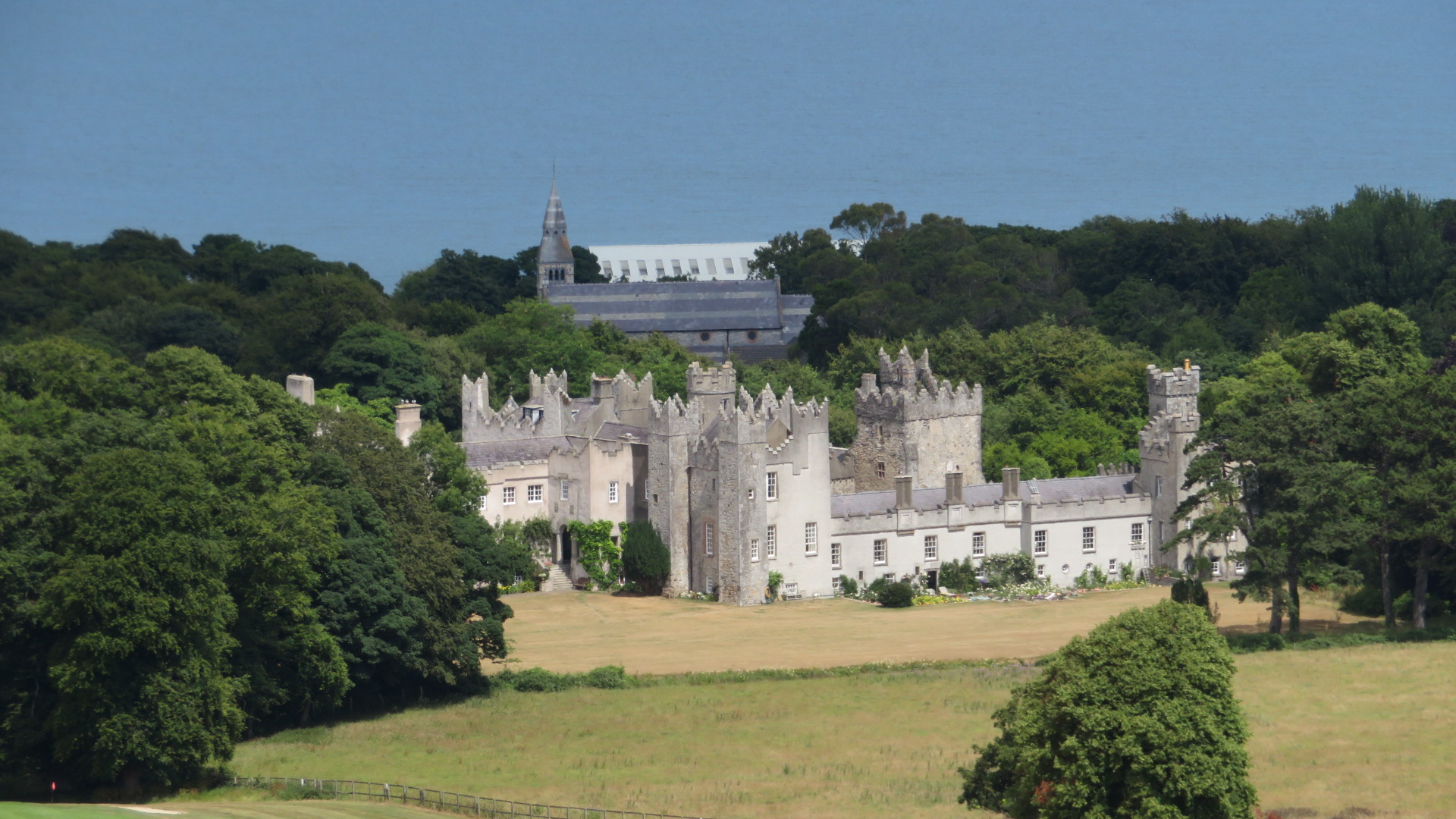
One Norman Family Held Howth Castle for 840 Years. Then Inheritance Tax Caught Up With Them.
There is a tradition at Howth Castle, on the rocky peninsula that juts into Dublin Bay nine miles from the city centre, that has been kept for somewhere between 400 and 500 years. At every dinner, an extra place is laid at the table. It is set for a guest who has never arrived, and probably never will.
The story behind it goes like this: in the late sixteenth century, a certain Gráinne Ní Mháille — Grace O’Malley, the pirate queen of Connacht — sailed into Howth harbour and presented herself at the castle gates, expecting, as was the ancient Irish tradition of hospitality, to be fed. The gates were closed against her. So she did what any self-respecting pirate queen would do: she waited near the shore, intercepted the young heir to the estate who had come down to admire her ship, and carried him back to Clew Bay. The boy was returned on one condition. From that day forward, the gates of Howth Castle would never be closed at the dinner hour, and a place would always be set for the unexpected guest.
Historians note, carefully, that no contemporary source for this story has ever been found. The timeline is awkward: O’Malley’s documented visit to Dublin was in 1576, and her famous trip to see Queen Elizabeth I not until 1593. The details shift depending on who is telling the tale. (Read the full story of that dinner-table promise in our deep dive on the legend itself.) But here is the thing about Howth Castle: the family who owned it simply kept setting that extra place anyway, generation after generation, for reasons that tell you almost everything about how they held this land for so long.
The Gaisford-St Lawrence family owned Howth Castle and its surrounding demesne for 840 years. That is not a rounding error. It is one of the longest unbroken periods of private family ownership of any property in the world, and it ended — as so many Irish stories do — with a deal signed in 2019.
How a Norman Soldier Named His Descendants
The story begins on 10 August 1177, which was, on the Catholic calendar, the feast day of St Lawrence. A Norman soldier named Almeric Tristram arrived in Ireland as part of the wave of conquest that followed Strongbow’s landing in 1169. His forces fought and won a decisive engagement at Evora Bridge, securing the entire Howth peninsula. The victory came on St Lawrence’s day, and Almeric, apparently moved by this, adopted the saint’s name for his family. He became the first Lord of Howth, and his descendants were called St Lawrence from that day forward.
It is the kind of origin story that sounds almost too neat — a family name plucked from the calendar on a victorious morning — but it is documented and consistent across sources. Almeric built his first castle in wood above the harbour. By 1235, a new structure had been raised on the present site, in the fertile middle of the peninsula. The oldest stones still standing date from the 1450s, when Christopher, the 14th Lord, built the Keep and Gate Tower. His descendant, another Christopher — the 20th Lord, known as the Blind Lord — added the great hall in 1558. William, the 25th Lord, constructed the East Wing between 1660 and 1671. By 1738, the house had acquired the form it broadly holds today.
The through-line of all this construction is the family’s survival. The St Lawrences navigated the Tudor conquest, the Elizabethan wars, the Cromwellian settlement, the Williamite upheaval, and the long decline of the Anglo-Irish ascendancy, all without losing their land. While other Norman and English families saw their Irish estates confiscated, gambled away, or divided into unworkability, Howth stayed intact. This was not luck. It was a sustained exercise in political adaptability, strategic loyalty, and — when necessary — quiet disappearance from the historical record until the storm passed.
The Architect Who Also Built New Delhi
By 1909, the direct line of Lords Howth had run out. The last holder of the title died without male heirs, and the estate passed to his nephew, Julian Gaisford, who combined the family names and became the first Gaisford-St Lawrence. He inherited not only the castle but the obligation to maintain it, and one of his first decisions was to bring in Edwin Lutyens.
Lutyens — who would go on to design the Viceroy’s House in New Delhi, the Cenotaph on Whitehall, and some of the most significant country houses in Britain and Ireland — was then in his early forties and at the height of his powers. At Howth, working between 1909 and 1911, he added the Gaisford Tower at the end of the west wing, purpose-built to hold the family’s library. He also designed a sunken garden, a loggia, steps to the east of the new tower, and a chapel. It is not a widely publicised connection — Howth is not on the standard Lutyens tour — but the work is there, embedded in the building.
The Gaisford-St Lawrences would continue their stewardship for another 110 years after Julian’s inheritance, through Irish independence, two world wars, and the radical restructuring of Irish society. They developed golf courses on the demesne and opened parts of the estate to visitors. They tried to make the numbers work. But the numbers kept getting harder.
The Rhododendrons: Ireland’s Most Spectacular Hillside
The one addition to Howth that gets the most attention from outsiders has nothing to do with the Norman conquest or Edwin Lutyens. In 1854 — a date that makes the gardens older than the Eiffel Tower, older than the formation of most modern European states — someone at Howth Castle began planting rhododendrons.
The gardens are widely considered the earliest dedicated rhododendron planting in Ireland. The original species was Rhododendron ponticum, the common purple rhododendron now so naturalised in Ireland and Britain that most people assume it has always been there. At Howth, it was packed into peat that had been wedged into crevasses in the cliff face, high on the rocky hillside overlooking the sea. Over subsequent decades, the ponticum was supplemented and in places replaced with newer hybrids and additional species. The collection that exists today numbers over two hundred distinct species and hybrids, and it covers roughly thirty acres of the demesne’s hillside.
In April and May, when the flowering peaks, the effect is startling: an entire cliff face submerged in dense colour, pinks and purples and deep reds cascading down through the rock. The writer H.G. Wells, who visited, described the view from the gardens and Muck Rock as one of the most beautiful in the world. Whether you take Wells as an authority on scenery is up to you, but the sight of a Victorian rhododendron collection in full bloom on an Irish cliff, with Dublin Bay spread below, is not something you are likely to forget.
The gardens are freely accessible to the public year-round, from dawn to dusk — one of the longer-standing commitments that has survived the ownership change. Guided tours have run during rhododendron season, and the estate’s paths lead through the gardens, past Aideen’s Grave (a Neolithic portal tomb, on the property for reasons that predate the St Lawrences by several thousand years), and up to Muck Rock at the cliff top.
The Exit: €1.5 Million Per Year, and a Decision
Julian Gaisford-St Lawrence, the man who sold the castle in 2019, was by most accounts the 30th heir in the family’s line at Howth. He had worked as a fund manager, which gave him a clearer view than most hereditary landowners of what the numbers on a 472-acre coastal estate actually looked like when written down properly.
The estate’s running costs had been estimated at around €1.5 million annually. There was the castle’s maintenance — a stone building of this age requires constant attention — plus the golf courses, the grounds, the Deer Park Hotel. The 50-year effort to turn the demesne into a tourist attraction had generated revenue but not enough to close the gap. And sitting beneath all of it, as it sits beneath every large Irish estate transferred between generations, was inheritance tax.
In October 2018, the family announced the sale. Tetrarch Capital, an Irish investment group with experience managing large hospitality assets including Mount Juliet Estate and Citywest Hotel, agreed to buy the entire package: the castle, 472 acres of demesne, the hotel, the golf courses, and Ireland’s Eye — the small island just off Howth harbour that had also passed down through the family. The deal closed in 2019. The price itself was never disclosed; contemporary reporting described it only as a multimillion-euro transaction.
Tetrarch subsequently sold a seven-acre portion, zoned for residential development near the castle gate, to Glenveagh Homes for €14 million — which gives you some sense of the land’s underlying value and of how the investment math was structured.
Julian Gaisford-St Lawrence, in a statement at the time of sale, said: “My family and I are very grateful to have been the owners of the Howth Estate for the last 840 years.” It is a sentence that sounds like understatement until you sit with it. Eight hundred and forty years. Every political upheaval in Irish history. Every generation passing the title forward. And at the end, a fund manager in 2019, calculating that the numbers no longer made sense.
What Comes Next
The plans Tetrarch announced for the estate — luxury hotel, revamped golf, retail, food, tourism infrastructure — have moved through Ireland’s planning system at the pace that large coastal development projects in protected areas typically do, which is slowly. A proposal for new road access was rejected following a planning appeal in September 2024. In early 2025, Tetrarch proposed a 99-year lease arrangement with Fingal County Council to develop the site as a tourism destination.
The castle itself and the demesne remain largely as they were. The rhododendron walks are still open. The cliff paths still wind up to Muck Rock. The gardens still bloom each April and May. Guided tours have continued during rhododendron season. The lands are zoned as High Amenity within the buffer zone of the Howth Special Amenity Area Order, which limits what can be built and how.
What is gone, specifically, is the family. And with the family went the particular kind of institutional memory that 840 years accumulates — the knowledge of which path floods in winter, which planting in the garden was put in by which generation, the reason for the extra place at the dinner table. Tetrarch is a competent institutional investor. It is not, and cannot be, the 31st generation of a Norman family who won this peninsula in a summer battle and named themselves after the saint on whose feast day they won it.
Whether the extra place is still set, we cannot say for certain. But if you walk the rhododendron paths in May, when the colour has taken over the cliff face and you can see all the way to the Mourne Mountains on a clear day, it is worth knowing what you are standing inside: a garden started in 1854, on land held since 1177, by a family who outlasted nearly everything that Irish history could throw at a Norman landowner — and who, in the end, were outlasted by the annual maintenance invoice.
There is something very Irish about that ending. And something quietly remarkable about everything that came before it.
Tours & experiences you might love


Powered by Viator. Some links are affiliate links — we may earn a small commission at no extra cost to you.
Secure Your Dream Irish Experience Before It’s Gone!
Planning a trip to Ireland? Don’t let sold-out tours or packed attractions spoil your journey. Iconic experiences like visiting the Cliffs of Moher, exploring the Rock of Cashel, or enjoying a guided walk through Ireland’s ancient past often sell out quickly—especially during peak travel seasons.

Booking in advance guarantees your place and ensures you can fully immerse yourself in the rich culture and breathtaking scenery without stress or disappointment. You’ll also free up time to explore Ireland’s hidden gems and savour those authentic moments that make your trip truly special.
Make the most of your journey—start planning today and secure those must-do experiences before they’re gone!