

Every county in Ireland tells a story. But Dublin tells all of them at once. The capital is where the threads of Irish history, culture, literature, and daily life converge in a city that somehow manages to feel both grand and intimate.
County Dublin is compact — the smallest county in Leinster by area — yet it contains nearly a third of the Republic’s population. Within its boundaries you will find medieval cathedrals and Georgian squares, world-class museums and hidden Victorian pubs, coastal walks that rival any in the west and literary landmarks on nearly every street.
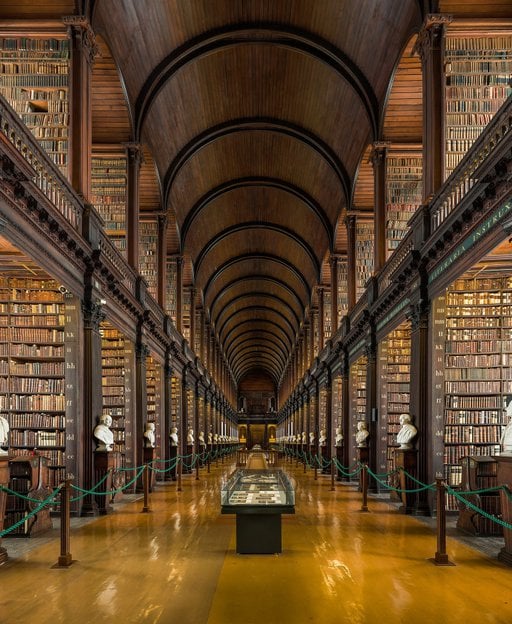
Trinity College — Where Knowledge Has Lived for Four Centuries
Founded by Elizabeth I in 1592, Trinity College is the oldest university in Ireland and one of the most beautiful campuses in Europe. But it is the Long Room that stops visitors in their tracks. Two hundred thousand of the library’s oldest books line the shelves of this barrel-vaulted chamber, which stretches nearly sixty-five metres. It is the kind of room that makes you lower your voice instinctively.
The Book of Kells, the ninth-century illuminated manuscript that may be Ireland’s single most famous artefact, is displayed in the Old Library beneath the Long Room. The detail in its pages — the interlocking spirals, the hidden animals, the jewel-like colours that have survived twelve centuries — is genuinely staggering when seen in person.
Georgian Dublin — The Doors That Tell a City’s Story
The coloured doors of Georgian Dublin have become one of the city’s defining images. Merrion Square, Fitzwilliam Square, and St Stephen’s Green are lined with eighteenth-century townhouses whose front doors were painted in every colour imaginable — according to legend, so that gentlemen returning home after an evening’s drinking could identify their own house.
Behind those doors lived some of Ireland’s greatest writers. Oscar Wilde grew up at 1 Merrion Square. W.B. Yeats lived at numbers 52 and 82. Daniel O’Connell, the Liberator, held court at 58. The statue of Wilde reclining on a boulder in Merrion Square Park, dressed in his trademark green smoking jacket, is one of the most photographed sculptures in the city.
☘️ Enjoying this journey through Dublin?
Join 64,000+ readers who get stories like this delivered free every morning.
Dublin’s Pubs — Where Conversation Is an Art Form
No city on earth does the pub quite like Dublin. These are not merely places to drink — they are living rooms, debating chambers, concert halls, and confessionals. The Brazen Head claims to be Ireland’s oldest pub, dating to 1198. Mulligan’s on Poolbeg Street has been serving pints since 1782. The Long Hall, Kehoe’s, Toner’s, The Stag’s Head — each has a character as distinct as a person.
☘️ Enjoying this? 64,000+ Ireland lovers get stories like this every week. Subscribe free →
Temple Bar, the cobblestoned cultural quarter on the south bank of the Liffey, is where most visitors begin their pub exploration. It is loud, colourful, and unapologetically tourist-facing — but step two streets in any direction and you will find the quieter pubs where Dubliners actually drink. That is where the real conversations happen.
Kilmainham Gaol — The Stone That Shaped a Nation
If there is one place in Dublin that every visitor should see, it is Kilmainham Gaol. This cold, grey Victorian prison held many of the leaders of every major Irish rebellion from 1798 to 1923. It was here that fourteen leaders of the 1916 Easter Rising were executed by firing squad in the stone-breakers’ yard — an act that transformed public opinion and ultimately led to Irish independence.
The guided tour is superb, leading through the cramped cells, the chapel where Joseph Plunkett married Grace Gifford hours before his execution, and finally into the east wing — the vast, skylit Victorian hall that has appeared in films from The Italian Job to In the Name of the Father.
The Guinness Storehouse and Phoenix Park — Dublin’s Biggest Draws
No County Dublin guide is complete without the Guinness Storehouse. Housed in the original fermentation plant at St James’s Gate, it has been Ireland’s most-visited paid attraction for well over a decade, drawing over 1.7 million visitors a year through seven floors that trace the beer’s history before ending at the Gravity Bar, with its 360-degree views over the city.
Just north of the city centre, Phoenix Park is one of the largest enclosed urban parks in any European capital — more than twice the size of New York’s Central Park — and free to explore. Inside its walls are Dublin Zoo, the official residence of the President of Ireland (Áras an Uachta&raacute;in), the Wellington Monument, and herds of wild fallow deer that have roamed the park since the 1660s.
The Coast — Dublin’s Best-Kept Secret
Most visitors never leave the city centre, which means they miss one of Dublin’s greatest treasures: its coastline. The DART railway hugs Dublin Bay from Howth in the north to Dalkey in the south, passing through Sandymount Strand, Dún Laoghaire, and Killiney — a coastal stretch that regularly draws comparisons to the Bay of Naples.
Howth Head, the rocky peninsula that guards the northern entrance to Dublin Bay, offers cliff walks with views that stretch to the Mourne Mountains on clear days. The village of Howth itself is famous for its fish restaurants, its harbour seals, and its Saturday morning farmers’ market.
At the southern end, the Forty Foot in Sandycove has been a bathing spot since the 1700s. James Joyce made it famous in the opening chapter of Ulysses, and locals still plunge into its frigid waters year-round. The nearby James Joyce Tower at Sandycove is a Martello tower that now houses a small museum dedicated to the writer.
Why Dublin Matters
Dublin is not always the Ireland of postcards. It does not have the wild emptiness of Connemara or the dramatic cliffs of Clare. What it has is depth and density — more history, more literature, more music, and more conversation per square kilometre than anywhere else on the island.
Four Nobel Prize winners in literature came from this city: Yeats, Shaw, Beckett, and Heaney (who lived here for decades). Joyce set his masterwork entirely within its streets. Bram Stoker, Oscar Wilde, Brendan Behan, Maeve Binchy, Roddy Doyle — the list of writers who emerged from Dublin is absurd for a city of its size.
Dublin does not demand that you be impressed. It invites you in, pours you a pint, tells you a story, and lets you make up your own mind. That is very Dublin. And it is very Irish.
☘️ Love learning about Ireland’s counties?
Join 64,000+ readers exploring Ireland — one story at a time. Free every morning.
This is part 13 of our 32 Counties series — a journey through every county in Ireland. Previously: Meath | Kilkenny | Tipperary | Limerick | Waterford | Wexford | Wicklow | Donegal | Clare | Galway | Cork | Kerry | Sligo | Louth
☘️ You Might Also Love
☘️ Want More Hidden Ireland?
Join 64,000+ subscribers who discover Ireland’s best-kept secrets every week.
Subscribe Free — Join the Community →
Free forever · Unsubscribe anytime · No spam
📥 Free Download: Ireland Travel Planning Guide
Our most popular resource — itineraries, insider tips, and the 50 places you must not miss.
Tours & experiences you might love


Powered by Viator. Some links are affiliate links — we may earn a small commission at no extra cost to you.
Secure Your Dream Irish Experience Before It’s Gone!
Planning a trip to Ireland? Don’t let sold-out tours or packed attractions spoil your journey. Iconic experiences like visiting the Cliffs of Moher, exploring the Rock of Cashel, or enjoying a guided walk through Ireland’s ancient past often sell out quickly—especially during peak travel seasons.

Booking in advance guarantees your place and ensures you can fully immerse yourself in the rich culture and breathtaking scenery without stress or disappointment. You’ll also free up time to explore Ireland’s hidden gems and savour those authentic moments that make your trip truly special.
Make the most of your journey—start planning today and secure those must-do experiences before they’re gone!