

The Building in Cork That Set the World Price of Butter
By the time most of Cork city was stirring for breakfast, the work was already nearly done. Farmers’ carts had been arriving since before dawn, horse-drawn and loaded with wooden barrels — firkins — packed tight with salted butter from the Kerry mountains, the Tipperary lowlands, the farms of Munster. At peak season, around 3,000 of those firkins arrived every single morning. Each one was inspected, graded, priced, and sold. The whole operation moved like a machine.
This was the Cork Butter Exchange, and for much of the nineteenth century it was the largest butter market on earth. The prices set in this single building on Shandon Street rippled outward to the West Indies, to Buenos Aires, to Bombay, to Sydney. When Cork’s daily quotations moved, commodity traders across the Atlantic noticed — in much the way that the London Metal Exchange sets global copper prices today.
It ran this way for more than 150 years, then disappeared almost entirely from common knowledge. (For the wider story, see our piece on the forgotten trade that made Cork the butter capital of the world.) The building still stands.
A Market That Invented Its Own Rules
The Cork Butter Exchange didn’t begin with a government charter or a royal decree. It began in 1769 with a group of merchants who had a problem: nobody trusted Irish butter.
By the mid-eighteenth century, Cork was already a significant export hub, with ships departing regularly for Britain, France, Spain, and the Caribbean. But butter, unlike timber or wool, degraded fast. It arrived rancid, or adulterated, or packed with salt so aggressively that it was barely edible. Merchants who paid premium prices for what a farmer called first-quality got no such guarantee. The market was full of bad actors and bad luck, and both looked identical until the lid came off.
The Committee of Merchants — the cartel of Cork’s butter exporters — decided to fix this not with laws but with inspection. They established a formal grading system in 1769 that was, for its time, astonishingly rigorous. Every firkin that came through the Exchange was assessed by a panel of trained inspectors. They extracted samples using long wooden pins, tasting and smelling the butter to evaluate its colour, texture, salt content, and freshness. Each barrel received a grade from first class down to sixth. Only after grading could it be sold.
The system had a clever anti-corruption mechanism built in: inspectors were randomly assigned their sections of the market floor each morning. Nobody could bribe the man who’d be inspecting their batch, because nobody knew in advance who that would be. This was an eighteenth-century solution to a twenty-first-century problem — regulatory capture — and it worked for over a century.
The result was “Cork 1,” a grade that became a recognized quality standard in markets around the world. Buyers from London to Lisbon to Kingston knew what they were getting. Cork butter commanded premium prices because Cork had built a reputation that could be trusted. The Exchange was not just a market; it was a certification system, a brand, and a global clearing house rolled into one.
The Man Who Built the Road Before There Was a Market
None of what followed would have been possible without the butter roads — and none of those roads would have mattered without one particularly unfortunate man from Castleisland, County Kerry.
His name was John Murphy, and in 1747 he took on the contract to build a new turnpike connecting the butter-producing lands of North Kerry to the Cork market. The route he surveyed was engineered to be, in the description of contemporary accounts, “as straight as the barrel of a gun.” He cut the effective journey from over 100 miles to roughly 66, reducing a week-long slog — along unpaved, winding tracks barely fit for a loaded horse — to a two- or three-day trip that a farmer could make and return from in a single push.
Murphy opened the road on May 1, 1748. He lost approximately £4,000 on the project. For a private contractor in mid-eighteenth-century Ireland, that was financial obliteration.
The tragedy has an added dimension. Murphy built his road before the Cork Butter Exchange formally existed. The institution that would make his turnpike indispensable to an entire economy didn’t open until 1769 — more than twenty years after he had gone into ruin laying its foundations. The toll revenues that might have rescued him arrived too late. The Butter Road outlasted him. The Exchange thrived on it for 150 years.
A loaded horse on Murphy’s road could carry two firkins of butter — roughly 112 pounds — to Cork and get the farmer home again before the week was out. Before the road, that journey was all but impossible for small producers. After it, tens of thousands of farms could access the market. Within decades, the Exchange was recording the arrivals of butter from 70,000 to 80,000 individual farmers in a single year.
How Big It Actually Got
The figures from the Exchange’s peak years are the kind that require a moment to process.
By the 1880s, the Exchange was handling around 500,000 firkins annually, valued at approximately £1.5 million — a sum that represented an enormous slice of Munster’s agricultural output. By 1835, one-third of all butter exported from the island of Ireland was leaving through Cork. The ships departing from Cork Harbour carried butter to the West Indies, to North and South America, to Australia, to India, to France, Spain, and Portugal. The Exchange’s geographic reach stretched across every ocean.
The building that housed this operation — rebuilt and expanded in its current form in 1849, designed by architect Sir John Benson with a classical limestone façade and Doric columns — was not large by the standards of, say, a Victorian railway terminus. But its function was global. The price set on that floor each morning was, for the international butter trade, the number that mattered.
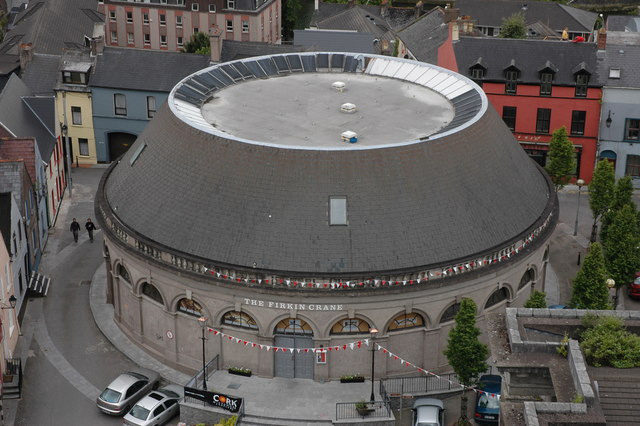
A separate structure nearby, the Firkin Crane building, opened in 1855 — also designed by Benson — to handle the preparation and repair of the barrels themselves. The word “crane” here refers not to the lifting machine but to the weighing scales used to measure each firkin before sale. The infrastructure of the trade had become substantial enough to require its own dedicated architecture.
The Long Decline
The Exchange’s fall was not sudden. It took about forty years of slow erosion before the doors finally closed.
The first crack appeared in the 1870s, when British consumer preferences began to shift. Cork butter was heavily salted — necessarily so, because before refrigeration, salt was the only reliable preservative for butter that needed to survive the voyage to Jamaica or Cape Breton. It worked well enough for export markets. But British domestic buyers, offered a choice, increasingly preferred the lighter, less aggressively salted butter coming out of Denmark and France.
Denmark, in particular, became a formidable competitor. Danish producers had modernized their operations, adopted cooperative structures, and began supplying a product specifically calibrated to what British middle-class consumers wanted. Cork’s exporters, built around a centuries-old system, were slow to respond.
Then refrigeration arrived in the 1880s, and the entire premise of salted butter as a preservation technology began to seem dated. At roughly the same time, the cooperative movement took root in the Irish countryside. Farmers who had once made the long journey to Cork could now sell through local cooperatives closer to home. The butter roads that John Murphy had built his fortune on — and lost it on — lost their reason to exist.
Quality at the Exchange itself reportedly slipped in the later decades, as the institution lost the tight merchant control that had originally made the grading system credible. The combination of British market preference, Danish competition, refrigeration, rural cooperatives, and internal decline proved fatal. The Exchange’s trustees sold the building in 1924. The last firkin had been weighed.
What Stands There Now
The building at Shandon survived, which is more than can be said for many of the great Victorian trading houses that once defined British and Irish commerce. Sir John Benson’s limestone facade — the Doric columns, the classical proportions — still faces the street in Cork’s northern quarter, looking very much as it did when 3,000 firkins a morning were stacking up outside.
Today it houses the Cork Butter Museum, which tells the full story of the trade: the grading system, the Butter Roads, the global exports, the cooperatives, the decline. The exhibits span from the farmstead butter-making of earlier centuries through to the modern Irish dairy industry, including the rise of brands like Kerrygold, which in its own way represents a continuation of the Cork 1 tradition — Irish butter marketed internationally as a quality product worth paying more for.
The Firkin Crane building next door is now home to Dance Cork Firkin Crane, one of the country’s major contemporary dance venues. The infrastructure of the butter trade has become, in its second life, the infrastructure of the arts.
There is something instructive in the whole arc. A group of merchants in 1769 built a quality-assurance system from scratch because reputation was the only moat they had. They randomized their inspectors to keep the system straightforward. They created a grade — Cork 1 — that became a global benchmark. The Exchange ran for 155 years on the strength of that original insight: that trust, once built carefully, is worth more than any single shipment. When the trust in Cork’s product eroded, the market eventually followed.
John Murphy never got to see any of it. He built the road, lost his money, and stepped off the stage before the curtain rose. But every firkin that rolled into that building in Shandon — all 500,000 of them in a peak year, all 30 million pounds of butter in an average export year — travelled at least part of the way on the road he surveyed and broke himself building, more than two decades before the Exchange opened its doors.
The butter market is gone. The building remains, and the story it holds is worth the detour north through the Shandon lanes to find it.
Tours & experiences you might love


Powered by Viator. Some links are affiliate links — we may earn a small commission at no extra cost to you.
Secure Your Dream Irish Experience Before It’s Gone!
Planning a trip to Ireland? Don’t let sold-out tours or packed attractions spoil your journey. Iconic experiences like visiting the Cliffs of Moher, exploring the Rock of Cashel, or enjoying a guided walk through Ireland’s ancient past often sell out quickly—especially during peak travel seasons.

Booking in advance guarantees your place and ensures you can fully immerse yourself in the rich culture and breathtaking scenery without stress or disappointment. You’ll also free up time to explore Ireland’s hidden gems and savour those authentic moments that make your trip truly special.
Make the most of your journey—start planning today and secure those must-do experiences before they’re gone!