

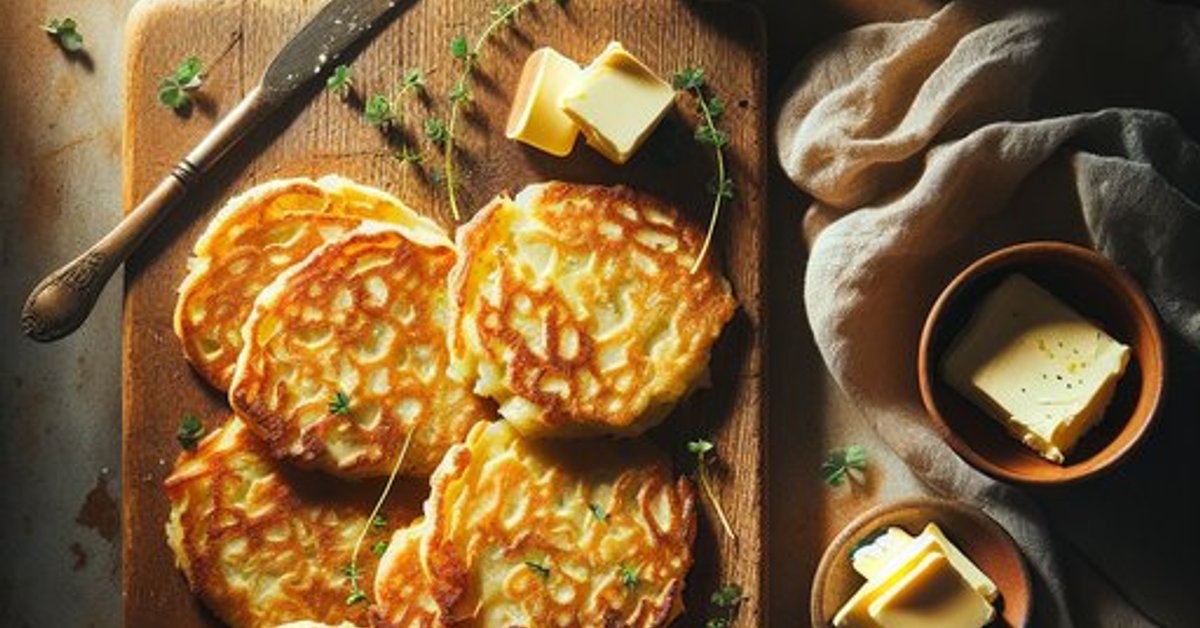
What’s the best Irish dish of all time? ☘️
Vote in our Best Irish Food poll — recipes nominated by the community.
What’s your Irish county’s signature dish? ☘️
Different counties claim different dishes — Your County’s Signature Food tells you which one your county is known for, with a short story behind it.
Boxty Recipe: The Beloved Potato Pancake of County Leitrim
There is a well-worn rhyme in the northwest of Ireland that goes: “Boxty on the griddle, boxty in the pan; if you can’t make boxty, you’ll never get a man.” It is the sort of saying that speaks to how deeply this humble potato pancake was woven into everyday Irish life — not just as food, but as a measure of domestic skill, of tradition passed hand to hand across kitchen tables. Boxty originated in the poorer, lakelands counties of Ulster and Connacht — Leitrim, Cavan, Donegal, and Fermanagh above all — where the potato was the cornerstone of survival and nothing, absolutely nothing, was wasted.
What makes boxty distinct from an ordinary potato pancake is its double nature: it combines both grated raw potato and mashed cooked potato in the same batter. The raw potato lends a slightly dense, chewy texture and a faint earthiness, while the mashed potato keeps the inside soft and yielding. Flour and buttermilk bind the whole thing into a batter that cooks to a golden, lacy-edged pancake on a hot griddle. It is rustic food in the very best sense — straightforward, satisfying, and deeply connected to the land that produced it.
Leitrim, in particular, claims boxty as its own. The county’s boggy, drumlin landscape was never kind to farmers, but it grew excellent potatoes, and boxty became a way of stretching a small amount of food into something filling and comforting. Today it is enjoyed across Ireland, served at breakfast alongside rashers and eggs, or as a supper dish with a filling of smoked salmon or sautéed mushrooms folded inside. This recipe is the traditional pan-fried version — simple, filling and good.
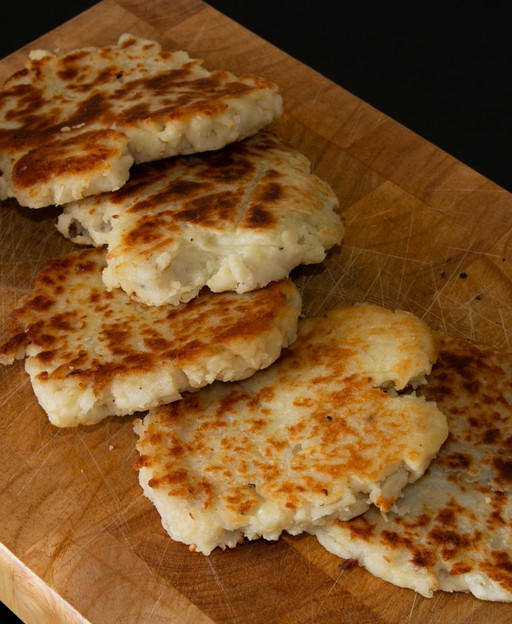
Traditional Irish Boxty (Potato Pancakes)
Ingredients
Equipment
Method
- Cut one 225 g (8 oz) portion of potatoes into even chunks and boil in lightly salted water for 15-18 minutes until completely tender. Drain well, mash until smooth and leave to cool.
- While they cook, finely grate the other 225 g (8 oz) of raw potato onto a clean tea towel or muslin. Gather it up and squeeze hard over a bowl to get out as much liquid as you can.
- Leave the squeezed liquid to stand for 10-20 minutes so the white starch settles at the bottom. Pour off and discard the watery liquid, then scrape the starch back in with the grated potato.
- In a large bowl, mix the cooled mash and the grated raw potato with a fork until even.
- Sift in the flour, baking powder, salt and pepper and stir until the mixture looks like rough, clumping crumbs.
- Add the egg and buttermilk and stir gently into a thick, slightly sticky batter that drops slowly from a spoon. If it is too stiff, add buttermilk a tablespoon at a time.
- Heat the oven to 100°C / 80°C fan / 200°F / Gas ¼ and put a baking tray in it. Heat a large heavy frying pan or griddle over a medium heat with a small knob of butter and a little oil.
- When the butter foams, drop in heaped tablespoons of batter and press them into rounds about 8-10 cm (3-4 in) across and 1 cm (½ in) thick.
- Cook for 4-5 minutes until deep golden underneath and set at the edges, then flip and cook for another 3-4 minutes. They are done when the centre feels firm to a light press; break the first one open to check there is no wet, raw potato inside. If they brown too fast, turn the heat down and cook a little longer.
- Keep the cooked boxty warm on the tray in the oven while you fry the rest in batches, adding butter and oil as needed. Serve hot.
Notes
Plain flour = all-purpose flour. Buttermilk: cultured buttermilk from the dairy aisle; or stir 1 tsp lemon juice into ⅔ cup milk and leave 5 minutes.
Squeeze the grated potato hard: wet potato makes heavy, soggy boxty. Keep the heat at medium so the inside cooks before the outside burns.
Batter: keeps covered in the fridge for up to 24 hours. The raw potato may darken a little; stir before frying.
Storage: cooked boxty keep covered in the fridge for 3-4 days. Reheat in a dry pan or the oven until hot through.
Serve with butter and sea salt, a full Irish breakfast, or smoked salmon. Photo: Mid-Kerry Media / Shutterstock Free from Love Ireland: 10 Real Irish Recipes
Tips
- Floury potato varieties are essential — waxy potatoes will not mash smoothly or grate with the right texture.
- Do not rush the squeezing step. A well-wrung grated potato makes the difference between a light, golden boxty and a soggy one.
- Keep the heat at a steady medium — too high and the outside burns before the inside cooks through.
- Leftover batter keeps well in the fridge, covered, for up to 24 hours. Give it a gentle stir before frying.
- Boxty is wonderful served simply with butter and a pinch of sea salt, or alongside a full Irish breakfast. For another Irish potato favourite on the same plate, try fadge (Ulster potato farls).
Visiting Dublin? Here is where to eat boxty in Dublin. Want more potato comfort? Try our colcannon or champ recipes, read about the boxty rhyme and its forgotten bread, or compare with our traditional Irish boxty recipe. See also Ireland’s 10 most beloved traditional dishes.
There is something quietly wonderful about a dish this old still holding its place at Irish tables. Boxty asks very little of you — a few potatoes, a bowl, a hot pan — and gives back something warm, golden, and genuinely satisfying in return. Make a batch on a grey weekend morning, and you will understand entirely why the people of Leitrim held it so dear.
Tours & experiences you might love


Powered by Viator. Some links are affiliate links — we may earn a small commission at no extra cost to you.
Secure Your Dream Irish Experience Before It’s Gone!
Planning a trip to Ireland? Don’t let sold-out tours or packed attractions spoil your journey. Iconic experiences like visiting the Cliffs of Moher, exploring the Rock of Cashel, or enjoying a guided walk through Ireland’s ancient past often sell out quickly—especially during peak travel seasons.

Booking in advance guarantees your place and ensures you can fully immerse yourself in the rich culture and breathtaking scenery without stress or disappointment. You’ll also free up time to explore Ireland’s hidden gems and savour those authentic moments that make your trip truly special.
Make the most of your journey—start planning today and secure those must-do experiences before they’re gone!