

How Eight Races Became Ireland’s Biggest Week
On Tuesday, 17 August 1869, roughly 40,000 people made their way to a stretch of farmland called Ballybrit, about a mile east of Galway city. They had come for eight horse races spread across two days. The park at Eyre Square had to be opened overnight to give the overflow somewhere to sleep.
Think about that crowd for a moment. This was Ireland two decades on from the worst years of the Famine — a country still reckoning with absence, with the arithmetic of emigration, with a west-of-Ireland city that had been reshaped by catastrophe. And yet 40,000 people arrived, travelling from across Connacht and beyond, for a meeting that had never been held before.
The centrepiece race was a handicap chase called the Galway Plate. It was won by a horse called Absentee. In an Ireland where a million people had died and another million had left, the name had a resonance that nobody was going to miss.
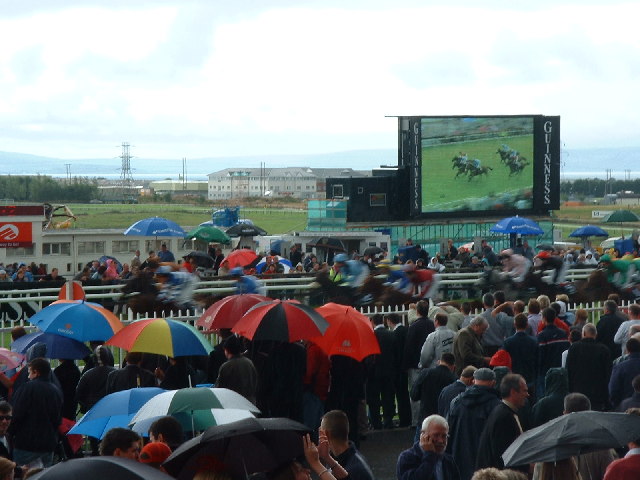
That first two-day meeting was the beginning of something that, more than 150 years later, still takes over the city every last week of July. The Galway Races — officially the Galway Festival — is now a seven-day event, one of the largest racing festivals in Europe, and the week around which, by informal consensus, a significant portion of Irish social and professional life quietly reorganises itself every summer.
A Very Patient Expansion
The Galway Festival did not grow quickly. That original two-day format stayed in place for ninety years. In 1959, a third day was added. In 1971, a fourth. In 1974, a fifth. By 1982, it had reached six days. In 1999 — exactly 130 years after that first eight-race card — the seventh day was added, completing the format the festival still runs today.
What this timeline reveals is something interesting about how racing festivals actually develop. The expansion wasn’t the product of a masterplan. Each additional day was a response to pressure from below: more horses wanting to run, more people wanting to come, more commercial money flowing into Irish racing, more capacity being built at Ballybrit. Nobody sat in a boardroom in 1890 and declared the festival would be seven days by 1999. It grew the way most durable institutions grow — by accumulating demand and then, eventually, making room for it.
The festival now opens on the last Monday of July every year, running through to the Sunday. Wednesday is Galway Plate day — the festival’s oldest race, still the headline act after a century and a half. Thursday is the Galway Hurdle and Ladies’ Day, the two biggest crowd-pullers on the social calendar. By the time Sunday arrives, a full week of Galway has been accounted for: the racing, the hospitality, the fashion, the bookmakers, the conversations that start in the parade ring and finish somewhere in the city at midnight.
The Horse and the Race
The Galway Plate is a handicap chase run over roughly two miles and six furlongs, and it is genuinely one of the oldest continuously contested races in Irish racing. It has been run on the same course — give or take wartime gaps — since Absentee won it in 1869. That kind of continuity is rarer than it sounds. Most of what passes for “tradition” in sport is branding applied retrospectively. The Galway Plate actually has the receipts: a winners’ roll stretching back to the Victorian era, a format almost unchanged, a crowd that has been watching it happen on the same slope of Galway ground every summer for generations.
Ballybrit as a track has its own character. Right-handed, with a testing uphill finish that punishes horses who lack stamina, it favours stayers over sprinters and tends to benefit horses who know how to settle early. The track’s geography is part of why the racing feels different here than at a flat-track city course. There is genuine terrain to negotiate, genuine questions to be answered, and on Plate day the stands fill with people who are there specifically to watch a horse race rather than to be photographed at one — though both happen simultaneously in large numbers.
The social dimension of the festival is real and has been since the beginning. That 1869 crowd needed somewhere to sleep, which is why Eyre Square was opened as overflow accommodation. The people who arrived that first day were not attending a corporate hospitality event. They were attending a horse race that had generated enough anticipation — by word of mouth, in the absence of any modern marketing infrastructure — to pull tens of thousands of people to a field outside Galway on a Tuesday in August. Whatever the Galway Races is commercially today, it started as something genuinely grassroots, and the texture of that origin has survived.
The Celtic Tiger Number
Attendance is where the Galway Races story gets genuinely interesting — and complicated.
During the Celtic Tiger years, the festival became one of the fullest expressions of Ireland’s appetite for spectacle. In 2006, the Irish Times reported attendance across the week at 216,942. That figure represents the festival at probably its historical peak, and it also represents something specific about that era: the confluence of disposable income, an inflated sense of occasion, and a particular Irish enthusiasm for the Galway Races as social theatre. The race week had become, in those years, as much about the city as the racecourse — a week when Dublin descended on Galway and the hotels tripled their rates and the restaurants were booked months in advance.
In 2024, total attendance was 116,374. In 2025, that figure recovered to approximately 126,000 — up nearly 10,000 on the year before, which the organizers were pleased about. Both figures are still substantial, and as attendance figures for a week-long horse racing festival go, they represent a genuinely large crowd. But the distance from 216,942 to 116,374 is not a small thing. It maps, almost exactly, onto the arc of Ireland’s economy and self-image since 2006. The festival endures; it just endures at a somewhat more proportionate scale.
The interesting question — and it is a real question — is what an attendance of 116,000 or 126,000 people actually means for Galway city. And here, the story takes an unexpected turn.
The Study Nobody Commissioned Again
In 2002, a team from UCD’s Smurfit Business School conducted a formal economic impact study of the Galway Races. Their finding: the festival contributed approximately €58 million to Galway city and the wider region. The study broke this down into roughly €22.8 million in direct visitor spend on accommodation, travel, and hospitality, approximately €11 million spent inside the racecourse itself, and a multiplier effect applied across the regional economy.
That 2002 UCD study is the last formal economic impact study the Galway Race Committee has commissioned. It is now more than two decades old.
This is not a minor caveat. Ireland’s economy has changed substantially since 2002. Galway has grown, hotel prices have inflated enormously, and the festival’s own prize fund has more than doubled. The same €58 million figure continues to appear in press releases and media coverage today, circulated unchanged as though it describes the 2020s rather than the early Celtic Tiger era. Whether the actual current figure is higher or lower, nobody has officially measured it. The gap between the data and the promotion is, in its own way, more revealing than any number could be: a festival confident enough in its own reputation that it has not felt the need to document what it actually generates.
What can be documented precisely is the prize money, because the racecourse publishes it. In 2017 — the 148th running of the festival, a number that itself confirms the continuity from 1869 — the total prize fund topped €2 million for the first time, an increase of €123,000 on the previous year. That year, the Guinness Galway Hurdle carried a prize fund of €300,000 and the Galway Plate was worth €250,000. These were, at the time, records for the festival. By 2023 and again in 2025, the total prize fund had reached €2.1 million across 53 races, with both the Plate and the Hurdle equalising to around €270,000 each. These are numbers that can be checked, cross-referenced, and confirmed. They tell a story of steady commercial growth even as the attendance figures tell a more ambivalent one.
What the Scale Actually Means
There is something worth sitting with in the comparison between 1869 and now. On the very first day of the very first Galway Races, 40,000 people turned up to a racecourse that had never held a meeting. The full week-long festival in 2024 drew roughly 116,000. Put that way, the mathematical growth looks modest — three times the first day’s crowd, across a week seven times as long.
But the 1869 crowd isn’t really a baseline for comparison. It is, instead, the evidence for something more fundamental: the demand was there from the beginning. In a region that had been devastated by famine and emptied by emigration, 40,000 people found their way to Ballybrit for eight horse races. That capacity for collective attendance, for the particular form of communal occasion that a horse racing festival provides — the betting, the judging of form, the social theatre of the parade ring, the specific pleasure of watching an animal do something at the edge of its ability — was already established in Galway before the first race had been run.
The festival didn’t create that appetite. It gave it a container. And for 157 years, it has been slowly making the container bigger.
Still Running
Every last Monday of July, the Ballybrit gates open and the racing begins. The city fills with people who have, in many cases, been coming for years — some of them carrying the kind of detailed institutional knowledge about the track, the draw, the going, and the trainers that takes decades to accumulate. The Galway Plate is run on the Wednesday. The Galway Hurdle on the Thursday. The week does what it has always done, which is to pull the west of Ireland toward a racecourse on the edge of a city and make something happen there that feels, despite everything, like it couldn’t quite happen anywhere else.
Absentee won the first one. The last one was won by something else, and the one after that will be won by something else again. The list of winners stretches back further than almost any other sporting record in Ireland. That is, in the end, what the Galway Races is: a very old habit, running on ground that has been absorbing the weight of August crowds since before the modern world existed, and showing no particular sign of stopping.
Tours & experiences you might love


Powered by Viator. Some links are affiliate links — we may earn a small commission at no extra cost to you.
Secure Your Dream Irish Experience Before It’s Gone!
Planning a trip to Ireland? Don’t let sold-out tours or packed attractions spoil your journey. Iconic experiences like visiting the Cliffs of Moher, exploring the Rock of Cashel, or enjoying a guided walk through Ireland’s ancient past often sell out quickly—especially during peak travel seasons.

Booking in advance guarantees your place and ensures you can fully immerse yourself in the rich culture and breathtaking scenery without stress or disappointment. You’ll also free up time to explore Ireland’s hidden gems and savour those authentic moments that make your trip truly special.
Make the most of your journey—start planning today and secure those must-do experiences before they’re gone!