

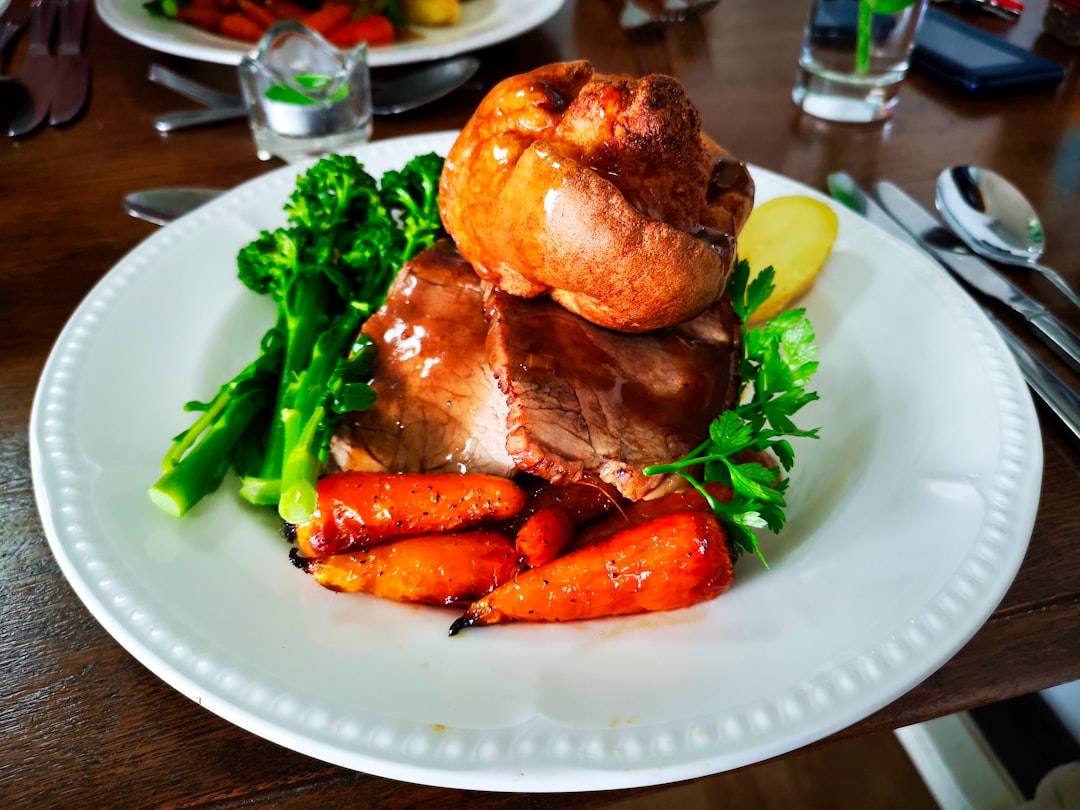
Walk into almost any rural Irish pub between half twelve and two on a Sunday afternoon and you will find the same scene: tables full, the smell of roasting meat drifting from a kitchen that has been working since early morning, and a steady queue forming beside a heavy silver counter stacked with carved beef, glazed ham, roast potatoes, and more vegetables than any single plate can reasonably hold. The Sunday carvery is not a recent invention dressed up as tradition. It has been a fixture of Irish pub life for decades, rooted in patterns of rural working life, the rhythms of mass-going, and the practical reality that cooking a full roast for a large family was, and sometimes still is, a considerable undertaking. The pub offered an easier answer.
The timing of the Sunday carvery is no accident. Catholic mass in rural Ireland traditionally ran through Sunday morning, with many congregations finishing between eleven and half past. The carvery slot — noon to two, sometimes stretching to three in busier houses — slotted in directly afterwards, which is why you will still hear the meal called “the Sunday dinner” rather than lunch. Families would come straight from the church car park to the pub, often three generations at once, making the Sunday carvery one of the few occasions on which Irish pubs functioned primarily as dining rooms rather than drinking establishments. The bar might be busy, but the carvery tables were the main event. Publicans understood this and structured their whole week around it; some country pubs that do modest midweek trade will turn over more covers on a Sunday lunchtime than on any other five days combined.
What distinguishes an Irish carvery from a standard roast is partly the sheer volume of food and partly the particular combination of dishes on offer. A well-run carvery will typically have two or three carved meats — beef and ham are near-universal, with turkey appearing year-round in many establishments, not only at Christmas. Alongside the carvings you will find roast and boiled potatoes served simultaneously (this is not considered redundant in Ireland), a soup course that often comes first without extra charge, stuffing served as a side rather than tucked inside a bird, and a rotation of vegetables that frequently includes turnip, which has fallen off menus in Britain but holds its ground on Irish carvery counters with quiet stubbornness. Gravy here is taken seriously — watery gravy is remembered and discussed unfavourably for years. The plates are large, the portions generous, and going back for seconds is expected rather than frowned upon.
The pubs that run the best carveries tend to be those that have done it long enough to have the logistics absolutely right. A successful carvery requires a kitchen that can hold large cuts at the correct temperature without drying them out, staff who can carve efficiently under pressure, and a system for replenishing trays before they run dry during the peak rush. Many of Ireland’s most beloved carvery pubs are in county towns and village crossroads rather than city centres — places like the midlands, the west, and south Leinster where the tradition has remained uninterrupted even as urban eating habits shifted. It is in these settings that you still see the full social picture: farmers still in good coats from mass, young families negotiating the serving counter with toddlers underfoot, older couples who have been coming to the same table in the same pub on the same day for thirty years.
Why It Matters Today
For visitors to Ireland, the Sunday carvery is one of the most direct ways to experience how rural Irish pub culture actually functions rather than how it is sometimes packaged for tourists. It is inclusive, affordable, and completely unpretentious — a proper meal in a working pub, surrounded by local people doing something they have always done. Many visitors arrive expecting the evening atmosphere of live music and sociable bar stools, which is real enough, but the Sunday lunchtime carvery shows a different and arguably more rooted side of Irish life. Arriving at a country pub just after midday on a Sunday, finding a table, and sitting down to a plate of carved beef with roast potatoes and a bowl of soup is one of those experiences that costs very little and stays with you for a long time.
The Sunday carvery has outlasted food trends, economic downturns, and the arrival of every kind of restaurant concept you can name, and it shows no signs of fading. It persists because it serves a genuine social function, because it tastes exactly like what it is, and because no amount of reimagining can quite replace the particular satisfaction of a plate piled properly high on a grey Sunday afternoon in the Irish countryside. That is not nostalgia. That is just a very good thing still being done very well.
Tours & experiences you might love


Powered by Viator. Some links are affiliate links — we may earn a small commission at no extra cost to you.
Secure Your Dream Irish Experience Before It’s Gone!
Planning a trip to Ireland? Don’t let sold-out tours or packed attractions spoil your journey. Iconic experiences like visiting the Cliffs of Moher, exploring the Rock of Cashel, or enjoying a guided walk through Ireland’s ancient past often sell out quickly—especially during peak travel seasons.

Booking in advance guarantees your place and ensures you can fully immerse yourself in the rich culture and breathtaking scenery without stress or disappointment. You’ll also free up time to explore Ireland’s hidden gems and savour those authentic moments that make your trip truly special.
Make the most of your journey—start planning today and secure those must-do experiences before they’re gone!