

Try the Guinness Timer ⏱️
A perfect pour takes 119.5 seconds — the rest, two minutes, gives the stout time to settle. Time your own pint and see if you wait long enough.
What’s the best Irish dish of all time? ☘️
Vote in our Best Irish Food poll — recipes nominated by the community.
Got a favourite Irish pub? ☘️
Vote in our Best Pubs in Ireland 2026 poll — nominees come from the community and the leaderboard updates live.
What’s your Irish county’s signature dish? ☘️
Different counties claim different dishes — Your County’s Signature Food tells you which one your county is known for, with a short story behind it.
Why do traditional Irish pubs have shelves and shop fittings inside?
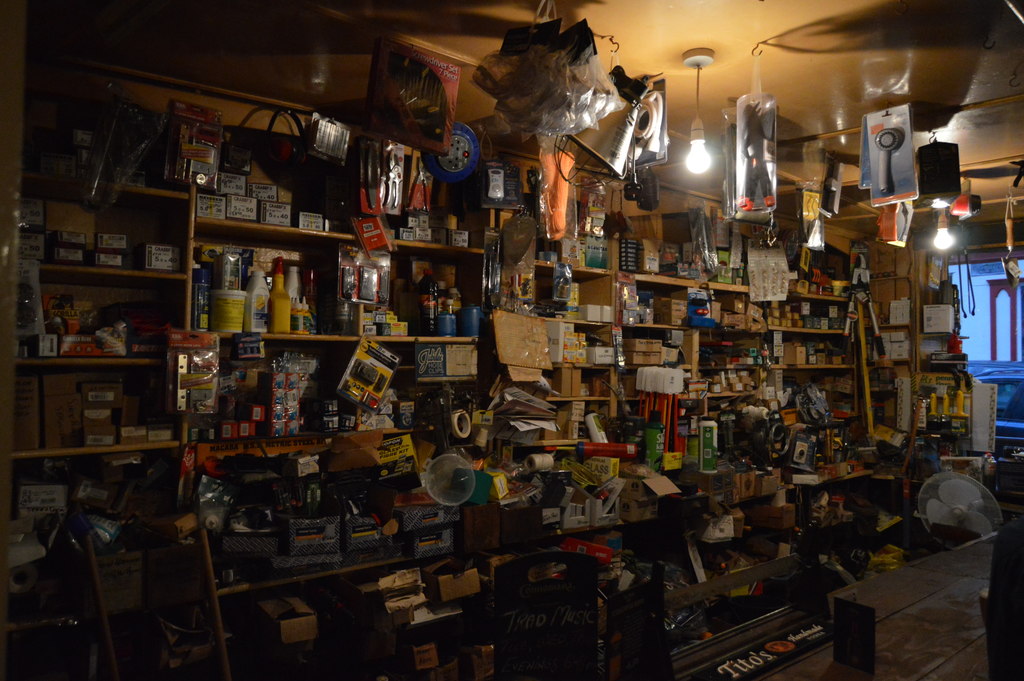
Walk into Morrissey’s in Abbeyleix, County Laois, and it takes a moment to work out what you’re looking at. There are jars of sweets on the shelves. A fixed-speed bicycle hangs somewhere near the ceiling. Old Jacob’s biscuit tins line the walls alongside vintage Fry’s chocolate advertisements. A grocer’s scales sits behind the bar, next to the spirits.
The pints are perfectly good. But the room looks unmistakably like a shop that someone, somewhere along the way, decided to start serving alcohol in as well.
That is, in the most literal sense, exactly what happened — not just in Morrissey’s, but in hundreds of pubs across Ireland. The strange fittings that catch your eye in older Irish bars are not decorative nostalgia. They are the physical residue of a specific business model that defined rural Irish commerce for the better part of a century, born from an unlikely collision between religious fervour, economic pressure, and some surprisingly creative licensing law.
To understand why your pint glass is resting on a mahogany counter that once held sacks of flour, you have to start in Cork, on the evening of 10 April 1838, with a Capuchin priest and a very large book.
The Man Who Made Drinking Complicated
Father Theobald Mathew had spent years working among the poorest communities in Cork city before he was persuaded to chair the first meeting of the Cork Total Abstinence Society. He expected a modest gathering. About sixty people showed up that evening, signed the pledge in his schoolhouse, and the movement began.
What followed was one of the most remarkable social campaigns in Irish history. Father Mathew travelled across Ireland, and crowds came to hear him and take the pledge in numbers that surprised everyone, including him. After just ten months, more than six thousand people had signed. By 1841, the estimated number of abstainers in Ireland had reached 4,647,000 — in a country whose total population at the time was a little over eight million. In the three years between 1838 and 1841, Irish spirit consumption fell by approximately fifty percent.
For the country’s publicans, this was a crisis measured in empty glasses. A trade that had been taken for granted suddenly had to account for a customer base being actively encouraged, by a priest with a national following, to stop drinking entirely.
Those publicans needed something to fall back on. The law, perhaps coincidentally, handed them exactly that in 1838 — the same year Father Mathew opened his pledge book.
The Spirit Grocery Takes Shape
New legislation passed in 1838 allowed grocers in Ireland to acquire spirit licences — and crucially, allowed publicans to operate grocery businesses on the same premises as their bar. The result was the “spirit grocery”: a single building running two businesses, often divided by nothing more than a counter and a working assumption about which side of the room you were on.
The physical layout became strikingly consistent across the country. A spirit grocery typically presented a symmetrical shopfront to the street — a central door flanked by a window on either side, a clean neoclassical proportion that you can still identify on older commercial buildings in small Irish towns once you know the pattern. Inside, a bar counter ran along one side of the room. Grocery shelving lined the other, stocked with spice drawers, tea canisters, a meat slicer, jars and tins. The shelving behind the bar — deep, floor-to-ceiling, built to carry goods — looks, to a modern eye, like far more storage than any drinking establishment actually needs. That is because it was built to carry goods.
Customers developed the habit of doing both things in the same trip. Pick up flour and stay for a whiskey. Stop in for a pint and leave with a pound of butter. The commercial logic was deliberate: the grocery gave the publican a daytime trade that did not depend on people wanting to drink, and the bar gave the grocer an evening revenue stream that did not depend on people wanting to shop. Between them, the two sides of the business covered most of the hours of the day.
When a Pub Sold Everything
Groceries and spirits were only the beginning. In many towns, the publican was the most commercially resourceful person in the community — and the spirit grocery expanded to fill whatever gap existed in the local economy.
In coastal communities, pubs kept fishing nets and rope alongside the spirits. Inland towns stocked hardware: bolts, hinges, buckets, nails, shovels, boot polish. Some ran a draper’s corner with fabric. In parts of Connacht, you could apparently arrange to be measured for a suit. The informal credit that publicans extended to regular customers — knowing that they would settle when the harvest came in or the wages arrived — made the spirit grocery function as something close to a community bank as well.
The most startling extension of the model was the undertaker’s business. In communities where death was a regular, unsentimentalised fact of daily life, it made a kind of rough sense: the publican knew everyone, had appropriate space, often had a cellar suited to temporary storage, and was already functioning as a community hub. In parts of southern and western Ireland in particular, the combination of pub and undertaker became unremarkable.
McCarthy’s of Fethard, County Tipperary, established by Richard McCarthy in the 1850s, ran at its peak as a spirit merchant, restaurant, hotel, undertaker, draper, grocer, baker, and provider of hackney transport — with separate retail areas for glass, pottery, and china. The current proprietor, Vincent Murphy, known locally as Jasper, still runs the undertaking business alongside the pub and restaurant. The slogan, printed without apparent irony, is: “We wine you, dine you and bury you.” Behind the bar, Murphy keeps an undertaker’s ledger from 1945. Michael Collins is said to have drunk there. So, in more recent years, have Alex Ferguson, Graham Norton, and David Frost.
One Building, Several Lifetimes
If you want to see what the spirit grocery looked like at its working peak, Morrissey’s in Abbeyleix is still about as close as you can get to the real thing.
The site traces its origins to 1775, when it operated as a grocery and shebeen — the term for an unlicensed drinking place, common in rural Ireland before the formal licensing system took hold. In the 1880s, a single-storey structure was replaced with the two-storey building that still stands: lofty, shelf-lined, built to hold a great deal of stock, with a pot-belly stove for winter and a bar counter that runs through the room at the angle of something designed to serve two purposes simultaneously.
The man who rebuilt it, Edward J. Morrissey, ran the kind of operation that was entirely normal for his era and would seem extraordinary now. In addition to the grocery and the bar, he worked as an undertaker, an auctioneer, and an insurance agent. He also sold travel tickets — including, according to the pub’s records, tickets for the Titanic’s maiden voyage in 1912. The artefacts of that era are still in the building: Jacob’s biscuit tins, a fixed-speed bicycle, the grocer’s scales, jars of sweets on the shelves, old advertisements that were simply never replaced.
The bar remained in the Morrissey family until 2003, when Carlow publican Tom Lennon bought it. He has largely left the interior as he found it. “It’s the real deal,” he has said. The actor John Hurt, who lived in County Kilkenny in his later years, was a regular. In 2017, Morrissey’s won Pub of the Year at the Irish Restaurant Awards. The grocer’s scales was presumably still there.
The Government Tightened the Screws — Twice
By the turn of the twentieth century, the spirit grocery was established enough as a commercial category that Parliament passed specific legislation to regulate it: the Beer Retailers’ and Spirit Grocers’ Retail Licences (Ireland) Act of 1900. Two years later, the Licensing (Ireland) Act of 1902 froze the issuing of new alcohol licences entirely. You could keep a licence you already held; getting a new one became essentially impossible except under a narrow set of conditions. This created an unusual situation: the licences that existed became significantly more valuable, and any business that held a combined pub-grocery licence had a strong incentive to protect it, even if the grocery trade was barely ticking over.
Then the First World War arrived and made everything more complicated.
The Defence of the Realm Act, passed in August 1914, gave the British government sweeping powers over civilian life. By spring 1915, those powers had been applied to alcohol: pub opening hours were restricted to noon until three in the afternoon, and 6:30 until 9:30 in the evening. Lloyd George, then Minister of Munitions, was direct about his reasoning: “We are fighting Germans, Austrians and drink.” A specific Defence of the Realm amendment for Ireland followed in May, covering the supply and sale of liquor.
For spirit groceries, curtailed pub hours were not entirely a disaster. If customers could not drink, they could still shop. The grocery half of the business filled the hours the bar was forced to leave empty. The wartime restrictions, paradoxically, gave the spirit grocery model a structural argument for survival at the moment it might otherwise have started to fade.
How Partition Split the Tradition in Two
In 1922, when Ireland was partitioned, the spirit grocery faced a regulatory decision — but only in the North. Under the new arrangements in Northern Ireland, proprietors of spirit groceries were required to choose: the retail trade or the licensed trade. They could keep the shop, or keep the bar. Not both. As a legal and commercial category, the spirit grocery ceased to exist above the border from that point forward, and the distinctive pub-shop hybrid that had been a feature of towns throughout the island became exclusively a phenomenon of the South.
In the Free State, and later the Republic, no equivalent separation was imposed. The spirit groceries of the South were left to evolve — or not — on their own terms.
What the Supermarkets Finished
What partition couldn’t accomplish in the South, the supermarket eventually did.
Through the 1950s, the old model held well enough. Rural towns still depended on the spirit grocery for much of their daily commercial life. But across the 1960s, grocery chains arrived at a scale no individual publican could match. Customers who had always bought flour, tea, hardware, and an evening drink from the same counter discovered they could get cheaper provisions at the new shops in town — and keep the pub strictly for drinking.
Most spirit groceries separated their functions quietly. The grocery shelves stayed where they were, because taking them out would have required effort and left the walls bare. The pub remained a pub. The artefacts of the old arrangement — the deep counter, the spice drawers, the scales — became background furniture. Familiar enough to stop being noticed. Too embedded to remove.
The Ones That Kept Going
A small number of places never made the split.
Foxy John’s on Main Street in Dingle, County Kerry, opened in 1899 and has been a hardware shop since at least the 1950s — alongside the bar, and alongside a bicycle rental operation that occupies the same room. The sign above the door gives roughly equal billing to all three activities. You can buy a pint, buy a padlock, and rent a bike, and the locals find nothing worth commenting on in this arrangement. A few streets away, Dick Mack’s keeps the same idea going with boots instead of bicycles.
McCarthy’s in Fethard is further along the same spectrum. The undertaking business that Richard McCarthy built alongside his bar and grocery and hotel and draper’s shop in the 1850s still operates. Jasper Murphy still runs it. The 1945 ledger is still behind the bar. The interior has changed very little from what McCarthy opened, which means that walking into it now is something close to walking into a fully operational commercial museum — one that will sell you a drink and, if the occasion demands, arrange your funeral.
What the Shelving Is Actually Telling You
When you walk into an older Irish pub and notice something slightly off — the counter is deeper than it needs to be, the shelving extends further back than any bar actually requires, the room has the bones of a space designed for two activities rather than one — you are looking at a design that made complete, rational sense to the person who built it.
It was built during a period when a priest with a national platform was persuading nearly five million people to stop drinking, when the licensing law made any existing licence a precious thing to hold, when a rural community might depend on a single commercial premises for most of what daily life required. The publican who added grocery shelves and a hardware corner and offered to organise your funeral was not being eccentric. He was being practical. He was building a business that could survive whatever came next.
The traditional Irish pub interior — long counter, floor-to-ceiling rear shelving, a layout that seems to have more storage than the operation needs — is not an aesthetic. It is an economic decision preserved in timber and tile. The spirit grocery is what it looked like when a publican did the maths and decided that one trade alone was too risky a bet.
Across Ireland, the shelves are still there in dozens of older pubs, holding bottles where the tea canisters used to be, framing a bar that once also served as a shop. Most people who drink beneath them have no idea what they’re sitting inside. The story tends not to come with the pint. But it is there in the joinery, if you know where to look.
☘️ Join 64,000+ Ireland Lovers
Every weekday morning, get Ireland’s hidden gems, local secrets, and travel inspiration — the kind you won’t find in any guidebook.
Subscribe free — enter your email:
Already subscribed? Download your free Ireland guide (PDF)
📲 Know someone who’d love this? Share on WhatsApp →
Love more? Join 43,000 Scotland lovers → · Join 29,000 Italy lovers → · Join 7,000 France lovers →
Free forever · Unsubscribe anytime
Tours & experiences you might love


Powered by Viator. Some links are affiliate links — we may earn a small commission at no extra cost to you.
Secure Your Dream Irish Experience Before It’s Gone!
Planning a trip to Ireland? Don’t let sold-out tours or packed attractions spoil your journey. Iconic experiences like visiting the Cliffs of Moher, exploring the Rock of Cashel, or enjoying a guided walk through Ireland’s ancient past often sell out quickly—especially during peak travel seasons.

Booking in advance guarantees your place and ensures you can fully immerse yourself in the rich culture and breathtaking scenery without stress or disappointment. You’ll also free up time to explore Ireland’s hidden gems and savour those authentic moments that make your trip truly special.
Make the most of your journey—start planning today and secure those must-do experiences before they’re gone!