

Ireland’s Best Food Festivals in 2026: Galway Oyster Festival, Taste of Dublin, Dingle, and More Worth Planning a Trip Around
In September 1954, a man named Brian Collins had a slow-month problem. Collins managed the Great Southern Hotel in Galway — the building that stands today as Hotel Meyrick on Eyre Square — and September wasn’t bringing people through the door the way he needed it to. He called in some help: the local Guinness representative, and a publican named Patrick M. Burke who ran a bar in Clarenbridge, a small village on the southern edge of Galway Bay where the native flat oysters were thriving in the cold water. Together they put on the first Galway Oyster Festival. Thirty-four people attended.
Seventy-two years later, the Galway International Oyster and Seafood Festival is the world’s longest-running oyster festival. The Sunday Times once called it one of the 12 greatest shows on earth. The AA Travel Guide listed it as one of Europe’s Seven Best Festivals in the 1980s. Countries that didn’t have oyster festivals when Galway started theirs now have entire industries built around the idea. And Galway is still running, still in late September, still tied to the biological reality that launched the whole thing: native oyster season opens in autumn, and the first weeks of September are when the flavour is at its sharpest.
That story — something small, specific, and rooted in place growing into something with genuine global standing — describes the wider arc of Ireland’s food festival calendar in 2026. From a coastal town in Waterford that’s been building a food festival quietly for 17 years, to a cookery school in East Cork that invites Ottolenghi collaborators into its hay sheds, to the small fishing town of Dingle hosting two overlapping food events that together draw more than 10,000 visitors over a single weekend: the season that runs from April through October is worth planning your year around. For a wider-angle look beyond these six — the full spread of 2026 food festivals across the country — see our roundup of Ireland’s 2026 food festivals.
April: Dungarvan, Where the Festival Is Older Than It Looks
The Waterford Festival of Food has been running in Dungarvan since before most people started taking Irish food tourism seriously. Its 17th edition runs April 24-26, 2026, across the town and the wider West Waterford region, and for the first time the programme extends into Waterford City as well.
More than 150 events are spread across the three days: long-table dinners, cooking demonstrations, artisan markets, farm visits, and food trails through the town and coastline. Dungarvan sits in a sheltered bay with the Comeragh Mountains rising behind it, and the geography shapes the food culture — this is a part of Ireland with a serious density of small-scale producers, growers, and cheesemakers who use the festival to actually meet each other and the people who eat their food.
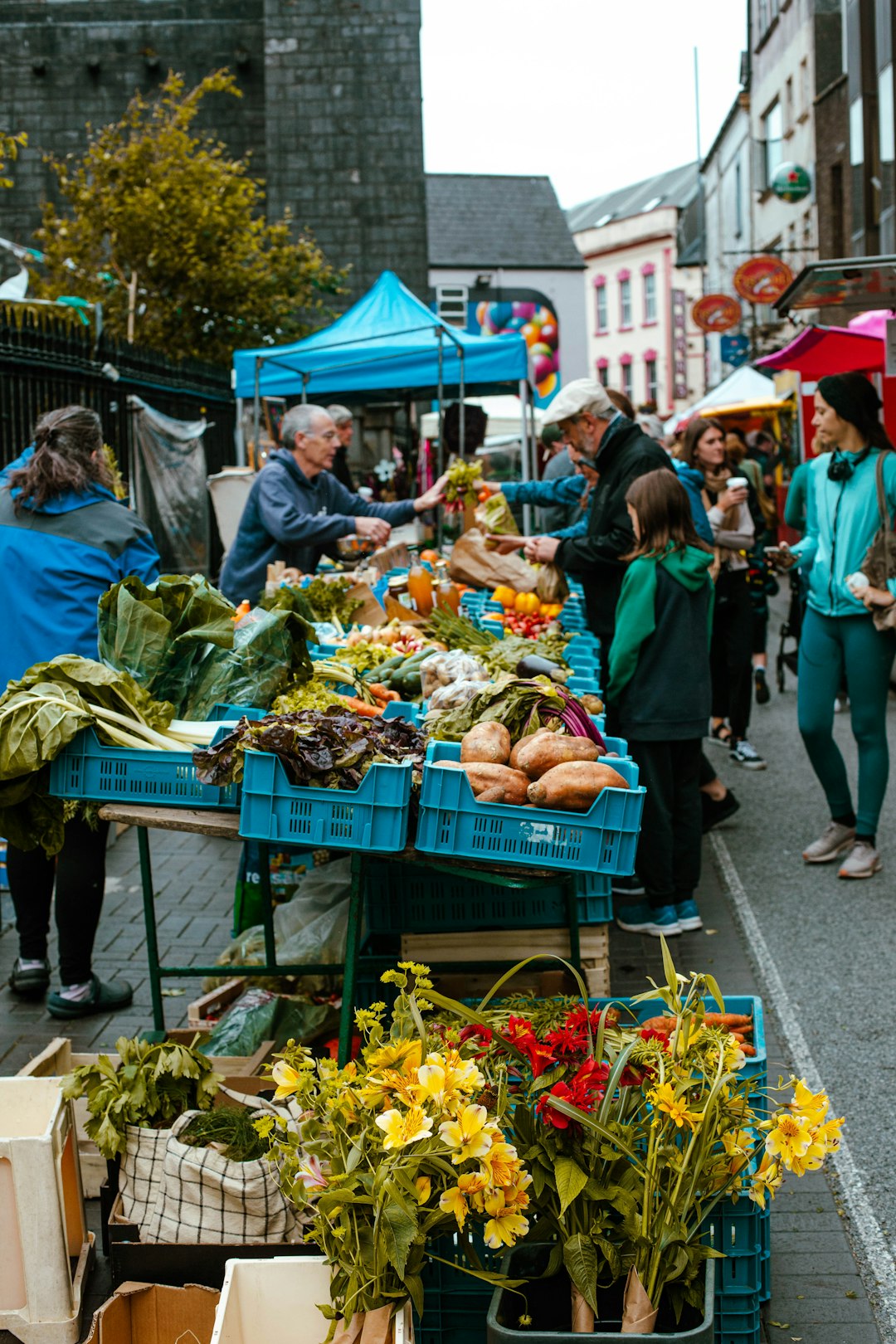
For visitors, the value is in the access the festival creates. Farm visits and producer tours that wouldn’t normally be open to the public are on the programme. The food trails let you cover a region’s worth of food culture on foot and by car over a single weekend. It’s an unhurried format, built for people who want to understand where something comes from rather than simply consume it efficiently.
May: Ballymaloe Hosts Its Third Festival, and the Lineup Is International
The name Ballymaloe carries a particular weight in Irish food. Myrtle Allen opened the restaurant at Ballymaloe House in Shanagarry, East Cork, in the 1960s. Her daughter-in-law Darina Allen founded the cookery school on the property in 1983 and spent the following decades making it one of the most significant culinary education institutions in Europe. The Literary Festival of Food and Wine — the original Litfest — became something of a pilgrimage for food writers and chefs for years before it evolved into the current format: the Ballymaloe Festival of Food, which returns for its third edition on May 15-17, 2026.
Darina Allen will be on home ground. So will Sami Tamimi, co-founder of Ottolenghi, whose approach to cooking has probably shaped more home kitchens over the past decade than almost any other voice in food. Felicity Cloake — the food writer who has spent years methodically dismantling and rebuilding classic recipes for The Guardian — is confirmed. So is Adam Byatt, Michelin-starred at Trinity in London and named Mentor of the Year by the Michelin Guide in 2025. The full list of speakers and chefs runs considerably longer.
Events take place across the Ballymaloe estate: the Grainstore, the Big Shed, the house itself, and the farm gardens. Pop-up dinners run in converted outbuildings over the weekend evenings. There are hands-on cooking and cocktail workshops, wine tastings, farm walks, and morning sessions with producers from the surrounding East Cork area. For anyone with a serious interest in food, the appeal is not just the programme — it’s the context. This is the actual Ballymaloe, not a branded event in a conference centre. You’re standing in the same place that has been growing and cooking and teaching about Irish seasonal food for more than half a century.
June: Taste of Dublin Settles Into Its New Address
After 18 years in the walled enclosure of Iveagh Gardens, Taste of Dublin moved to Merrion Square in 2024 and returns to that address for the 2026 edition, running June 11-14. The shift changed the character of the event considerably: Merrion Square is open, ringed by Georgian terraces, and visible from the street in a way that Iveagh Gardens never was. The festival now occupies one of the most recognisable green spaces in the city centre.
The format is efficiently designed for people who want to understand where Dublin’s restaurant scene is right now without committing to a full tasting menu at each kitchen. Around 15 restaurants from across the city set up tasting stands across the four days, eight sessions in total, with more than 50 chefs involved. Visitors move between stands, sampling dishes at a fraction of the cost of a full restaurant meal, with demonstrations and drinks masterclasses running alongside. Over 60 event features and exhibitors round out the space.
Standard entry starts under €20, though the tiered options — including the Häagen-Dazs VIP Suite — add up. The value of Taste of Dublin isn’t the price point; it’s the concentration. On a good afternoon in Merrion Square in June, you can get a meaningful read of the city’s food ambition across a few hours and a booklet of tasting tokens. There are worse ways to understand a city.
September: West Cork Takes Over an Entire Coastline
Calling A Taste of West Cork a festival is technically accurate and practically insufficient. The 2026 edition runs September 6-15, with Skibbereen as its informal base, and the programme extends to 265 events across 41 towns and villages and eight islands. The stretch from Bantry to Beara, from Baltimore to Bandon, Clonakilty to Courtmacsherry, covers some of the most productive coastal and agricultural land in the country, and the event is essentially a ten-day argument that West Cork has more interesting food than it gets credit for outside Ireland.
The format includes long-table dinners at one end of the register and ferry trips to island cheesemakers and foraging walks through coastal farmland at the other. The cheesemakers, small fisheries, charcuterie producers, craft brewers, and distillers who have built operations in West Cork over the past two decades are the actual content of the festival — not a curated representation of the region, but the region itself, temporarily open to visitors in a more direct way than usual. If you’ve only ever passed through West Cork on the way to somewhere else, this is the argument for staying.
Then, at the end of the month, Galway makes its case.
September: Galway’s 72nd
The Galway International Oyster and Seafood Festival returns September 25-27, 2026 — its 72nd consecutive year. At the centre of the weekend is the Irish and World Oyster Opening Championships: competitive oyster shucking at speed and precision, with national champions from across Europe in the city for the competition. It’s a strange and compulsive thing to watch people be extraordinary at, and it has no real equivalent on the food festival circuit anywhere else.
The rest of the weekend radiates out through the city: seafood tastings, live music across multiple venues, street entertainment, the Oyster Trail linking pubs and restaurants, and the Taste the Atlantic Tours that bring small groups to the farms and beds where Galway Bay oysters are actually grown.
The biological context matters. Galway Bay oysters — the native flat oyster, Ostrea edulis — grow slowly in cold clean water and have a flavour that reflects the specific mineral character of the bay. Their season runs September through April. Collins chose September in 1954 because it’s when the season opens, when the oysters come to the table for the first time after summer. The festival is still tied to that rhythm, 72 years later. What you’re eating at the end of September in Galway is the first flush of a new season’s oysters, in the city that invented the reason to celebrate them publicly.
October: Dingle’s Remarkable Double-Header
For one weekend in early October, Dingle manages something that’s difficult to explain in proportion to the town’s actual size. Blas na hÉireann — the Irish Food Awards — runs October 1-4, 2026, with the awards ceremony itself on October 2. The Dingle Food Festival runs October 3-4. The two events overlap, and together they turn a small Kerry town into the densest food event per square metre on the island.
Blas na hÉireann is now in its 19th year, and its scale has grown to match its reputation. More than 3,000 product entries from across the island are submitted each year, judged blind across more than 200 food and drink categories using a methodology developed in partnership with the Food Science Department at University College Cork — a process that has since been recognised as an international industry standard. Bronze, silver, and gold medals are awarded across the categories, with the Supreme Champion (supported by Bord Bia) and Best Artisan Producer awards as the major prizes. The concurrent Blas Village lets finalists show their products and meet buyers, food journalists, and fellow producers. The Eat Ireland in a Day market runs alongside it.
Then, while the Blas Village is still active, the Dingle Food Festival fills the town’s streets on the Saturday and Sunday. More than 70 vendor stalls line the roads. The Taste Trail — a booklet of tasting tickets redeemable at local restaurants, cafés, and food stands across the town — sends visitors on a self-directed circuit of everything Dingle and the broader peninsula produces and cooks. The festival’s own estimate is that more than 150,000 individual food tastings take place across the two days, and more than 10,000 visitors pass through. The whole event is organised by local volunteers and run on a non-profit basis, with a genuine zero-landfill-waste target that shapes everything from the vendor requirements to the rental stainless-steel plates available at the gate.
For a town whose permanent population is a small fraction of that visitor number, the logistics of the first weekend in October in Dingle are worth understanding before you arrive. Book accommodation early. The Taste Trail is the right way in — it forces you to walk the town systematically rather than gravitating to the same three streets.
Building a Season
The full shape of Ireland’s 2026 food festival calendar is worth holding in your head, because the clustering reveals something about the country’s food culture that’s easy to miss when you only look at individual events. April in Dungarvan. May in East Cork. June in Dublin. September across West Cork and then Galway. October in Dingle twice over. That’s effectively a season — a continuous argument that Ireland’s food production and cooking culture, which has transformed considerably over the past three decades, is worth travelling for at almost any point from spring to autumn.
The festivals at either end of the calendar — Waterford in April, Dingle in October — are the ones that tend to benefit the most specific kind of visitor: people who want access to producers rather than a showcase, who’d rather drink from a beaker with a farmer than a branded glass in a tasting tent. The ones in the middle — Ballymaloe and Taste of Dublin — speak to different impulses: the pull of a world-class lineup on a working farm estate, the efficiency of a city’s best restaurants in one park for a long June afternoon.
Brian Collins couldn’t have anticipated any of this when he organised a table of oysters for 34 people in 1954. He was just trying to fill a hotel in September. The logic he was working with — that the right food, in the right place, at the right time of year, is worth going somewhere for — turned out to be durable. It still is.
Tours & experiences you might love


Powered by Viator. Some links are affiliate links — we may earn a small commission at no extra cost to you.
Secure Your Dream Irish Experience Before It’s Gone!
Planning a trip to Ireland? Don’t let sold-out tours or packed attractions spoil your journey. Iconic experiences like visiting the Cliffs of Moher, exploring the Rock of Cashel, or enjoying a guided walk through Ireland’s ancient past often sell out quickly—especially during peak travel seasons.

Booking in advance guarantees your place and ensures you can fully immerse yourself in the rich culture and breathtaking scenery without stress or disappointment. You’ll also free up time to explore Ireland’s hidden gems and savour those authentic moments that make your trip truly special.
Make the most of your journey—start planning today and secure those must-do experiences before they’re gone!