

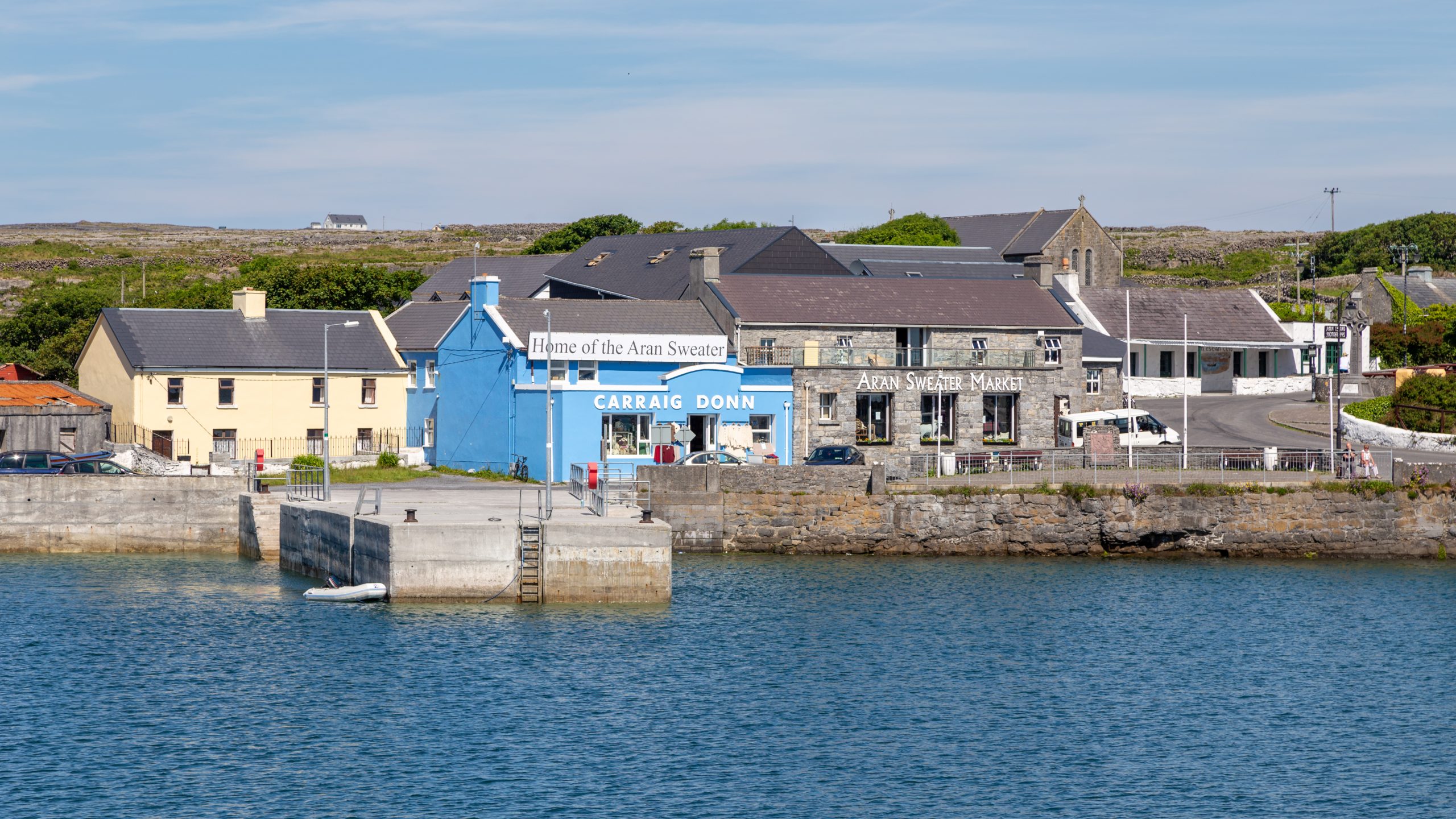
The Aran Sweater Is Not an Ancient Irish Tradition. It Was Invented in the 1890s.
In souvenir shops from Galway to Dublin, a particular story gets told with great confidence. It goes something like this: the Aran sweater has been knitted on the islands off the Connaught coast for centuries. Each family developed its own pattern — a secret combination of stitches passed from mother to daughter across generations. The purpose was grimly practical. Fishermen drowned with regularity in those Atlantic waters, and when bodies washed ashore, the sweater could identify the dead man by his clan’s stitch. The O’Flahertys had their cable. The Fahertys their honeycomb. The sea gave back its dead, and the knitting told you whose son he was.
It is a compelling story. It is also, in essentially every detail, untrue.
The Aran sweater as we know it — thick báinín wool, all-over cable patterning, saddle shoulders — does not trace to any ancient Celtic textile tradition. It was developed in the 1890s and early 1900s as part of a British government poverty-relief programme. The family identification story has no archaeological, historical, or folkloric evidence behind it whatsoever. The symbolic meanings attributed to each stitch — moss for abundance, honeycomb for good luck, the tree of life for well, life — were largely invented in 1967 by a Prussian-born Oxford yarn shop owner with no connection to the Aran Islands at all.
And yet the sweater is genuinely iconic. Marilyn Monroe wore one. Grace Kelly wore one. The Clancy Brothers made it the uniform of Irish America. Vogue published a pattern for it in 1956. Today it is one of the most recognised garments in the world. The real story of how a practical workwear item invented during a government poverty programme became a global fashion symbol is, if anything, better than the myth.
The Board That Built the Sweater
In 1891, the British government established the Congested Districts Board for Ireland, created under the Purchase of Land Act introduced by Chief Secretary Arthur Balfour. Its remit was to address the crushing poverty, overcrowding, and economic stagnation of the western seaboard — the windswept counties of Connacht and parts of Donegal and Kerry where smallholdings were too small to support families, and where the post-Famine population was still quietly dying of want.
The Board sent instructors to coastal communities to improve fishing practices, teach fish processing, and develop cottage industries that could provide supplementary income. Among the instructors were fishermen and their wives from other parts of Britain and Ireland who brought with them the working garment of the Atlantic fishing trade: the guernsey, or gansey. It was a close-knit wool jumper, dense enough to resist wind and spray, worn by fishermen from Cornwall to Scotland. The women on the Aran Islands — Inis Mór, Inis Meáin, Inis Oírr — observed these garments, and then did what skilled craftspeople do. They adapted.
They used the heavy, undyed báinín wool that was locally available. They made the garments thicker, with more elaborate cable work that added both structure and insulation. They developed what would become the visual signature of the style: dense, textured stitchwork across every inch of the fabric. The result was genuinely functional — warm, durable, water-resistant through the natural lanolin in unprocessed wool — and it was produced for trade, not ceremony. These were working clothes. Their first market was the fishermen who needed them.
There is no evidence, from any source, that the patterns carried family meanings or served as identification. The islands’ dominant families — Flaherty, Faherty, Conneely, Derrane — kept no such codified stitch registers. No folklorist documented the practice. No oral history records it. Historians who have searched specifically for this evidence have come up empty. As one researcher summarised it: there is exactly zero historical, archaeological or folkloric evidence for Aran fisher families or villages ever engaging in such an organised practice.
The Woman from Donegal
For several decades the sweater remained what it was: practical workwear, traded locally, worn by the people who made it. The transformation into a commercial product with a wider market was largely the work of one woman.
Muriel Gahan was born in 1897 in County Donegal, into a world where the crafts traditions of rural Ireland were quietly eroding. By 1930, she and a group of fellow United Irishwomen had opened The Country Shop in Dublin — a fair-trade outlet, decades before that term existed, designed to give isolated rural craftspeople access to urban markets and pay them properly for their work. It sold homespun textiles, handmade pottery, traditional foodstuffs. It was, in spirit, a refusal to let the old skills disappear just because the economy had no formal structure to support them.
In 1932, Gahan commissioned the first adult Aran jumper as the garment would come to be understood globally: standardised in sizing, made for sale beyond the islands, designed for a wearing public that had never hauled a currach. The historian Vawn Corrigan credits her directly with this moment. In 1935, Gahan launched the Irish Homespun Society, institutionalising the support network she had built informally. She would later become a founding member of Ireland’s Arts Council in 1951, and go on to receive an honorary doctorate from Trinity College Dublin. She died in 1995, at 97.
What Gahan understood, and what the sweater’s subsequent history bears out, is that the garment was genuinely beautiful and genuinely useful — it did not need a fabricated story to sell. But the fabricated story was coming regardless.
Vogue, Hollywood, and the Clancy Brothers
Through the 1940s, commercial interest in the Aran sweater accelerated steadily. In 1940, Patons of England published the first commercially available knitting pattern for an Aran-style jumper, bringing the design within reach of anyone who could hold needles. Seven years later, the opening of the world’s first duty-free shop at Shannon Airport began funnelling American tourists into the west of Ireland in numbers that hadn’t existed before. They wanted something to bring home.
In 1955, the London designer Digby Morton featured Aran-inspired knitwear in his autumn collection, drawing the attention of the international fashion press. Vogue followed in 1956, publishing an Aran sweater knitting pattern — a validation from the most authoritative voice in Western fashion that this thing from the Atlantic fringe was worth paying attention to. By the late 1950s, Marilyn Monroe, Grace Kelly, and Steve McQueen had all been photographed in versions of the garment. The Aran sweater had become, with remarkable speed, a statement of a certain kind of relaxed, authentic cool.
Then came the Clancy Brothers.
The Clancy Brothers and Tommy Makem were an Irish folk group who arrived in New York in the late 1950s and made the Aran sweater their trademark stage uniform. They were performing Irish traditional music in Greenwich Village at the same moment Bob Dylan was starting out — he later cited them as an influence — and their visual identity was inseparable from those cream-coloured jumpers. In the early 1960s they appeared on The Ed Sullivan Show in Aran sweaters. They performed privately for President John F. Kennedy in them. By 1963, a single Galway outfitter was supplied by more than 500 local home knitters struggling to keep pace with American demand.
The economics of this moment were staggering. An industry that had been a poverty-relief measure for islanders in the 1890s was now producing garments that couldn’t be made fast enough for a global market. The sweater had achieved something rare: it was simultaneously high fashion and working-class authentic, expensive and handmade, Irish and universal.
The Man Who Wrote the Ancient History
Into this commercially supercharged atmosphere stepped Heinz Edgar Kiewe.
Kiewe was born in Prussia in 1906. He ran a needlework and yarn shop in Oxford, England, from around 1940. He had no personal connection to the Aran Islands. But he had an eye for resemblance — and he noticed that the cable patterns of Aran knitwear bore a visual similarity to the interlaced knotwork of Celtic illuminated manuscripts. From this observation, he constructed an elaborate historical theory.
In 1967, Kiewe published The Sacred History of Knitting, in which he argued that the stitch patterns of Aran sweaters were ancient Celtic symbols with deep spiritual meanings: the moss stitch signified growth and abundance, the blackberry represented nature, the honeycomb was a lucky stitch promising plenty, the tree of life tracked the stages of human existence. And each family on the Aran Islands, he wrote, had its own unique pattern combination — so that when a man drowned at sea, his sweater would tell you who he was and where he came from.
None of this had any documentary basis. Kiewe was, in the most charitable reading, extrapolating freely from visual resemblance and romantic imagination. In the less charitable reading, he was fabricating history to sell a compelling product story.
The origin of the family identification myth, to the extent it has any origin at all, actually traces to a play. John Millington Synge’s 1904 drama Riders to the Sea contains a scene in which a woman identifies a drowned man partly through a stocking she had knitted — identifiable by the count of its stitches, not its pattern, and fictional besides. Somewhere between Synge’s stocking and Kiewe’s book, the stocking became a sweater, the counted stitches became decorative patterns, and the individual identification became a whole system of family heraldry. Kiewe gave this evolving story its most marketable form.
His fanciful descriptions were enthusiastically taken up by Irish tourist retailers and diaspora shops across the United States, where the idea of a sweater carrying your ancestral clan’s secret code was irresistible to people hungry for connection to a homeland they’d never seen. By the time historian Richard Rutt published A History of Handknitting in 1987 — methodically dismantling the symbolic stitch claims with primary sources — the story was so embedded in the marketing of the product that no debunking was ever going to dislodge it commercially.
Today, most Aran sweaters sold in tourist shops are machine-knitted. A substantial proportion are not made in Ireland at all. Tourists still ask for O’Flaherty patterns. They do not exist.
Why the Real Story Is Better
The myth works because it gives the sweater a weight that a government poverty-relief programme from 1891 doesn’t obviously provide. But the actual history, if you sit with it, is more interesting than the invented one.
What really happened is this: a British government body, trying to stop the slow economic death of Ireland’s Atlantic communities, sent instructors to teach fishing to islanders. Those islanders’ wives absorbed a working-class textile tradition from across Britain and Ireland, and improved it — made it thicker, more patterned, more distinctively their own. A Donegal woman opened a fair-trade shop in Dublin in 1930 and commissioned the first commercial version in 1932. A Vogue editor noticed it in the 1950s. Marilyn Monroe put one on. Three brothers from Tipperary and their bandmate from County Armagh wore them on national television in America and couldn’t meet the demand that followed.
That is a story about craft, commercial ingenuity, and the quiet persistence of people who found a way to turn poverty into something lasting. The sweater doesn’t need to be ancient to deserve its place in the world. It became genuinely iconic — and it did it in about sixty years.
The only tradition that is truly ancient here is the Irish one of making something extraordinary from very little, and then telling a better story about it than the facts strictly require. We could be annoyed about that. Or we could simply acknowledge that the sweater earned its mythology, even if the mythology got there before the historians did. Every great garment carries a story people want to believe. The Aran sweater’s real story just happens to be true.
Tours & experiences you might love


Powered by Viator. Some links are affiliate links — we may earn a small commission at no extra cost to you.
Secure Your Dream Irish Experience Before It’s Gone!
Planning a trip to Ireland? Don’t let sold-out tours or packed attractions spoil your journey. Iconic experiences like visiting the Cliffs of Moher, exploring the Rock of Cashel, or enjoying a guided walk through Ireland’s ancient past often sell out quickly—especially during peak travel seasons.

Booking in advance guarantees your place and ensures you can fully immerse yourself in the rich culture and breathtaking scenery without stress or disappointment. You’ll also free up time to explore Ireland’s hidden gems and savour those authentic moments that make your trip truly special.
Make the most of your journey—start planning today and secure those must-do experiences before they’re gone!