

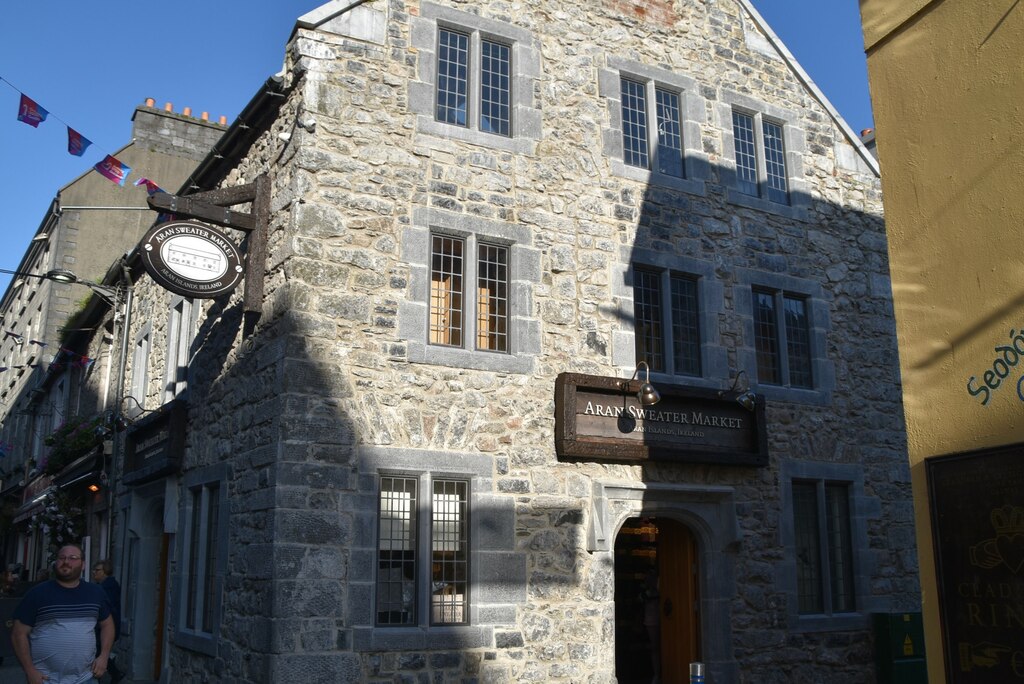
The story is irresistible, and we know it well. Somewhere off the west coast of Ireland, on the limestone slabs of the Aran Islands, fishermen put to sea in currach boats knowing they might never return. Before each voyage, their wives and mothers would knit them a gansey — a thick, cable-knit sweater — worked in a pattern unique to their family. If the man drowned and the Atlantic returned his body weeks later, battered beyond recognition, the sweater would still speak: the pattern would name him, place him, bring him home.
It is one of the great origin stories of Irish craft. It has been repeated in thousands of tourist shops, printed on the tags of sweaters exported to America and Japan, woven into newspaper travel pieces, and passed along in conversation as one of those facts that feels so right it must be true. There is one problem: there is not a single shred of historical, archaeological, or folkloric evidence that it ever happened.
Not one family pattern has been documented. Not one account from an Aran Islander — contemporary or historical — describes such a system. Not one drowned man was ever recorded as having been identified this way. The “family identification” story is a 20th-century fabrication, and once you start pulling the thread, what unravels is a tale that is stranger, funnier, and in some ways more interesting than the myth itself.
A Sock. A Play. Not Real.
The nearest thing to a source for the identification story is a 1904 play by John Millington Synge. Riders to the Sea opens on Aran, where a grieving mother has received a bundle of clothing recovered from a drowned man. The identification is made not through a sweater pattern but through a plain sock — and even then, the evidence is a counting error, not a family design. The character Nora says: “I put up three score stitches, and I dropped four of them.” A dropped stitch, miscounted. That is the entire origin of one of fashion’s most resilient myths.
Synge’s play is, of course, fiction. He spent time on the islands and wrote about what he observed, but he was a playwright. His islanders were characters, not depositions. The identification scene reflected the islands’ constant anxiety about the sea — its most merciless presence — but it was never a description of an actual Aran practice. And crucially, it was a sock. Not a sweater. Not a cable pattern. Not a family heraldic design worked in wool. A plain sock with a dropped stitch.
Somewhere between 1904 and the mid-20th century, that sock became a sweater, the individual counting error became a family tradition, and the fiction became fact. That transformation had a specific architect.
The Oxford Yarn-Shop Owner Who Made It All Up
Heinz Edgar Kiewe, a self-styled “textile journalist,” ran a yarn shop in Oxford connected with Art Needlework Industries Ltd. He was sharp, entrepreneurial, and possessed a keen eye for a story that would sell wool.
Kiewe wrote a book called The Sacred History of Knitting. In it, he argued that Aran stitch patterns were not practical designs developed by island knitters in the previous century but ancient symbols — religious, mystical, Celtic — with meanings encoded stitch by stitch by generation after generation of island women. He drew an elaborate connection between the cables and diamonds of Aran sweaters and the illuminated manuscripts of early Irish Christianity. He described the patterns as a kind of textile scripture, each one carrying meaning the way a heraldic crest might.
None of it was based on documented evidence. Kiewe had spotted a visual resemblance between knotwork and cables and built a cathedral of mythology on top of it. Wikipedia’s own article on Aran knitting patterns now describes his book plainly as “an entirely fabricated book.” His fabrications were subsequently used, with considerable commercial success, to market Aran sweaters to the Irish diaspora in the United States — a community emotionally primed for stories of ancient, authentic Irishness.
Academic scholarship has placed Kiewe’s invention within a broader phenomenon. In a 2014 article in the journal Costume, “Cable Crossings: The Aran Jumper as Myth and Merchandise,” researcher Siún Carden treated the Aran jumper as an invented tradition shaped by 20th-century marketing. Richard Rutt, Alice Starmore, and Vawn Corrigan have also examined the history of Aran knitting in their published books. The Aran sweater’s ancient soul, in other words, was manufactured at the same historical moment as its growing international market.
When Aran Knitting Actually Began
The knitting itself, as a practice on the islands, is surprisingly recent. Most historians now agree that Aran knitting as we know it developed in the 1890s and early 1900s — not across deep Celtic time, but within living memory of people who were alive in the 20th century.
The institutional catalyst was the Congested Districts Board, a body established in 1891 to address poverty in the most economically depressed parts of Ireland’s western seaboard. The Aran Islands qualified. Agents introduced knitting to island women as a cottage industry — a way to generate income from a skill that could be practiced at home, in the hours between other work. The patterns were taught and shared. They spread freely among knitters across the islands, as craft knowledge does, because knitters talk to each other. They were not secret. They were not family-specific. The notion that they were systematically assigned by family is not just undocumented — it is structurally impossible given how the craft arrived and spread.
The cable and diamond patterns that now seem so definitively “Aran” were practical choices: thick and tightly worked, they created insulation and durability in a wet, cold environment. The diamond was efficient. The cable was structural. They were not, as Kiewe would later claim, symbolic inscriptions drawn from the Book of Kells.
The first adult Aran gansey in the form we recognise today is dated by historians to 1932, when social reformer Muriel Gahan commissioned one. Gahan was a leading figure in the United Irishwomen, which became the Irish Countrywomen’s Association in 1935, and a passionate advocate for rural Irish craft. The garment she commissioned — thick, cable-worked, cream-coloured — became a template. It was not the rediscovery of an ancient form. It was a design decision made in the 20th century by a specific person with a specific purpose.
From the Islands to Vogue
The global reach of the Aran sweater came not through ancient trade routes but through the very modern machinery of mid-century fashion marketing.
Patons of England published home-knitting Aran patterns, including its Patons Aran Book in 1968, bringing the form to British women who had never been within sight of the Atlantic. In 1957, Vogue Knitting published an Aran pattern in the United States — a moment that delivered the sweater into the orbit of American fashion consciousness at exactly the right cultural moment. On the islands themselves, merchants were contracting local women to supply growing domestic and international markets. Historical accounts suggest that by the mid-20th century many island women were supplementing family income through their knitting work, with merchants handling distribution beyond Ireland’s shores.
Pádraig Ó Síocháin, a lawyer turned Galway businessman, is documented as a key promoter of Aran sweater exports during this period. The garment arrived in America at the same historical moment as a surge of cultural nostalgia for Ireland among the diaspora, and it fused with that feeling. The ancient-tradition narrative was not just commercially convenient — it was emotionally necessary, a way of making the purchase feel like contact with something irreplaceable.
The genius of the myth, in retrospect, is how perfectly it matched the buyer’s emotional need. Customers of Irish descent were not simply buying a sweater. They were buying continuity, heritage, the image of an island grandmother encoding her family’s identity in wool before her son went out to sea. That the image was invented made it no less powerful as a commercial force. But it does make it false.
What Is Still Real
None of this means the Aran Islands are a fiction, or that the sweaters coming from them today are somehow counterfeit. Genuine Aran knitwear still exists, made by real hands in the real place.
Inis Meáin Knitting Company — based on Inis Meáin, the middle island of the three — was founded in 1976 by Tarlach de Blácam and his wife Áine Ní Chonghaile, and has been producing knitwear on the island for half a century. For the wider story of the sweater, read our guide to the Aran sweater. Their garments are made on the island, by islanders, using a craft tradition that — while recent in the grand historical scheme — is authentically local, seriously skilled, and genuinely rooted in the place.
The patterns, too, have a real aesthetic logic. The honeycomb stitch, the blackberry, the tree of life — these evolved through real hands in a real landscape, and the women who developed and refined them were exercising creative judgment, not decoding mystical symbols. That is, in its own way, a more interesting story than the one Kiewe told: the story of craft as work, as livelihood, as adaptation across hard conditions.
The Myth Lives On
Walk into almost any souvenir shop on the west coast of Ireland and you will still find the identification story on the tags, in the display cards, in the cheerful patter of the sale. It persists because it sells, because it is genuinely moving, and because no one who has just spent serious money on a sweater particularly wants to hear that the backstory is a Prussian émigré’s marketing copy from 1967.
The academic consensus has been clear for decades. Siún Carden’s peer-reviewed work, Richard Rutt’s A History of Hand Knitting, Alice Starmore’s authoritative Aran Knitting, Vawn Corrigan’s 2019 Irish Aran: History, Tradition, Fashion — all of them reach the same conclusion. There are no documented family patterns. There are no drowned men identified by their sweaters. There is no ancient tradition. There is a craft that is roughly 130 years old, introduced as poverty relief, developed into genuine beauty, and then given a false prehistory by a man selling yarn from a shop in Oxford.
What remains, once the myth is cleared away, is something genuinely worth holding onto. The islands are real. The craft is real. The skill required to produce a proper Aran sweater — by hand, in the right place, by someone who has spent years learning it — is considerable and worth paying for. The sweater does not need an invented identity. It has an actual one: the story of women who needed income, of instructors and merchants and a government body trying to stop a coastline from starving, of a reformer named Muriel Gahan who commissioned a garment in 1932, of knitters who developed their own patterns through decades of practice and shared them freely, because that is what craftspeople do.
To see what life on the islands looks like today, read Aran Islands Ireland: Local Life Beyond the Tourist Trail. There are islands, real ones, off the Galway coast, wind-scoured and limestone-grey, looking out towards nothing but open Atlantic. The knitting that came out of them is extraordinary — not because of any encoded family secret, but because of what people can make when necessity and skill converge in a specific place over a long stretch of time. That turns out to be quite enough.
Tours & experiences you might love


Powered by Viator. Some links are affiliate links — we may earn a small commission at no extra cost to you.
Secure Your Dream Irish Experience Before It’s Gone!
Planning a trip to Ireland? Don’t let sold-out tours or packed attractions spoil your journey. Iconic experiences like visiting the Cliffs of Moher, exploring the Rock of Cashel, or enjoying a guided walk through Ireland’s ancient past often sell out quickly—especially during peak travel seasons.

Booking in advance guarantees your place and ensures you can fully immerse yourself in the rich culture and breathtaking scenery without stress or disappointment. You’ll also free up time to explore Ireland’s hidden gems and savour those authentic moments that make your trip truly special.
Make the most of your journey—start planning today and secure those must-do experiences before they’re gone!