

Fungie the Dingle Dolphin: What Happened to the Wild Bottlenose Who Became Ireland’s Biggest Tourist Attraction
The town of Dingle, County Kerry, has a permanent population of around 1,700 people. For 37 years, it also had a single resident wild dolphin — and for much of that time, the dolphin was the main reason hundreds of thousands of tourists made the journey each year to a small harbour on the edge of the Atlantic.
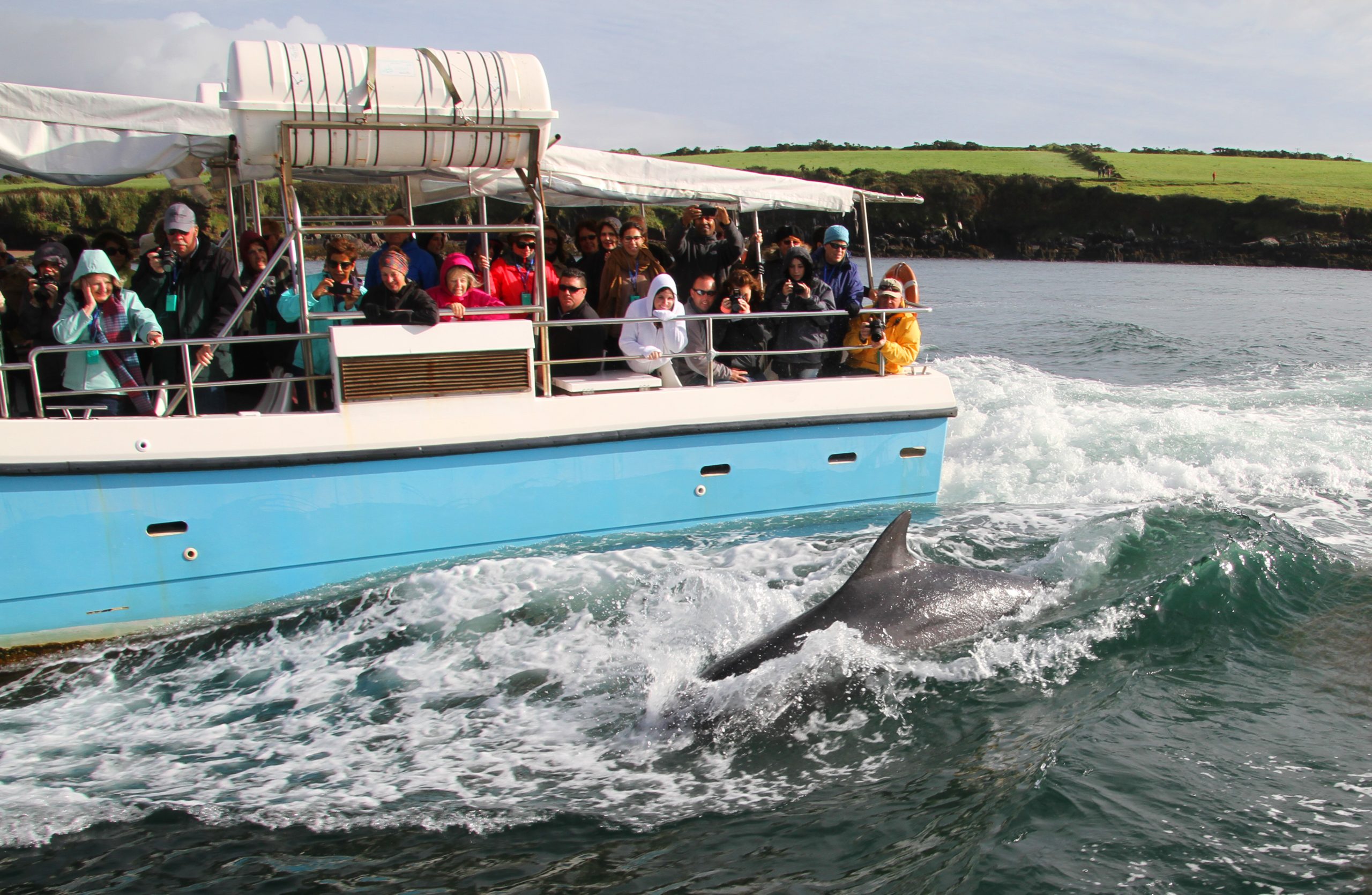
The dolphin’s name was Fungie. He was a bottlenose, roughly 13 feet long and about 500 pounds. He was male and middle-aged when he arrived, by most estimates somewhere around nine years old. He appeared in the late autumn of 1983 and never left. The fishing boats went out; Fungie escorted them. The boats came back; Fungie escorted them home. He did this for nearly four decades, and at some point between then and now, Dingle stopped being a post-industrial fishing town struggling to find its footing and became one of the most-visited small towns in Ireland.
In October 2020, Fungie didn’t show up. He never showed up again.
The Lighthouse Keeper’s Discovery
The first person to notice the dolphin was Paddy Ferriter, the harbour lighthouse keeper. By all accounts, Ferriter was a man who preferred the company of his dogs to that of most people — which makes it fitting that what caught his attention was something similarly uncomplicated: a dolphin, following the fishing boats through the harbour mouth, autumn 1983.
Ferriter kept watching. The dolphin kept coming back. Through that winter and into 1984, it became clear this wasn’t a passing visitor. Kevin Flannery, the local manager for the Irish Ministry of Marine, officially recorded Fungie as a permanent resident by August 1984. The animal had no pod, no companions of his own species, no apparent interest in leaving. He simply seemed to prefer the harbour — and the boats, and eventually the people.
Swimmers discovered that Fungie was not shy. By 1984, people were getting into the water with him, and he approached on his own terms — choosing certain swimmers as favourites, apparently indifferent to others, playful but unpredictable in his attentions. Boat operators noticed he would accelerate into their wakes and surf them. He hunted garfish, a prey species no dolphin had been observed taking before. He made spectacular aerial turns that nobody had asked him to perform.
Nobody trained him. Nobody fed him. He was a wild animal who had apparently decided that Dingle Harbour suited him better than wherever he’d been before.
The Economy That Grew Around a Single Dolphin
When Fungie arrived, Dingle’s tourist trade was thin. The conventional wisdom of the time was that you didn’t travel to Clare or Kerry to see dolphins — you went to Florida for that. Within a few years, one bottlenose dolphin and a fleet of repurposed fishing boats had overturned the conventional wisdom entirely.
Boat trips to see Fungie began operating from the pier. Then more boats. Then boats that guaranteed you’d see him or your money back — a guarantee backed by 37 years of reliable dolphin attendance. At peak season, up to 12 chartered vessels ran daily, employing more than 50 people. The restaurants filled. The pubs filled. Gift shops moved Fungie T-shirts and toys and jewellery. Hotels and guesthouses in a town of fewer than 2,000 were hosting visitors who had come specifically for a wild animal that lived in the harbour and wasn’t on any payroll.
Jimmy Flannery ran Dingle Dolphin Tours for 32 years. Over that span, more than a million people took his boats out to see Fungie. The tourists came from everywhere — Korea, China, mainland Europe, American cities where Kerry was something people’s grandparents had spoken about. The director of Dingle’s Oceanworld Aquarium said what had become obvious: “The fishing industry has virtually gone. We’re totally dependent on tourism.” And Fungie — a wild animal with no contractual obligation to anyone — was the reason much of that tourism existed at all.
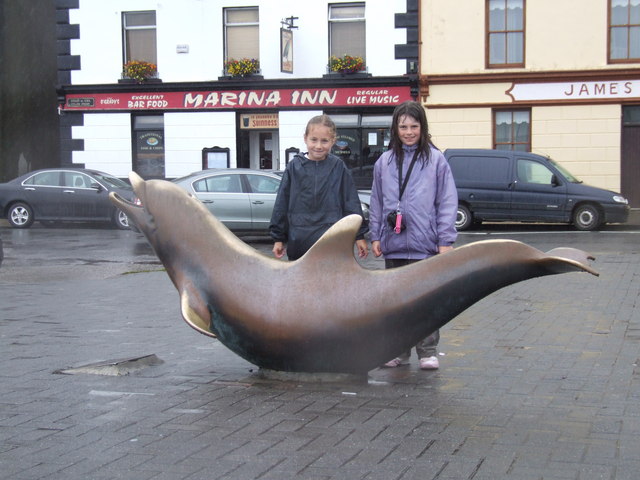
Dingle commissioned a bronze statue of him as the town’s Millennium project, cast by the American sculptor James ‘Bud’ Bottoms and installed at the pier. Pubs took his name. A plaque went up near the town centre. All of this for an animal that could, at any point, have simply swum away.
The Science Behind the Singularity
Here is where Fungie’s story gets genuinely strange, beyond the economic curiosity of it.
Solitary sociable dolphins — wild dolphins that live apart from their own kind and seek out human contact instead — are a documented but rare phenomenon. A 2018 study in the journal Frontiers in Veterinary Science catalogued cases going back decades and found that since 2008, researchers had recorded 36 such cetaceans globally. Bottlenose dolphins make up the majority of cases, probably because they’re inshore coastal animals who encounter humans more than their open-ocean relatives do. About 72 percent of the individuals whose sex has been identified are male. Nobody fully understands why it happens — possible explanations include loss of a pod through injury or death, individual inability to integrate into dolphin social structures, or something else entirely that the current science hasn’t named yet.
Fungie reached what researchers classify as Stage 4 sociability, the furthest point on the scale — an animal that doesn’t merely tolerate human presence but actively seeks it out. At the time of his disappearance, he held the Guinness World Record as the oldest solitary wild dolphin in the world.
Then, in August 2026, a team at Atlantic Technological University published something that reframed how we understand him. The study, led by Lorenzo de Bonis during his IMBRSea Master’s research and supervised by Dr. Luca Mirimin, appeared in the journal Ecology and Evolution. Its methodology alone is worth pausing on. Because Fungie was gone, there was no way to take a sample directly. Instead, the researchers obtained a wetsuit that Denis O’Regan — an Irish Whale and Dolphin Group member who had swum with Fungie regularly for years — had worn during his last swims with the dolphin. They swabbed the fabric. The swabs contained dolphin DNA.
What that DNA revealed was that Fungie was genetically unlike any of the other solitary dolphins studied in Irish waters. Four others — named Nick, Finn, Dusty, and Nimmo — were each assigned exclusively to Ireland’s offshore bottlenose dolphin population. Fungie was different. His ancestry was a mixture of Shannon Estuary bottlenose dolphins and the offshore population: two groups that don’t typically interbreed, and that Irish dolphins almost always belong to one of exclusively. Fungie was neither, and both.
Dr. Simon Berrow of the IWDG and ATU noted that the finding raised questions without answering them. The offshore and Shannon Estuary populations may use different vocal dialects; they may have different ecological needs. Whether a dolphin genetically caught between two communities might find himself unable to fully belong to either — and whether that has anything to do with why he ended up in a harbour in Kerry, surrounded by fishing boats and swimmers — “remains an important unanswered question.”
He arrived somewhere between two worlds and found his way to Dingle. There is something in that, though we are not certain what.
The Last Week of October 2020
Fungie had a routine. He escorted boats. He surfed wakes. He occasionally left the immediate harbour to hunt in the wider bay during salmon season, but he never stayed away more than half a day. For 37 years, this was how it went.
The last confirmed sighting was in the second week of October 2020. Records differ slightly on the exact date — some say October 13, others October 15. What’s consistent is what happened after: nothing. No Fungie the next morning. No Fungie the morning after that. Within days, the absence was extraordinary by any measure.
Twelve boats and divers equipped with sonar began searching Dingle Harbour and the surrounding Kerry coastline. They checked coves, scanned seabeds, patrolled stretches of water the dolphin had swum every day for nearly four decades. One hypothesis circulated — quietly, and never confirmed — that he may have been caught in the nets of a pair trawler working the area that week. Kevin Flannery, who had been officially recording Fungie’s presence since 1984, did the arithmetic plainly: “We think he was about nine years of age when he first arrived here in 1983, so that puts him at 45.” Bottlenose dolphins in the wild average about 17 years. Even in captivity, they rarely exceed 50. By October 2020, Fungie was old.
The search was called off after roughly a week. Jimmy Flannery, who had spent more hours watching this dolphin than almost anyone alive, told reporters: “It’s been over a week since there’s been a sighting but I’m still hoping he’s gone off on an adventure somewhere.” He also said something that mattered more: “The boatmen are in mourning for a friend. This is not just about financial gain.”
A local resident, Juli Ní Mhaoileoin, who had watched Fungie from her harbour-view home for years, found the simpler phrase: “It is like a light has just gone out.”
What Dingle Did Next
Dingle didn’t collapse. Tour operators pivoted to sea safaris and eco-tours, moving from a single charismatic mammal to the broader wildlife of the Atlantic around the peninsula. The harbour is still busy. Visitors still come. But operators who had run dolphin tours for decades acknowledged that what Fungie built wasn’t really a product, and couldn’t quite be replicated with a different offering.
In October 2021, a year after the disappearance, the town held a memorial. The bronze statue still stands at the pier. As of the time of writing, there have been no confirmed sightings.
The Guinness World Record for oldest solitary wild dolphin passed to JoJo, a bottlenose who has been living alone around Turks and Caicos for more than 40 years. The phenomenon, in other words, continues — a scattering of individual animals, mostly male, mostly bottlenose, choosing lives apart from their own kind and close to ours, for reasons that remain genuinely unresolved.
What made Fungie unusual wasn’t just the duration, or the economy, or the DNA study conducted on a swabbed wetsuit six years after he vanished. It was the completeness of the story — the way it has a clear beginning (a lighthouse keeper and a fishing boat, autumn 1983), a long middle (a million boat trips, a bronze statue, a Guinness record), and an end (a week of searching, a lot of silence, an empty harbour). Most wild animal stories don’t hold that shape. Most of them just trail off.
Jimmy Flannery said it best when he talked about the generation of Irish people who grew up knowing about the dolphins and whales in their own waters because of Fungie: “He laid the groundwork for that.” A wild animal, under no obligation to any of us, turned up one autumn at the edge of the Atlantic and stayed for 37 years. Whatever his reasons — genetic, ecological, social, or something we haven’t named — he gave a small town something it couldn’t have planned for or replaced. The boats still go out from Dingle pier. The harbour is still there. But one October morning in 2020, the light went out, and it hasn’t come back on.
☘️ Join 64,000+ Ireland Lovers
Every Friday, get Ireland’s hidden gems, local secrets, and travel inspiration — the kind you won’t find in any guidebook.
Already subscribed? Download your free Ireland guide (PDF)
Free forever · One email per week · Unsubscribe anytime
Tours & experiences you might love


Powered by Viator. Some links are affiliate links — we may earn a small commission at no extra cost to you.
Secure Your Dream Irish Experience Before It’s Gone!
Planning a trip to Ireland? Don’t let sold-out tours or packed attractions spoil your journey. Iconic experiences like visiting the Cliffs of Moher, exploring the Rock of Cashel, or enjoying a guided walk through Ireland’s ancient past often sell out quickly—especially during peak travel seasons.

Booking in advance guarantees your place and ensures you can fully immerse yourself in the rich culture and breathtaking scenery without stress or disappointment. You’ll also free up time to explore Ireland’s hidden gems and savour those authentic moments that make your trip truly special.
Make the most of your journey—start planning today and secure those must-do experiences before they’re gone!