

Saint Brendan the Navigator sailed from the coast of County Kerry in the 6th century and may have reached North America nearly 900 years before Christopher Columbus — and the medieval manuscript that tells his story is one of the most widely copied texts in European history. Known in Irish as Naomh Bréanainn, this Kerry-born monk launched one of the great voyages of the ancient world from a rocky headland that still bears his name today.
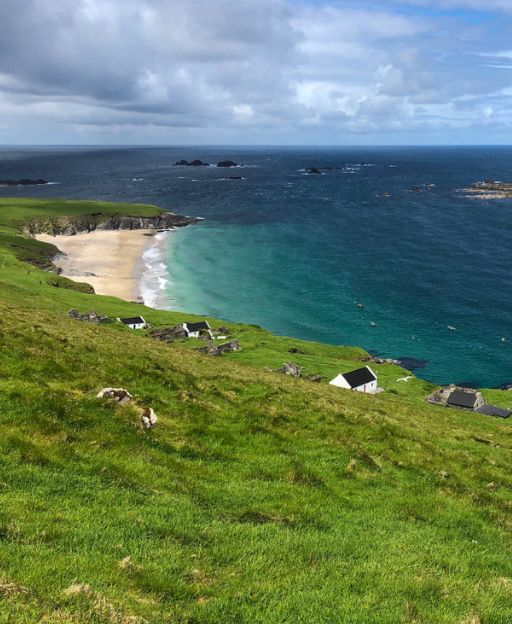
The Navigatio Sancti Brendani — the Voyage of Saint Brendan — reached written form around 900 AD, though the journey it describes took place roughly 300 years earlier. Monks across Ireland, Britain, France, Germany and Italy copied and recopied the text, and over 120 manuscripts survive. That sheer volume tells you something: medieval readers treated this not as legend, but as a genuine sailing account.
Who Was Saint Brendan the Navigator?
Brendan was born around 484 AD near Tralee in County Kerry. Saint Ita of Limerick — one of the most important female scholars in early Irish Christianity — took charge of his early education. He went on to found the great monastery of Clonfert in County Galway in 558 AD. That monastery grew into one of Ireland’s most important ecclesiastical centres, and its doorway survives to this day as a masterpiece of Romanesque stone carving.
Brendan lived to roughly 93 years of age, dying around 577 AD. By the time of his death, he had earned the title An Naofa — the Saint — and had become one of the most celebrated figures in early Irish Christianity. His feast day falls on 16 May, and churches dedicated to him can be found across Ireland, Scotland, Wales and Brittany.
But it was not his learning or his monastery-building that made his name echo across the medieval world. It was the voyage.
The Voyage: Seven Years Across the Ocean
According to the Navigatio, Brendan set sail from Brandon Creek on the Dingle Peninsula in Kerry with a crew of either 17 or 60 monks — the manuscripts disagree on the number. Their vessel was a currach: a traditional Irish open boat with a wooden frame covered in ox-hides stitched together and waterproofed with tallow. This was not a primitive craft. Currachs are light, flexible and extraordinarily seaworthy. They ride waves rather than cutting through them, which makes them far more suitable for the open Atlantic than a rigid-hulled vessel.
The voyage lasted seven years. During that time, Brendan and his crew encountered a remarkable series of islands, each stranger than the last.
☘️ Researching your Irish roots?
Our free step-by-step guide walks you through every record, database, and DNA tool to trace your Irish family — no experience needed.
The Islands They Encountered
The Navigatio describes a series of extraordinary stopping points, some of which scholars have been trying to identify for centuries:
- The Island of Sheep — a fertile island where sheep were as large as cattle. Many scholars identify this as one of the Faroe Islands, whose very name derives from the Old Norse for “sheep islands.”
- The Island of Birds — a paradise island where birds sang Psalms. Brendan was told by a fallen angel that the monks would return to the same island each Easter for seven years.
- The Crystal Pillar in the Sea — a towering column of clear material surrounded by silver netting, stretching far above the water. Most scholars believe this is a description of an iceberg.
- The Island of Smiths — where dark men hurled fire into the sea from a shore that roared and stank of brimstone. This closely matches descriptions of volcanic Iceland, which Irish monks visited as early as 795 AD.
- The Promised Land of the Saints — a vast, fertile landmass where daylight lasted for days and stretched further than the monks could see. No Atlantic island matches this description. A continent does.
Most striking of all, the monks landed each year on what they thought was an island — a great flat expanse of dark rock — and lit their Easter fire upon it. It then moved. The “island” was a whale, which the Navigatio names Jasconius. Brendan reportedly told his frightened monks that it was simply God’s creature, doing what it was made to do.
☘️ Enjoying this? 64,000+ Ireland lovers get stories like this every week. Subscribe free →
Did Saint Brendan Actually Reach America?
This is the question that has kept historians, maritime archaeologists and Atlantic scholars arguing for decades. We do not know for certain. But the case for it being possible is far stronger than most people realise.
The Severin Experiment
In 1976, British explorer Tim Severin built a replica currach using the same materials and methods described in the Navigatio. He named the vessel Brendan. Sailing from Brandon Creek in Kerry, Severin and his crew of four followed the route described in the manuscript — island-hopping through the Hebrides, Faroes and Iceland before continuing west.
On 26 June 1977, after 50 days at sea from Iceland, Severin landed at Peckford Island in Newfoundland, Canada. The voyage proved beyond serious doubt that a 6th-century Irish monk could have crossed the North Atlantic in a currach built without a single metal nail. The boat performed exactly as the Navigatio suggested it would.
The Irish and Iceland — Confirmed by Norse Sagas
The Norse sagas actually confirm that Irish monks were living in Iceland before the Vikings arrived. The Íslendingabók, written around 1130 AD, records that when Norse settlers reached Iceland around 870 AD, they found Irish hermit monks already there. The Norse called them papar, a term derived from the Latin papa (father). The monks departed when the pagan Norsemen arrived.
If Irish monks regularly sailed to Iceland — some 900 kilometres west of the Scottish coast — there is no geographical reason they could not have continued further. The Norse did, reaching Greenland around 985 AD and Newfoundland shortly after. The Atlantic route, island-hopping via the Faroes and Iceland, is far shorter than it appears on a modern flat map.
The Manuscript That Travelled the World
The Navigatio Sancti Brendani stands among the most successful pieces of Irish writing ever produced. Between the 9th and 15th centuries, monks and scribes across the whole of Christian Europe copied it again and again. More than 120 Latin manuscripts survive, alongside translations into Norman French, Middle High German, Middle English, Old Norse, Flemish, Italian and Provençal.
The text shaped the medieval European imagination of what lay beyond the horizon. The “Island of the Blessed” — paradise in the western sea — appeared on maps for centuries. Early cartographers marked Insula Beata (Blessed Island) or Brendanae Insulae (Brendan’s Islands) in the Atlantic as recently as 1570. Some scholars argue that Columbus himself may have known the Navigatio — and that the prospect of Brendan’s paradise land influenced his decision to sail west.
Whether or not that is true, the influence is undeniable. Ireland gave the medieval world its most enduring story of Atlantic exploration — five centuries before the Norse reached Vinland, and nearly a millennium before European colonisation of the Americas began in earnest.
Where to Follow Saint Brendan’s Trail in Ireland
Much of Brendan’s world still exists, and several of the key sites are remarkably accessible. If you are planning a trip to Ireland, combining two or three of these into a single itinerary is very practical.
Brandon Creek, Dingle Peninsula, County Kerry
This is where Brendan launched his currach. A narrow inlet on the northern side of the Dingle Peninsula, Brandon Creek sits at the end of a single-track road that winds down through open bogland to a small stone pier. Nothing greets you here except the sea and the silence — no visitor centre, no car park, no café. That is precisely why it is worth going.
Standing at the waterline and looking west, it is not difficult to feel the scale of what Brendan attempted. On a clear day, the Blasket Islands sit dark on the horizon — the last Irish land the saint would have seen before the open Atlantic swallowed the view.
Mount Brandon, County Kerry
At 952 metres, Mount Brandon is the second-highest peak in Ireland and the highest outside the Macgillycuddy’s Reeks range. Its Irish name, Cnoc Bréanainn, honours the saint directly — tradition holds that Brendan retreated here to fast and pray before setting sail. Pilgrims and travellers have walked the Cosán na Naomh (Saint’s Road) for over a thousand years. The path climbs the western shoulder of the mountain towards the summit oratory.
Clonfert Cathedral, County Galway
Brendan founded Clonfert monastery in 558 AD, and its cathedral still stands in a quiet corner of south County Galway. The Romanesque doorway, added around 1150 AD, is one of the finest examples of Irish Romanesque architecture in existence. Six orders of carved stonework — human heads, interlaced patterns and animal figures — frame an arched entrance that draws visitors from across the world.
Brendan’s tomb lies beneath the floor of the cathedral that grew from the monastery he built. The place carries a quiet weight that tourist sites rarely achieve. For more on Ireland’s early medieval monastic heritage, the Glendalough monastic city in County Wicklow offers a similarly atmospheric experience.
The Aran Islands, County Galway
The Aran Islands sit at the mouth of Galway Bay and served as a key stopping point for early Irish monks. Inis Mór, the largest of the three islands, carries over 3,000 years of continuous settlement and holds some of the finest early Christian remains in Ireland. The tradition of currach-building never died here. On stormy days, you can watch fishermen haul their boats clear of the surf with a speed and coordination that speaks of centuries of unbroken practice.
Frequently Asked Questions
Did Saint Brendan really reach America?
There is no definitive archaeological evidence that Brendan’s monks landed in North America, but Tim Severin’s 1976–77 voyage proved it was physically possible using 6th-century technology. The descriptions in the Navigatio — of icebergs, volcanic Iceland and a vast fertile landmass in the west — are consistent with what a sailor following the North Atlantic island-hop route would actually encounter. Most historians treat the voyage as a genuine account of early Atlantic exploration, even if the theological embellishments have complicated its reception as a strict historical document.
Where did Saint Brendan set sail from?
The Navigatio places the departure at a location consistent with Brandon Creek on the northern shore of the Dingle Peninsula in County Kerry. Mount Brandon — the second-highest peak in Ireland at 952 metres — also bears his name and is traditionally the place where Brendan prayed and fasted before the voyage. Tim Severin used Brandon Creek as his starting point in 1976, confirming it as the likeliest departure site.
What type of boat did Saint Brendan use?
A currach — an Irish boat built with a wooden frame covered in ox-hides, stitched and waterproofed with tallow. Currachs were the standard ocean-going vessel of early medieval Ireland and remained in use on the west coast for fishing well into the 20th century. Tim Severin’s replica, built to the exact specifications described in the Navigatio, crossed the North Atlantic successfully and demonstrated the craft’s genuine seaworthiness in open Atlantic conditions.
Where is Saint Brendan buried?
Saint Brendan died at Annaghdown, County Galway, around 577 AD while visiting his sister Briga. Monks carried his remains to Clonfert Cathedral in County Galway — the monastery he founded in 558 AD — and laid him to rest beneath the floor. The cathedral’s famous Romanesque doorway, dating from around 1150 AD, stands as one of the finest examples of Irish Romanesque architecture in existence.
Can you visit the sites associated with Saint Brendan today?
Yes. Brandon Creek on the Dingle Peninsula is freely accessible by car, though the final stretch is a narrow single-track road. Clonfert Cathedral welcomes visitors in County Galway. The Cosán na Naomh pilgrim path up Mount Brandon is a well-established walking route, though the summit clouds over frequently — check conditions before setting out. For broader trip planning, start with our complete Ireland planning guide. You may also enjoy reading about Fionn Mac Cumhaill, another figure whose legend winds through Ireland’s ancient west.
October is Family History Month — if tracing your own Irish roots is something you have been meaning to do, the free ancestry guide below walks you through every record and archive available, step by step.
☘️ Join 64,000+ Ireland Lovers
Every weekday morning, get Ireland’s hidden gems, local secrets, and travel inspiration — the kind you won’t find in any guidebook.
Subscribe free — enter your email:
Already subscribed? Download your free Ireland guide (PDF)
📲 Know someone who’d love this? Share on WhatsApp →
Love more? Join 43,000 Scotland lovers → · Join 29,000 Italy lovers → · Join 7,000 France lovers →
Free forever · Unsubscribe anytime
Tours & experiences you might love


Powered by Viator. Some links are affiliate links — we may earn a small commission at no extra cost to you.
Secure Your Dream Irish Experience Before It’s Gone!
Planning a trip to Ireland? Don’t let sold-out tours or packed attractions spoil your journey. Iconic experiences like visiting the Cliffs of Moher, exploring the Rock of Cashel, or enjoying a guided walk through Ireland’s ancient past often sell out quickly—especially during peak travel seasons.

Booking in advance guarantees your place and ensures you can fully immerse yourself in the rich culture and breathtaking scenery without stress or disappointment. You’ll also free up time to explore Ireland’s hidden gems and savour those authentic moments that make your trip truly special.
Make the most of your journey—start planning today and secure those must-do experiences before they’re gone!