

McCartie, MacCarthy and McCarty: Origin of the Irish Surname Mac Cárthaigh
If your family spelled it McCartie, you are in good company. In 1588 an English report to the Privy Council still called the head of the family “MacCartie Mor”, and the Irish name behind every one of these spellings is Mac Cárthaigh, “son of Cárthach”.
Here is the story behind the name: the lord of Cashel whose death is in the annals, the kings of Desmond who took his name, why McCartie, MacCarthy and McCarty are one name, and where to search for yours in Cork, Kerry and beyond.
The lord of Cashel who gave the name
The man at the start is Cárthach, son of Saerbhreathach, lord of the Eóghanacht of Cashel, the ruling dynasty of Munster. The annals record how he died in 1045: the Annals of the Four Masters say he “was burned in a house set on fire by the grandson of Longargain, son of Donncuan”, and the Annals of Ulster give the same entry for the same year, adding that many nobles died with him.
The annals name the man, not the surname. Patrick Woulfe, in Irish Names and Surnames (1923), explains that the MacCarthys “took their name from Cárthach”, and that they were the chief family of the Eóghanacht, descended from Eoghan Mór, son of Oilill Ólum, king of Munster. The name means “son of Cárthach”, and Cárthach itself is an old personal name.
Kings of Desmond, and a chapel on the Rock of Cashel
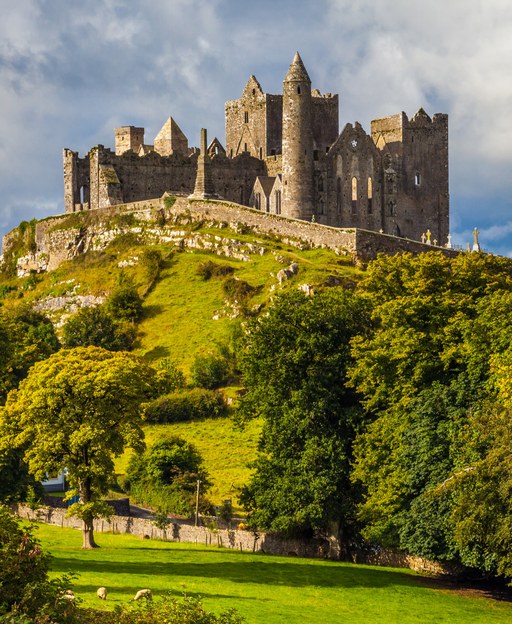
Woulfe says that before the Anglo-Norman invasion the MacCarthys were kings of Desmond, or South Munster. One of them, Cormac Mac Cárthaigh, is the king whose name is tied to Cormac’s Chapel on the Rock of Cashel. Heritage Ireland’s visitor material describes him as king of Desmond and says the chapel was consecrated in 1134, and Samuel Trant McCarthy’s family history, The MacCarthys of Munster (1922), gives the work as started in 1127 and finished in 1134. If you are visiting Tipperary, it is the one stop where the name is built into the stonework.
From Tipperary to Cork and Kerry
After the Anglo-Normans arrived, Woulfe writes, the MacCarthys “were driven from the plains of Tipperary into the present counties of Cork and Kerry”, where they became very numerous and kept considerable possessions until the wars of the late seventeenth century. He names three great branches:
- MacCarthy Mór: chiefly in Kerry. In 1565 Donal MacCarthy Mór was created Earl of Clancar.
- MacCarthy Reagh: lords of Carbery in west Cork.
- MacCarthy of Muskerry: in the country west of Cork city.
He adds that there were numerous minor branches too. We have a separate guide to the McCarthy name if you want more on the family as a whole.
McCartie, MacCarty, McCarthy: one name, many spellings
Woulfe lists the anglicised forms M’Carhig, MacCarha, MacCarthy, MacCartie, MacCarty and MacArthy. The 1588 report quoted in the 1922 family history shows McCartie in an official paper of the period, and a clerk, a priest or a census enumerator in your family’s county could have chosen any of them. That is why a McCartie in one record can turn up as a McCarthy in the next. Search every form, and the Irish forms Mac Cárthaigh and Ó Cárthaigh too (Woulfe lists Ó Cárthaigh as a separate name, so check which family your records point to).
Where to search for your McCartie or McCarthy
- Pick a county first. A family story that says Cork or Kerry is a better starting point than the name alone. Our guides: County Cork family records, County Kerry family records and County Tipperary family records. Names have many variants and many separate families, so a shared spelling does not prove a shared ancestor.
- Civil records. IrishGenealogy.ie gives access to births 1864 to 1925, marriages 1845 to 1950 and deaths 1871 to 1975; non-Catholic marriages are recorded from 1845 and Catholic marriages from 1864.
- Census. The National Archives of Ireland has the 1901 and 1911 censuses online, and the 1926 census was published online in April 2026. Try each spelling.
- Land records. Griffith’s Valuation (1847 to 1864) on Ask About Ireland shows who held land in which townland, so you can see which spellings cluster where.
- Then the parish. Once you have a townland, our guide to finding your ancestral townland explains the next steps.
☘️ Join 64,000+ Ireland Lovers
Every weekday morning, get Ireland’s hidden gems, local secrets, and travel inspiration — the kind you won’t find in any guidebook.
Subscribe free — enter your email:
Free forever · Unsubscribe anytime
For more on how Irish surnames formed and where they were found, see our guides to what your Irish surname says about where your family came from, where the most common Irish surnames come from and what your Irish surname reveals about your family’s origins.
Checked November 2026. Record ranges and online collections change, so confirm each step on the official pages.
Tours & experiences you might love


Powered by Viator. Some links are affiliate links — we may earn a small commission at no extra cost to you.
Secure Your Dream Irish Experience Before It’s Gone!
Planning a trip to Ireland? Don’t let sold-out tours or packed attractions spoil your journey. Iconic experiences like visiting the Cliffs of Moher, exploring the Rock of Cashel, or enjoying a guided walk through Ireland’s ancient past often sell out quickly—especially during peak travel seasons.

Booking in advance guarantees your place and ensures you can fully immerse yourself in the rich culture and breathtaking scenery without stress or disappointment. You’ll also free up time to explore Ireland’s hidden gems and savour those authentic moments that make your trip truly special.
Make the most of your journey—start planning today and secure those must-do experiences before they’re gone!