

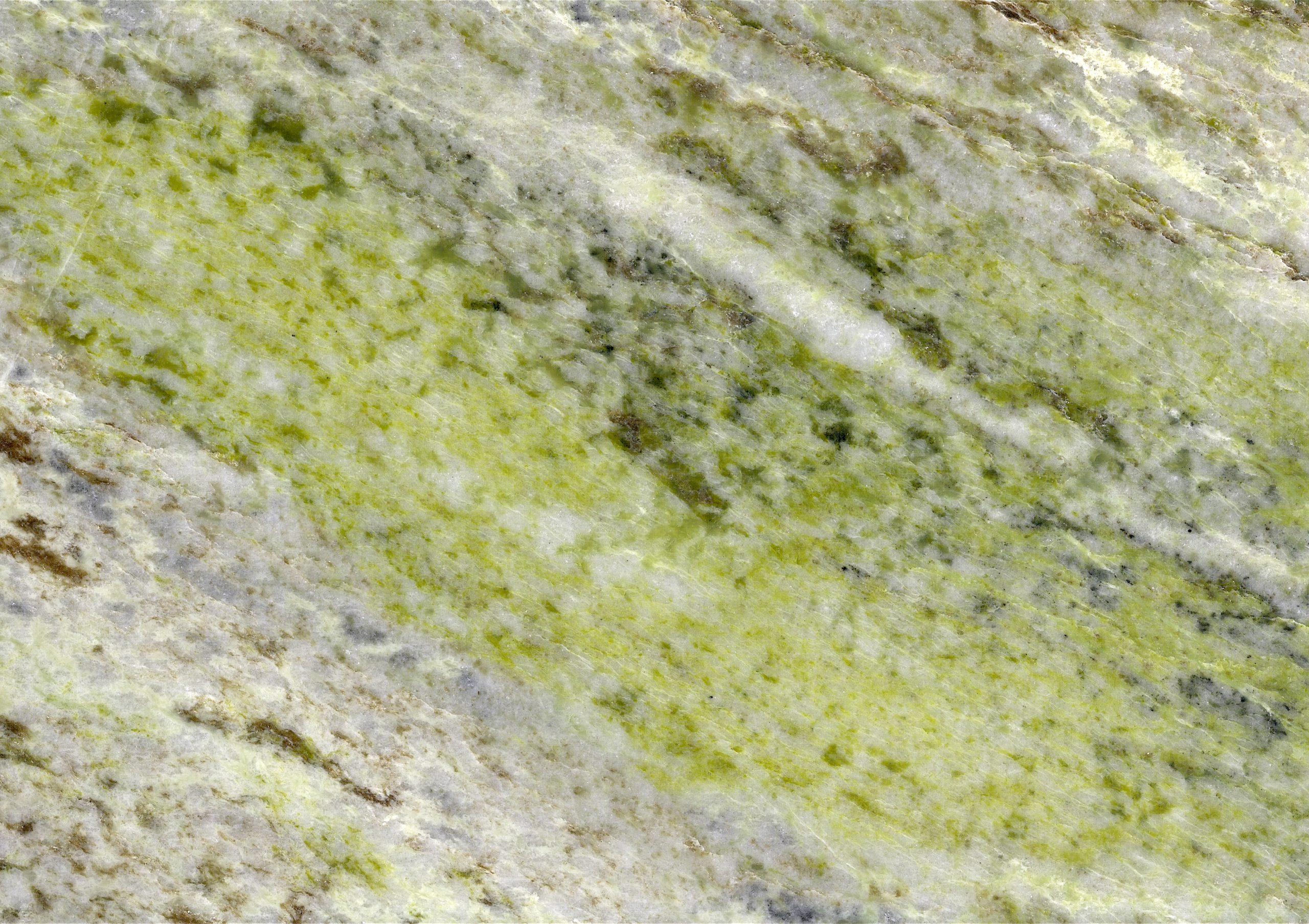
All the World’s Connemara Marble Comes From a Strip of Ground 20 Miles Long
The Senate Chamber of Pennsylvania’s state capitol building is clad in green Irish marble. Not ornamental green marble from Italy or Vermont or Brazil — specifically, marble from a narrow corridor of bog and mountain in County Galway, quarried from a deposit that stretches roughly 20 miles from east to west and exists nowhere else on Earth. It was installed in the early 1900s as the building took shape, cut and shipped across the Atlantic while construction was still underway. The senators who work in that chamber walk past walls of stone that formed before multicellular life existed on this planet. Most of them, we’d wager, have no idea.
Why the Stone Is Green — and Why There’s Only One Place It Exists
The story begins in the Neoproterozoic era, when what is now western Ireland sat at the margin of an ancient continent called Laurentia — the geological core of North America. Lime mud accumulated on a shallow sea floor over millions of years, layer by layer. That sediment became limestone.
Then, around 460 million years ago, a collision and compression event called the Grampian Orogeny — the mountain-building episode that raised the Caledonian range — subjected those limestone beds to enormous heat and pressure. Limestone under such conditions recrystallises into marble. But this wasn’t clean, uniform limestone. It was impure, silica-rich, dolomitic rock threaded with other minerals. As it transformed under pressure, those minerals transformed too. Among them: serpentine.
Serpentine is a magnesium-rich silicate mineral group, and it is specifically why Connemara marble is green. Deep jewel-green from serpentine itself, pale green from epidote, white and grey from calcite, occasional flashes of gold from traces of pyrite — each piece of the stone is a cross-section through the layers of an ancient sea floor, the colour variations a record of exactly which minerals were present at exactly which depth. The result is a stone that doesn’t just look distinctive. It is geologically distinctive: no similar formation exists anywhere in the world. The deposit runs in a narrow corridor from Clifden to Recess, bounded on all sides by different rock types — Silurian and Ordovician rocks to the north, Carboniferous limestones to the east, younger granites to the south. The Grampian Orogeny created it and contained it simultaneously.
The source sediment is somewhere between 650 and 750 million years old. The metamorphic event that turned it into the stone we know occurred around 460 million years ago. In 2022, the International Union of Geological Sciences formally designated Connemara marble as one of just 32 World Heritage Stones — a classification reserved for geological materials of singular global significance. There are 32 such stones in the world. This is one of them.
The Neolithic Trade Route
Long before anyone had a word for marble, people were digging the green stone out of the Connemara hills and carrying it away. Archaeological evidence places Connemara marble artefacts in Neolithic contexts more than 5,000 years ago: stone axes, made from the green rock, have been recovered at Lough Gur in County Limerick — roughly 150 miles from the quarry face. The stone was also traded, it appears, as far as the Boyne Valley, putting it in the orbit of the same civilisation that built Newgrange.
These weren’t decorative objects. Stone axes were high-value tools, moving across significant distances in exchange for food, livestock, or social standing. That the green stone from Connemara was travelling this far in the Neolithic suggests people recognized early that this particular rock was unusual. It takes a high polish. It’s dense and resistant. Unlike limestone, it doesn’t crumble in the hand. It feels, and looks, like something worth keeping.
How a Clifden Landlord Turned It Into Commerce
For most of recorded history, Connemara marble served intermittently for local ornamental purposes. Its modern commercial life begins in the early 1820s, when John D’Arcy — founder of the town of Clifden and the man actively trying to develop this remote corner of Galway — began quarrying it in earnest. D’Arcy (1785–1839) had built Clifden Castle around 1818 in the Gothic Revival style and was promoting the economic potential of the surrounding region. The green stone in the hills to his east was, he correctly judged, something the Victorian market for architectural stone would pay for.
He was right. Over the following decades, Connemara marble appeared in buildings across Britain and Ireland: Kensington Palace, Westminster Cathedral, the London General Post Office, Oxford’s Natural History Museum, Trinity College Dublin’s Museum Building. The Victorian appetite for decorative stonework was large, and Connemara’s swirling green was unlike anything quarried in Britain.
The clearest sign of how seriously the Edwardian establishment regarded the stone came in 1903, when King Edward VII and Queen Alexandra visited the Lissoughter Quarry in person. A royal visit to an active stone quarry is not a common event in any century. It speaks to what the marble had become: not a regional curiosity but a material with genuine cultural cachet.
The American Moment: A State Capitol and an Irish Jade
It was a New York marble merchant, Robert C. Fisher of Robert C. Fisher & Co., who brought Connemara marble to the American market in serious volume during the 1890s. The most significant project was the Senate Chamber of the Pennsylvania State Capitol in Harrisburg, a building conceived on a scale of near-theatrical grandeur. The walls and door frames of the Senate Chamber were lined in Connemara marble — specifically, a rare and particularly intense variant sometimes called Irish Jade, found in one specific Galway quarry and notable for its unusually deep, saturated green. The Capitol building was completed in 1906. The Connemara marble in its Senate Chamber has been there ever since.
There’s a practical reason it survives so well indoors: Connemara marble, used inside, holds its colour indefinitely. Used outside, the reverse is true. The serpentine minerals oxidise when exposed to the elements, and the stone eventually turns black. Every piece ever made for architecture was always destined for an interior. It was never a building facade material. It was a statement of interior wealth — and in the Senate Chamber of a state capitol at the height of the Gilded Age, that statement was being made loudly.
The Slump, and the Man Who Bought a Sleeping Quarry
After World War I, demand for high-end architectural stone collapsed. Tastes shifted, building costs changed, and the great Victorian appetite for marble chimneypieces and wall cladding dried up. The Connemara quarries fell quiet. Lissoughter, which had hosted royalty, became overgrown and abandoned.
In November 1945, a man named Thomas Walsh set up a small workshop in Terenure Place, Dublin, and incorporated a company called The Irish Consolidated Bead Company. The purpose was modest: produce rosary beads for the Irish and export market, using Connemara marble as the primary material. By 1947, the company was supplying rosaries to Shannon Airport’s newly opened duty-free shop — one of the first duty-free retail operations in the world. Connemara marble, in the form of a rosary, was becoming a gift that Irish emigrants carried with them when they left.
Thomas’s grandson Stephen joined the family business in 1975, right after leaving school. By the early 1980s, with demand for Irish goods growing and the diaspora market for Irish crafts increasingly real, the company needed a secure supply of raw stone. In 1983, Stephen Walsh tracked down the derelict Lissoughter Quarry and bought it. He described finding the site as like discovering Sleeping Beauty’s castle — decades of vegetation reclaiming the workings, the infrastructure long gone, the stone entirely still.
The quarry had been waiting. The Grampian Orogeny, 460 million years prior, had been less patient.
How You Sell Ancient Stone to the Diaspora
The masterstroke came in the late 1980s, when J.C. Walsh & Sons brokered a partnership with the American shopping channel QVC. On St. Patrick’s Day 1990, Connemara marble made its television debut. It was an almost algorithmically perfect fit: a genuine, certifiably ancient stone with a verifiable Irish origin, sold to an audience buying a connection to somewhere ancestral as much as they were buying jewelry.
Stephen Walsh has appeared on QVC annually since 1993. The company has sold more than 160,000 rosaries through the channel alone — which, laid end to end, would stretch over 100 miles. Put another way: those beads represent over eight million individual Hail Marys, all strung from stone that formed before the first fish appeared in the oceans.
The primary products today are jewelry — rings, pendants, earrings, bracelets, typically set in sterling silver with Celtic knotwork motifs — alongside rosaries, small figurines, decorative objects, and occasionally larger architectural panels. The stone is widely described as Ireland’s national gemstone, a designation that is more cultural than statutory but no less real for that.
The Numbers Behind the Scarcity
The economics of Connemara marble are shaped by a single uncomfortable ratio: for every 1,000 kilograms of stone extracted from the ground, only around 100 kilograms ends up as usable finished material. The other 900 kilograms — cracked, discoloured, structurally compromised, or simply cut from the wrong part of the seam — is waste. A 90% waste rate is not unusual in high-grade decorative stone extraction, but it concentrates the mind about supply.
The deposit itself is finite. The extractable corridor runs from Clifden to Recess in a strip roughly 20 miles long and, at its narrowest, around a quarter-mile wide. Only a small number of quarries remain active, operated by family-run enterprises — among them J.C. Walsh & Sons at Lissoughter and Connemara Marble Industries Ltd., which runs quarries at Streamstown and Cregg and operates a factory and visitor centre at Moycullen, describing itself as Ireland’s largest manufacturer of Connemara marble jewelry and gifts. These are not mining conglomerates. They are artisan operations built around a geological accident that happened once and cannot be replicated.
The IUGS Heritage Stone designation formalises what the industry has always understood: this material cannot be substituted or scaled. There is no other source. The 2022 designation, placing Connemara marble in a list of 32 globally significant geological materials alongside the likes of Portland Stone and Norwegian Larvikite, is also a quiet acknowledgement that finite resources eventually require formal recognition.
The Floor You Stand On
The most dramatic single use of Connemara marble currently standing is the floor of Galway Cathedral, the Cathedral of Our Lady Assumed into Heaven and St Nicholas. Completed in 1965 as the last great stone-built Catholic cathedral to be erected in Ireland, its interior floors are covered almost entirely in locally quarried Connemara marble — a surface area widely described as the largest single expanse of this stone anywhere in the world. The stone that normally ends up as a pendant the size of a thumbnail here covers thousands of square metres.
There’s something slightly vertiginous about standing on it — knowing that you are walking on something irreplaceable, and that this same stone spent the better part of 700 million years as sediment on an ancient sea floor before someone with a quarry in Recess and a contract for a cathedral decided it should become a floor.
The stone has been here longer than Ireland has. Longer than Europe. Longer, by a considerable margin, than anything with a spine. It formed under pressures we can measure but not fully imagine, in a mountain-building event that no living creature witnessed. It ended up in a senate chamber in Pennsylvania and a cathedral in Galway and a rosary at Shannon Airport’s first duty-free, and it is slowly, carefully, extracted from a 20-mile strip of Galway ground by a small number of families who know that what they’re working with is, in every meaningful sense, irreplaceable.
Join 169,000+ Ireland lovers
Every week, stories like this one — plus hidden gems, heritage deep-dives, and the Ireland most visitors never find.
Already subscribed? Download your free Ireland guide (PDF)
Free forever · One email per week · Unsubscribe anytime
☘️ Join 168,000+ Ireland Lovers
Every week, get Ireland’s hidden stories, heritage, and travel inspiration — delivered free to your inbox.
Subscribe free:
Tours & experiences you might love


Powered by Viator. Some links are affiliate links — we may earn a small commission at no extra cost to you.
Secure Your Dream Irish Experience Before It’s Gone!
Planning a trip to Ireland? Don’t let sold-out tours or packed attractions spoil your journey. Iconic experiences like visiting the Cliffs of Moher, exploring the Rock of Cashel, or enjoying a guided walk through Ireland’s ancient past often sell out quickly—especially during peak travel seasons.

Booking in advance guarantees your place and ensures you can fully immerse yourself in the rich culture and breathtaking scenery without stress or disappointment. You’ll also free up time to explore Ireland’s hidden gems and savour those authentic moments that make your trip truly special.
Make the most of your journey—start planning today and secure those must-do experiences before they’re gone!