

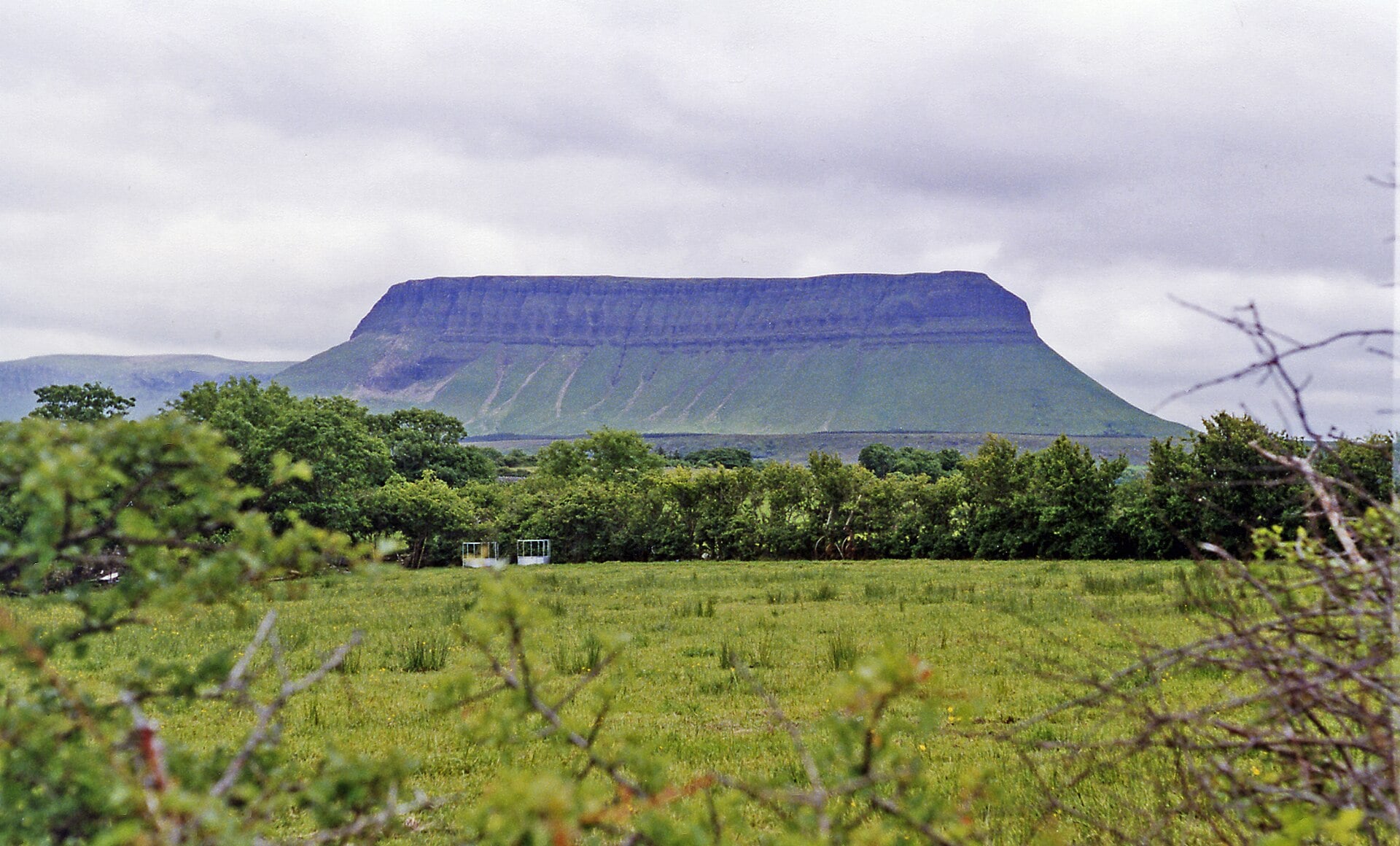
Benbulben stands in County Sligo like a giant flat-topped fortress. Its vertical cliffs drop sharply on three sides, and its plateau stretches out on top as if someone sliced the peak clean off. It is one of the most distinctive mountains in Ireland — and one of the most significant, for reasons that go well beyond its shape.
Whether you are planning a visit to Sligo or simply curious about the landscape that shaped one of Ireland’s greatest poets, Benbulben rewards the time you spend getting to know it.
What Makes Benbulben So Distinctive?
Most mountains taper to a point. Benbulben does not. It rises to a flat summit at 526 metres, flanked by near-vertical cliffs of layered limestone and shale. From below, particularly from the north, it looks more like a mesa than a typical Irish hill.
The mountain sits within the Dartry range, which stretches across north Sligo and into Leitrim. But Benbulben is the one that catches the eye. On a clear day you can see it from miles out to sea. On a misty morning, the upper cliffs disappear into cloud and the mountain seems to float above the fields.
That visual drama is part of why it has been painted, photographed, and written about for centuries. It does not look quite like anything else in Ireland.
How Benbulben Got Its Shape
The mountain is made of carboniferous limestone laid down roughly 320 million years ago when this part of Ireland sat beneath a shallow tropical sea. Over time, the layers built up. Then the ice ages came.
Glaciers carved the landscape around Benbulben from the base up, undercutting the soft shale and exposing the harder limestone above. The result is that distinctive table shape — a hard cap of limestone sitting on eroded lower slopes, with cliffs where the ice pulled the softer rock away.
The nutrient-rich limestone also makes the upper slopes unusually diverse for a mountain this far north. Benbulben is home to several rare Arctic-alpine plants that have survived here since the last ice age. Species such as fringed sandwort and alpine saxifrage cling to ledges that are too steep for grazing animals to reach. For botanists, it is a significant site.
Benbulben and W.B. Yeats
The poet W.B. Yeats grew up spending summers in County Sligo, and the landscape never left him. Benbulben appears in several of his poems, most famously in “Under Ben Bulben,” written in 1938 shortly before his death. The poem ends with what became his own epitaph:
“Cast a cold eye / On life, on death. / Horseman, pass by!”
These words are carved on his gravestone in the churchyard at Drumcliff, a small village at the foot of the mountain. Yeats asked to be buried there specifically — within sight of Benbulben, in a place his family had known for generations.
Drumcliff itself is worth a visit. The churchyard contains the remains of a round tower and a carved high cross dating from around the 10th century. Yeats’s grave is marked by a simple stone, and it draws visitors from around the world who come to pay their respects and read those final lines.
The connection between Yeats and this landscape was not sentimental. He genuinely believed the hills and coastline of Sligo had a power that fed his imagination. Many scholars argue that without Sligo, his mythology-soaked poetry would have been a different thing entirely.
Walking and Hiking Around Benbulben
Benbulben is part of a larger walking area that includes several interconnected trails. The most popular approach to the summit plateau starts from the southern side, above the village of Ballintrillick. The route is steep but manageable for anyone reasonably fit, and the views from the top stretch across to Donegal, out over the Atlantic, and south towards Roscommon on a clear day.
The summit plateau is wider than it looks from below. It takes a good 30 to 40 minutes to cross from one end to the other. The grass is short and springy, kept that way by the mountain sheep that graze up here in summer. Watch your footing near the cliff edges — the drop is serious and the rock can be wet even on dry days.
For those who prefer lower-level walking, the Benbulben Loop takes in the base of the mountain and the surrounding farmland without requiring a summit ascent. It passes through Drumcliff and offers good views of the cliffs from the valley floor. Total distance is around 10 kilometres.
Walking boots are essential. The ground on the upper slopes can be boggy even in summer, and the limestone sections can be slippery when wet. Bring a waterproof layer regardless of the forecast — conditions change quickly this close to the Atlantic.
What to See Nearby
Sligo is a small county but it is dense with things worth seeing. These are some of the places worth combining with a visit to Benbulben:
- Carrowmore Megalithic Cemetery — one of the largest collections of Stone Age monuments in Ireland, just south of Sligo town. Around 30 tombs survive, some dating back almost 6,000 years.
- Lissadell House — a Greek Revival mansion on the shores of Sligo Bay, associated with Yeats and the Gore-Booth family. Constance Markievicz, a leader of the 1916 Rising, grew up here.
- Strandhill — a surf beach about 8 kilometres west of Sligo town, with a strong surf culture and several good places to eat nearby.
- Hazelwood Sculpture Trail — a quiet forest walk along the shores of Lough Gill, with contemporary sculptures positioned along the route.
- Sligo Town — a genuine working town with a good food scene, several Yeats-related sites including the Yeats Memorial Building, and easy access to the coast and mountains.
When to Visit Benbulben
Benbulben is accessible year-round, but the conditions vary considerably by season.
Late spring and early summer (May to June) offer the best combination of longer daylight hours and relatively dry conditions. The vegetation on the lower slopes is at its most vivid, and the rare plants on the upper ledges are often in flower.
Summer (July and August) brings more visitors and warmer temperatures, but also more cloud and Atlantic rain. The mountain can be perfectly clear in the morning and wrapped in mist by early afternoon.
Autumn is underrated. October in particular can bring sharp clear days when the light is exceptional and the walking crowds thin out. The lower slopes turn russet and gold.
Winter walking on Benbulben is for experienced hillwalkers only. The plateau can be icy, wind speeds at the top are often severe, and the days are short. That said, a calm winter day with snow on the upper cliffs and frost on the valley floor is something to remember.
How to Get to Benbulben
Benbulben sits about 13 kilometres (8 miles) north of Sligo town. By car, take the N15 north from Sligo towards Donegal. The mountain will be visible to your left as you pass through Drumcliff. For the southern trail head above Ballintrillick, follow signs from the N16 through Manorhamilton direction.
There is no direct public transport to the trail heads. Bus Éireann runs services from Sligo town to Bundoran along the N15, stopping in Drumcliff, but you will need a car or bicycle to reach the walking routes from there.
Sligo town has good transport links — Bus Éireann services from Dublin, Galway, and Belfast, and a rail connection from Dublin Connolly. Journey time from Dublin by train is around three hours and 15 minutes.
Accommodation ranges from hotels in Sligo town to B&Bs in Drumcliff and the surrounding villages. Booking ahead is advisable in July and August.
A Landmark Worth the Journey
Benbulben is not hard to get to and it is not hard to understand why it matters. You can see it from the road, photograph it from the valley, and stand on its summit on the same day. It has been shaping the imagination of the people who live around it for thousands of years.
Yeats asked to be buried in its shadow because he understood that some places carry weight that outlasts any individual life. Benbulben is one of those places.
If you are heading to Sligo, give the mountain the time it deserves. Walk around it at least, even if you do not climb it. Stand in the graveyard at Drumcliff and read the epitaph. Look up at the cliffs and think about what 320 million years of geological history looks like when it is standing right in front of you.
It looks like this.
Thinking about it seriously?
If you’ve started actually planning a move, our complete the full Move to Ireland guide walks through every step, every cost, and the paperwork that catches most people out.
Tours & experiences you might love


Powered by Viator. Some links are affiliate links — we may earn a small commission at no extra cost to you.
Secure Your Dream Irish Experience Before It’s Gone!
Planning a trip to Ireland? Don’t let sold-out tours or packed attractions spoil your journey. Iconic experiences like visiting the Cliffs of Moher, exploring the Rock of Cashel, or enjoying a guided walk through Ireland’s ancient past often sell out quickly—especially during peak travel seasons.

Booking in advance guarantees your place and ensures you can fully immerse yourself in the rich culture and breathtaking scenery without stress or disappointment. You’ll also free up time to explore Ireland’s hidden gems and savour those authentic moments that make your trip truly special.
Make the most of your journey—start planning today and secure those must-do experiences before they’re gone!