

The bond between a mother and son is one of the most enduring relationships in human experience. In Ireland, this connection is not just felt — it is remembered in stone, metal, and ink. Celtic symbols have long carried the weight of what words cannot fully express, and several of those symbols speak directly to the tie between a mother and her son.
This article looks at the Celtic symbols most closely associated with the mother-son bond, where they come from, what they mean, and why they still resonate with people of Irish heritage today.
Love Ireland? Get our weekly newsletter with stories, heritage, and travel inspiration. Subscribe free here →
The Celtic Motherhood Knot
The Celtic Motherhood Knot is probably the most direct symbol for the relationship between a parent and child. It is a variation of the Trinity Knot — the triquetra — but with one key difference. The interwoven loops are arranged so that the lines form the outline of an adult figure cradling a smaller one beneath.
The unbroken line is central to its meaning. In Celtic tradition, a line with no beginning and no end represents something that cannot be severed. The Motherhood Knot takes this idea and applies it specifically to the parent-child relationship — a bond that does not weaken with time, distance, or even death.
For Irish families who experienced emigration — and that is the majority of Irish families, across centuries of departure — this symbol carries particular weight. Mothers who sent sons across the Atlantic during the Famine, or to England in the 1950s, or to the United States and Australia in more recent decades, held onto something that geography could not dissolve. The Motherhood Knot makes that invisible thread visible.
The symbol is widely used today in jewellery — pendants, rings, and bracelets — and is a popular gift from sons to mothers, or from mothers to sons reaching adulthood or leaving home.
The Trinity Knot (Triquetra) and Its Meanings
The triquetra is one of the oldest Celtic symbols found in Ireland. Examples appear in the Book of Kells, the illuminated manuscript produced around 800 AD by monks, most likely at the monastery on the island of Iona. The triple-pointed interlaced shape also appears carved into early Christian stonework and metalwork across the island.
In pre-Christian Celtic belief, the number three was significant. The triquetra was used to represent the three stages of life, the three elements, and the concept of the eternal cycle. When Christianity arrived in Ireland, the symbol was adapted to represent the Holy Trinity — Father, Son, and Holy Spirit — but its earlier meaning of interconnected forces continued alongside the new interpretation.
In the context of mother and son, the triquetra has been interpreted as representing the three core elements of that bond: love, protection, and continuity. Some families use it specifically to represent the three generations of a family line — grandmother, mother, and son. The interlinked design, where no single point is separate from the whole, reflects the idea that each generation shapes and is shaped by the ones before and after it.
The triquetra appears in many forms across Ireland. You will find it on Celtic crosses in County Mayo, on reproduction metalwork in craft shops from Dingle to Donegal, and on gravestones in churchyards that date back several centuries.
The Claddagh Ring: Love, Loyalty, and Family
The Claddagh ring comes from the fishing village of Claddagh, just outside the old walls of Galway city. The design — two hands holding a crowned heart — dates to the seventeenth century, and the symbolism is straightforward: the hands represent friendship, the heart represents love, and the crown represents loyalty.
While the Claddagh is most commonly associated with romantic relationships, it has long been used within families to mark bonds between parents and children. Mothers have passed Claddagh rings to their sons for generations, particularly when a son was leaving Ireland. The ring served as a physical reminder of home and of the person left behind.
There is a tradition, observed in many Connacht families, of a mother giving her son a Claddagh ring on the day he emigrated. The instruction was to wear it with the heart facing inward — the traditional sign that one’s heart was taken. It was understood that the heart in question belonged, in part, to the mother who gave it.
Today the Claddagh is one of the most recognised Irish symbols internationally, but in Galway it retains its local connection to the original fishing community. The Galway City Museum holds the oldest known Claddagh ring, made by the goldsmith Richard Joyce around 1700, and Thomas Dillon’s Claddagh Gold on Quay Street — trading since 1750 — runs a small museum dedicated to the ring’s history. The village of Claddagh itself no longer stands — the original thatched cottages were demolished in the 1930s — but the ring it gave to the world continues.
Enjoy stories like this? Our free weekly newsletter covers Irish heritage, travel, and culture — delivered to your inbox. Sign up here →
The Triskelion: Movement and Endurance
The triskelion — also called the triskele — is a three-armed spiral symbol. Ireland’s most famous example is the entrance stone at Newgrange in County Meath, which dates to around 3200 BC, making it older than the Egyptian pyramids. The spirals carved into that stone have been studied for millennia, and their precise meaning remains debated among archaeologists. A short drive away, the passage cairns at Loughcrew hold even more carved spirals than Newgrange itself, with far fewer visitors.
The most widely accepted interpretation is that the triskelion represents motion and progression — the sun moving across the sky, the seasons changing, and the cycle of birth, life, and death. The three arms also connect to Celtic triads: land, sea, and sky; past, present, and future; life, death, and rebirth.
In the context of the mother-son relationship, the triskelion speaks to continuity across time. A mother carries the past — the family line, the traditions, the stories — while her son carries the present and moves into the future. The three spirals, each moving outward from a central point yet always connected, reflect that dynamic. The centre holds, no matter how far the arms extend.
It is also worth noting that Newgrange was built to align with the winter solstice sunrise — the shortest, darkest day of the year — so that the inner chamber would be flooded with light on that single morning. Some scholars suggest this was connected to beliefs about rebirth and the relationship between the living and the dead. A mother’s connection to her child, and a child’s connection to his ancestors, fits naturally within that framework.
Where These Symbols Appear in Ireland Today
If you are visiting Ireland and want to see these symbols in their original context, there are several places worth making the effort to reach.
Newgrange, County Meath — The entrance stone and kerbstones feature triskelion and spiral carvings. Access to the passage tomb itself is by guided tour only, booked through the Brú na Bóinne Visitor Centre. The winter solstice illumination is allocated by lottery.
The Book of Kells, Trinity College Dublin — The manuscript is on permanent display and shows triquetra and interlace designs in extraordinary detail. The library also holds the Long Room, one of Ireland’s most impressive spaces.
The Aran Islands, County Galway — Dún Aonghasa on Inis Mór is a prehistoric hill fort perched on a cliff edge, its massive stone ramparts first raised in the late Bronze Age around 1100 BC and refortified in early medieval times, with views across the Atlantic. The islands have a strong connection to pre-Christian Irish tradition and are one of the few places where Irish is the everyday spoken language.
The National Museum of Ireland, Dublin — The Archaeology branch on Kildare Street holds one of the finest collections of Celtic metalwork in the world, including torcs, brooches, and neck rings from the Iron Age. The Tara Brooch is here, and it is worth the visit on its own.
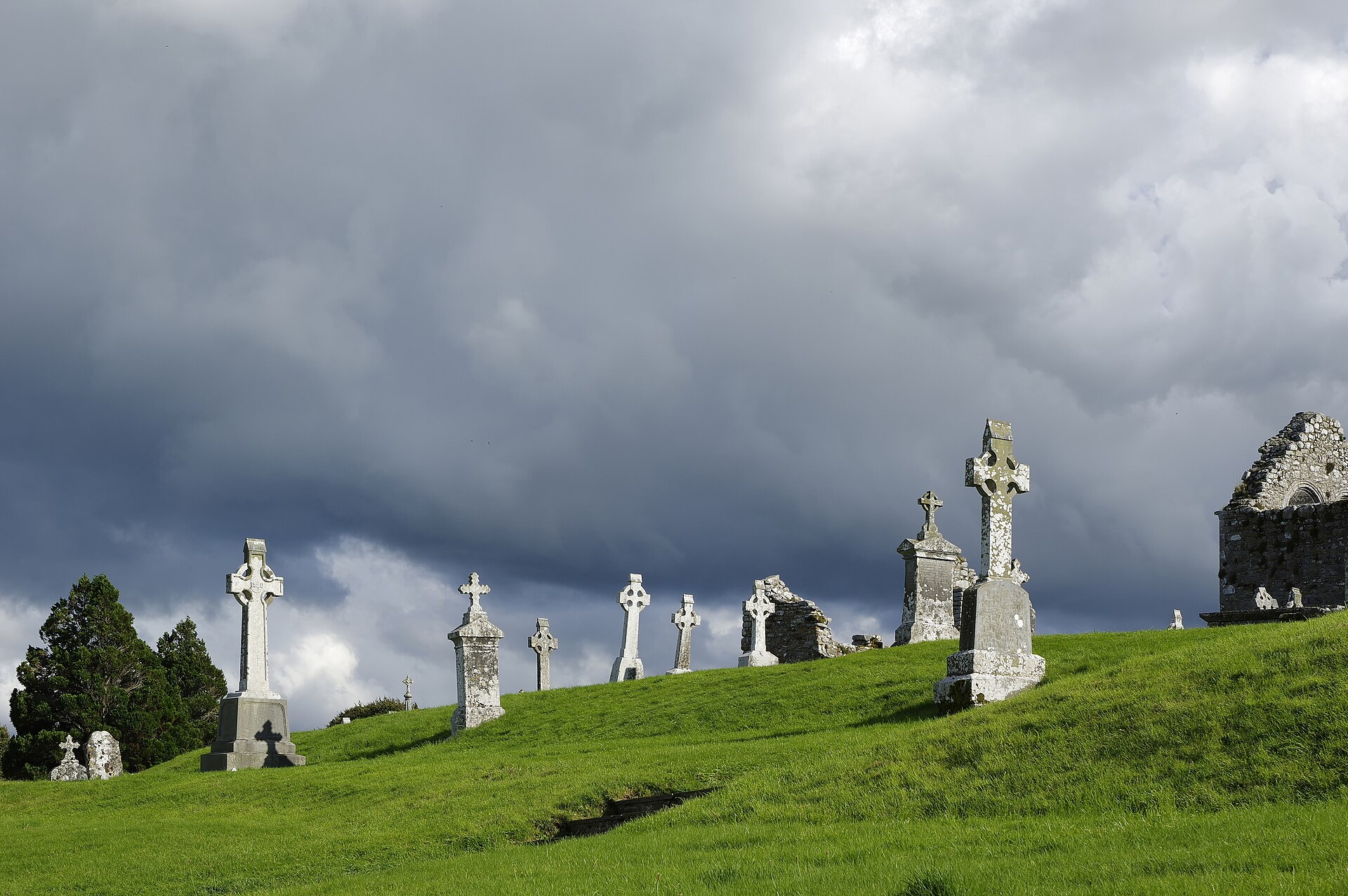
Clonmacnoise, County Offaly — One of Ireland’s great monastic sites, on the banks of the River Shannon. The High Crosses here carry intricate knotwork that combines Celtic and early Christian design.
Using These Symbols as Gifts
Celtic symbols are widely available in Ireland in jewellery, engraved metalwork, and printed art. If you are buying something as a gift to mark a mother-son bond, a few practical points are worth knowing.
First, the Motherhood Knot is specifically designed for the parent-child bond and is the most direct choice if that is the relationship you want to acknowledge. You will find it most commonly in pendant form, in silver or gold.
Second, the Claddagh ring has a recognised wearing tradition in Ireland. A ring worn on the right hand with the heart facing outward means the wearer is unattached. Facing inward means the heart is taken. Worn on the left hand, it traditionally indicates engagement or marriage. If you are giving a Claddagh ring as a non-romantic gift, it is worth explaining this to the recipient so they can make an informed choice about how to wear it.
Third, when buying Celtic jewellery, look for pieces made in Ireland by Irish makers. There is a significant quantity of Celtic-design jewellery manufactured overseas. If provenance matters to you, look for the Irish Craft mark or buy directly from a maker whose workshop is in Ireland.
Towns with particularly strong craft jewellery traditions include Kenmare in County Kerry, Clifden in County Galway, and the Dingle Peninsula. Dublin’s Temple Bar area has many jewellery shops, though quality varies considerably.
The Role of Heritage in Irish Identity
Ireland has one of the largest diaspora populations relative to its home population of any country in the world. Estimates put the number of people of Irish heritage outside Ireland at somewhere between 70 and 80 million, compared to a home population of around five million. This means that for the majority of people who identify as Irish or Irish-heritage, Ireland is a place of origin rather than a place of residence.
Celtic symbols have taken on a particular role within this diaspora. They serve as a visible, portable marker of connection — a way of carrying Ireland with you when you are far from it. For families separated by emigration, a shared symbol — whether a Claddagh ring, a triquetra pendant, or a triskelion tattoo — can be a way of maintaining the bond across distance.
The mother-son dimension of this is especially resonant in the Irish story. Emigration has historically fallen disproportionately on young men. The mothers who remained, and the sons who left, needed ways of holding the relationship in place when letters were slow and calls were expensive. The symbols discussed here gave physical form to something that distance threatened to erode.
That context continues to apply today. Irish people move for work, for study, for opportunity. The symbols endure because the underlying experience endures.
Get more Irish heritage, history, and travel in your inbox each week. It’s free. Join our newsletter →
☘️ Join 64,000+ Ireland Lovers
Every weekday morning, get Ireland’s hidden gems, local secrets, and travel inspiration — the kind you won’t find in any guidebook.
Subscribe free — enter your email:
📲 Know someone who’d love this? Share on WhatsApp →
Free forever · Unsubscribe anytime
Tours & experiences you might love


Powered by Viator. Some links are affiliate links — we may earn a small commission at no extra cost to you.
Secure Your Dream Irish Experience Before It’s Gone!
Planning a trip to Ireland? Don’t let sold-out tours or packed attractions spoil your journey. Iconic experiences like visiting the Cliffs of Moher, exploring the Rock of Cashel, or enjoying a guided walk through Ireland’s ancient past often sell out quickly—especially during peak travel seasons.

Booking in advance guarantees your place and ensures you can fully immerse yourself in the rich culture and breathtaking scenery without stress or disappointment. You’ll also free up time to explore Ireland’s hidden gems and savour those authentic moments that make your trip truly special.
Make the most of your journey—start planning today and secure those must-do experiences before they’re gone!