

One Million Irish Hearts ☘ 6.4% there
Every person who joins the Love Ireland family colours one heart on the map. Together we’re filling the whole island of Ireland — 1,000,000 hearts — by St Patrick’s Day 2027.
of 275 145
days to St Patrick’s Day 2027 936,206
hearts still needed
Live scoreboard, refreshed daily — updated 2026-10-23.
When Is St Patrick’s Day?
St Patrick’s Day falls on 17 March every single year, without exception. The date is fixed because it commemorates the feast day of Ireland’s patron saint — the day traditionally held to mark the death of St Patrick in the fifth century. As a liturgical feast rather than a calculated observance like Easter, it never moves, which makes planning beautifully straightforward.
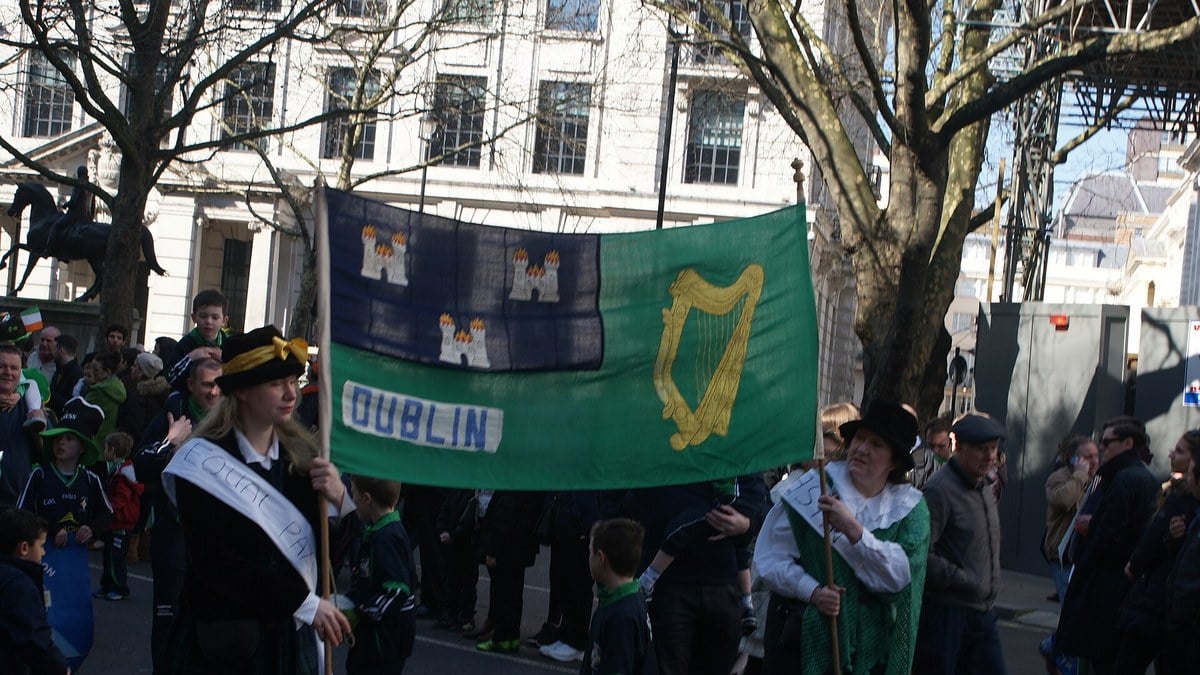
In Ireland, 17 March is a public holiday, meaning schools, banks, and most businesses close for the day. Pubs, restaurants, and the parade routes, however, are very much open — and absolutely heaving. The island embraces the occasion with genuine warmth rather than mere obligation, and in recent decades the celebrations in Dublin have expanded from a single day into a multi-day festival that draws hundreds of thousands of visitors from across the world.
When St Patrick’s Day falls during Holy Week — as it occasionally does — the Catholic Church moves the feast to another date on the liturgical calendar, though the public holiday and cultural celebrations stay firmly on 17 March regardless. So whatever year you’re counting down to, circle the seventeenth and start dreaming.
Who Was St Patrick?
The real St Patrick is a considerably more fascinating figure than the cartoon depictions on novelty hats might suggest. He was a fifth-century Romano-British Christian, likely born somewhere along the western coast of Britain — possibly in Wales or the north of England, though scholars still debate the precise location. His birth name is generally given as Maewyn Succat, though he took the Latin name Patricius, from which Patrick derives.
As a teenager, around the age of sixteen, Patrick was captured by Irish raiders and taken to Ireland as a slave, most probably to work as a shepherd in the west of the country. He spent around six years in captivity, during which time, according to his own autobiographical writings — the Confessio and the Epistola — his Christian faith deepened profoundly. He eventually escaped, made his way back to Britain, and began formal religious training.
The pivotal moment in the Patrick story came when he felt a divine calling to return to Ireland as a missionary. He was ordained a bishop and arrived back on Irish shores around 432 AD, spending the rest of his life travelling the country, establishing churches, and baptising converts. He is credited with playing a central role in bringing Christianity to Ireland, though it is important to note that Christian communities already existed in parts of the island before his mission.
The Shamrock and the Trinity
One of the most enduring legends associated with Patrick is his use of the shamrock to explain the Christian doctrine of the Holy Trinity — Father, Son, and Holy Spirit as three distinct persons within one God. By holding up the small three-leafed plant, Patrick reportedly made an abstract theological concept tangible for his Irish audience. Whether this moment is historically documented or later embellishment is debated by scholars, but the shamrock has been inseparable from his legacy ever since.
What About the Snakes?
The famous story that Patrick drove all the snakes out of Ireland is almost certainly a myth — and not only because it makes for a suspiciously tidy legend. The scientific reality is that Ireland has been free of native snake species since the end of the last Ice Age, roughly ten thousand years ago. The island separated from Britain before snakes could recolonise northwards. Most historians and theologians interpret the snake story as a metaphor — snakes being symbolic of paganism and evil in early Christian tradition — representing Patrick’s missionary work in banishing pre-Christian religious practices. It is a powerful image, just not a literal one.
How Ireland Celebrates
In Ireland, St Patrick’s Day is a genuinely joyful public occasion that blends the sacred and the celebratory in a way that feels distinctly Irish. Churches hold special masses in the morning, families gather for meals, and communities turn out in their thousands for parades that range from grand city spectacles to wonderfully eccentric small-town processions.
The Dublin Festival
Dublin is the undisputed centrepiece of the national celebration. What was once a single parade has grown into St Patrick’s Festival Dublin, a multi-day event typically running for four to five days around 17 March. The festival brings together street theatre, céilí dancing, spectacular light installations, live music stages across the city, and the main parade through the heart of the capital. The parade itself draws over half a million spectators lining the streets, with performers and floats travelling through College Green and O’Connell Street in a riot of colour and noise.
Regional Celebrations
Beyond Dublin, virtually every town and village across the island holds its own parade and festivities. Downpatrick in County Down — the town traditionally associated with Patrick’s burial place — holds particular significance and draws pilgrims as well as revellers. Limerick, Cork, Galway, and Waterford all host substantial festivals of their own, each with a distinct local character. In smaller towns, the parade might consist of the local GAA club, a few tractors, and the school band — and be all the more charming for it.
The craic — that untranslatable Irish word encompassing good conversation, laughter, music, and atmosphere — is central to the day. Pubs fill early, traditional music sessions start up, and the mood across the country is one of collective good humour and pride.
St Patrick’s Day Around the World
St Patrick’s Day is, in a remarkable quirk of cultural history, celebrated more exuberantly in some parts of the world than in Ireland itself. The Irish diaspora, which spread across the globe through centuries of emigration — and most dramatically during and after the Great Famine of the 1840s — carried their identity and traditions with them, and nowhere did those traditions take root more vigorously than in the United States.
America’s Love Affair with St Patrick’s Day
The United States is home to the largest and most spectacular St Patrick’s Day celebrations outside of Ireland. New York City’s St Patrick’s Day Parade on Fifth Avenue is among the oldest and largest parades in the world, having been held continuously since 1762 — before American independence. Boston, with its deep Irish-American heritage particularly in neighbourhoods like South Boston, treats the day with enormous civic pride. Chicago has its own legendary tradition: the dyeing of the Chicago River green, a practice that has taken place annually since 1962, turning the waterway a vivid emerald for the occasion using an environmentally approved orange powder that reacts with the water.
The scale of Irish-American identity helps explain why the day is so significant in the US. It is estimated that over 30 million Americans claim Irish ancestry — a figure several times larger than the entire population of the island of Ireland itself. For many, St Patrick’s Day is a genuine expression of that heritage; for others, it is simply a joyful excuse to embrace a little Irish spirit.
The Global Greening
Tourism Ireland’s Global Greening initiative, launched in 2010, has become one of the most visually striking annual events in the world. Each year, famous landmarks across the globe are illuminated in green to mark St Patrick’s Day — from the Colosseum in Rome to the Sydney Opera House, Niagara Falls, the Great Wall of China, and the London Eye. It is a remarkable statement of Irish soft power and the global reach of Irish culture.
Traditions and Symbols
The Shamrock
The shamrock — a young sprig of clover, specifically a three-leafed variety — is the defining symbol of St Patrick’s Day and of Irish national identity more broadly. On the morning of 17 March in Ireland, it is traditional to wear a shamrock on your lapel. The President of Ireland presents shamrock to the American President (or their representative) in a long-standing diplomatic tradition. The four-leaf clover, often confused with the shamrock in commercial imagery, is a separate good-luck symbol and is not specifically associated with St Patrick.
The Colour Green — and the Older Blue
Green is so thoroughly associated with Ireland and St Patrick’s Day that it can feel as though it has always been so. In fact, the colour most historically associated with St Patrick is a particular shade of blue, sometimes called “St Patrick’s Blue,” which appears in early heraldic imagery. Green became dominant over centuries, tied to the Irish landscape, the shamrock, and eventually Irish nationalism. Today, wearing green on 17 March is the universal signal of participation in the celebration — and in parts of America, schoolchildren are famously warned they’ll be pinched if they forget.
Music, Food, and the Leprechaun
Traditional Irish music — fiddles, uilleann pipes, tin whistles, and bodhráns — forms the authentic soundtrack to St Patrick’s Day, whether in a pub session in Galway or an Irish bar in Boston. It is living, improvisational, and communal in a way that sets it apart from performance music.
Food traditions vary by geography. In Ireland, a celebratory meal might centre on bacon and cabbage — a classic combination of boiled back bacon with buttered cabbage and floury potatoes. In the United States, corned beef and cabbage became the iconic dish, an adaptation that emerged from Irish immigrant communities in America who substituted the more affordable and available corned beef for the bacon they knew at home. Both are delicious; neither should be skipped.
As for the leprechaun — the small, red-haired, buckle-hatted cobbler of Irish folklore — he exists in genuine Irish tradition as a fairy craftsman associated with hidden pots of gold. The commercial caricature beloved of novelty shops is, understandably, regarded with mild exasperation by many Irish people. The real folklore is far richer and stranger, and worth exploring.
Planning a Trip to Ireland for St Patrick’s Day
Visiting Ireland for St Patrick’s Day is a wonderful experience, but it requires advance planning, particularly if Dublin is on your itinerary.
Book accommodation as early as possible — ideally six months or more ahead. Hotels in Dublin fill rapidly, and prices rise significantly around festival dates. Consider staying slightly outside the city centre and travelling in by public transport, or look at options in the wider Leinster region.
If the bustle of a major city isn’t your ideal, smaller Irish towns offer a genuinely magical alternative. A village parade in County Clare or County Kerry, followed by an afternoon in a traditional pub with live music and a pint of Guinness, can be a more intimate and arguably more authentically Irish experience than the vast Dublin spectacle — and accommodation will be considerably easier to secure.
Be prepared for March weather in Ireland, which is famously unpredictable. Temperatures typically range from around 5°C to 12°C (40°F to 54°F), and rain is a real possibility on any given day. Layering is essential, and a waterproof jacket is non-negotiable. The upside is that Ireland in early spring has long evenings of soft light beginning to emerge, and the countryside is brilliantly green.
If you plan to attend the Dublin parade, arrive early to secure a good viewing spot along the route. The festival programme typically spans four to five days, so check the official St Patrick’s Festival website for the full schedule of events — there is far more on offer than just the parade itself.
Frequently Asked Questions
What date is St Patrick’s Day?
St Patrick’s Day is always on 17 March every year. The date never changes because it is a fixed liturgical feast day commemorating the death of St Patrick in the fifth century.
Why is the shamrock associated with St Patrick’s Day?
According to tradition, St Patrick used the three-leafed shamrock as a teaching tool to explain the Christian concept of the Holy Trinity — three persons in one God — to the people of Ireland. Whether or not this specific moment is historically documented, the shamrock has been linked to Patrick’s legacy for many centuries and is now Ireland’s most recognised national symbol.
Is St Patrick’s Day a public holiday in Ireland?
Yes. 17 March is a public holiday in the Republic of Ireland, and a bank holiday in Northern Ireland. Schools, banks, and most businesses close for the day, while pubs, restaurants, and the parade routes remain very much open for business.
What colour is really associated with St Patrick?
Historically, St Patrick’s Blue — a specific shade of azure — was the colour most closely associated with the saint and appears in early Irish heraldry. Green became dominant over subsequent centuries, tied to the Irish landscape, the shamrock, and Irish nationalist identity, and is now universally recognised as the colour of St Patrick’s Day.
How long does the Dublin St Patrick’s Festival run?
The St Patrick’s Festival Dublin typically runs for four to five days around 17 March, with the main parade taking place on St Patrick’s Day itself. The broader festival includes street performances, music, cultural events, and evening spectaculars. Exact dates vary slightly year to year, so checking the official festival programme in advance is always advisable.