

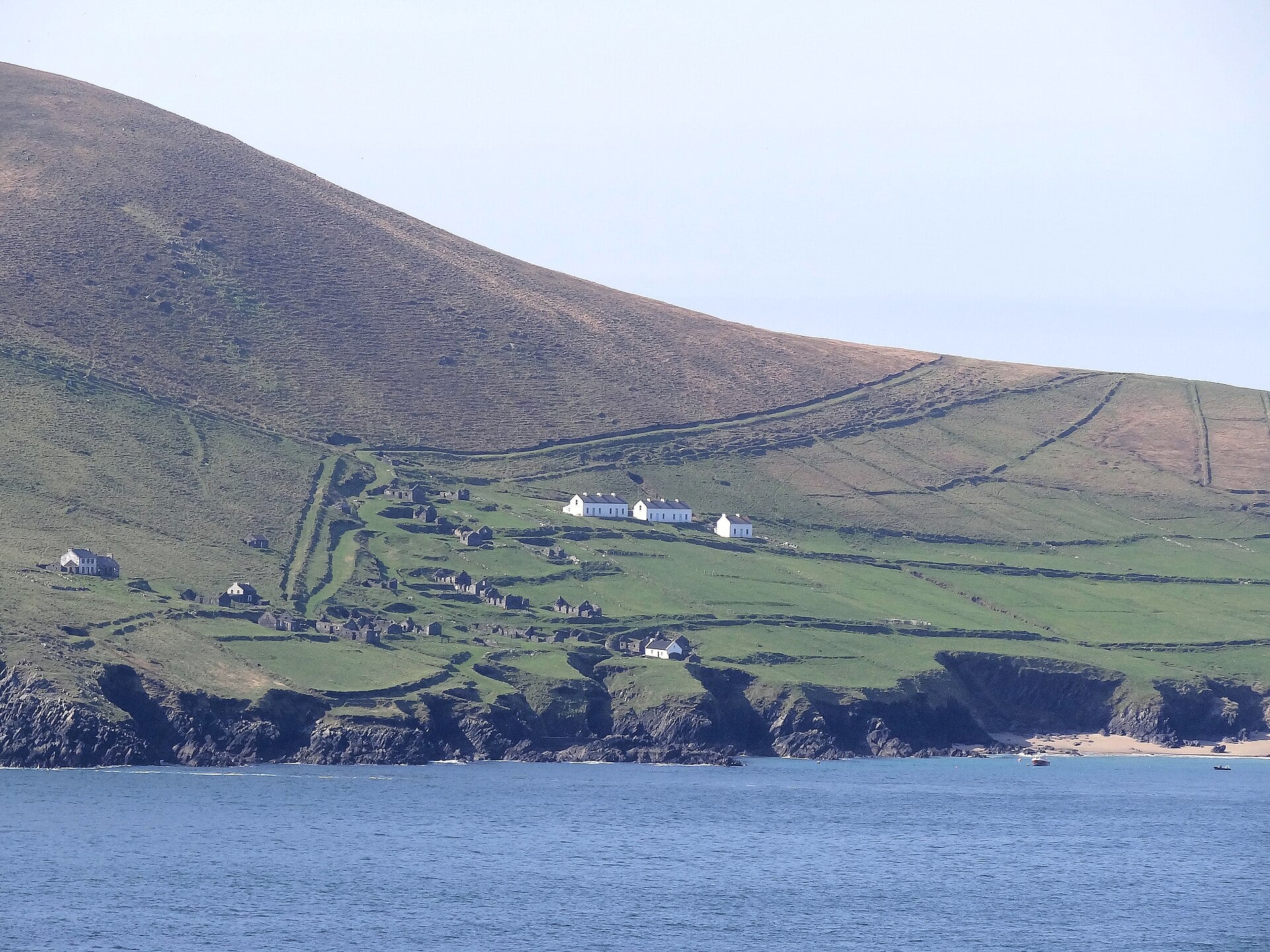
Great Blasket Island Caretaker Job: Why 23,000 People Applied to Live Off-Grid on a Remote Irish Island
On an early January morning in 2020, Billy O’Connor and Alice Hayes posted a job advertisement on social media. The role: two people to run a small café and manage a cluster of holiday cottages on Great Blasket Island, off the Dingle Peninsula in County Kerry, from April through October. The pay was not disclosed. The conditions were. No electricity. No hot water. Cooking on gas canisters. Candles after dark. A solid-fuel stove against the Atlantic cold. No Wi-Fi, no television, no refrigerator.
Within about ten days, they had received more than 23,000 applications.
Applications poured in from Iran, Argentina, Finland, Mexico, Australia, the United States, Greece, across the Middle East and Asia — and, by Hayes’s own account, in languages neither of them could identify. A couple aged 79 and 83 threw their names in. O’Connor later observed that if every applicant had stayed just one night, they’d be fully booked for the next thirty years.
“We are beyond overwhelmed at the response,” the couple wrote — which ranked among the more restrained understatements of January 2020.
What had just happened? And why does it keep happening, every single year?
The Island They Left Behind
To understand why tens of thousands of strangers wanted to spend six months on a remote Kerry island with no electricity, you need to understand what Great Blasket actually is — and what it was.
The island stretches roughly six kilometres along the Atlantic edge of the Dingle Peninsula, a long ridge of high ground ending in sea cliffs, with a sheltered beach and a cluster of stone houses on its eastern flank. At its peak in 1911, around 160 people lived there — a Gaelic-speaking community almost entirely cut off from the mainland by the turbulent stretch of water between them. They fished, farmed, married, and raised children on a piece of land that sat, by any measure, at the far edge of the known world.
Their culture was also, it turned out, remarkable. In the early twentieth century, three people from this small island produced books that entered the Irish literary canon. Tomás Ó Criomhthain’s An tOileánach (The Islandman), published in 1929. Muiris Ó Súilleabháin’s Fiche Bliain ag Fás (Twenty Years A-Growing), in 1933. And Peig Sayers’s memoir, which for decades was compulsory reading for secondary students across Ireland — her voice so woven into the national curriculum that generations of Irish schoolchildren grew up knowing this island through her words, whether they wanted to or not.
By the 1951 census, only 27 people remained on the island. Emigration had taken the young; the sea had worn down the rest. In November 1953, the Irish government concluded it could no longer guarantee the safety of those who remained, and the last inhabitants were moved to the mainland — resettled in Dunquin, within view of the island they’d left. The stonewalled cottages were left to the wind and the rabbits and the seabirds. Great Blasket became, in the way depopulated Irish islands sometimes do, a place of strange romantic weight: a lost world that had produced great literature and been quietly reclaimed by nature.
🇮🇪 Discover Your Irish Heritage
Join 64,000 people staying connected to their Irish roots. Get our free Irish Ancestry Guide — surnames, counties, parish records and emigration history — when you subscribe free.
The Man With the Boat
Billy O’Connor operates the ferry that takes visitors out to Great Blasket. He named the boat The Peig Sayers. He also renovated several of the island’s original stone cottages into holiday accommodation — including, notably, the house where Peig Sayers herself once lived.
It’s a business model that required, come tourist season, someone to actually be there. The island has no permanent residents. The café can see as many as 400 visitors on a single busy summer day. The cottages need turning over between guests. Somebody has to manage all of that without being able to nip to the shops, run a dishwasher, or charge a phone from the mains. That someone, O’Connor and Hayes decided, should ideally be a pair of people who genuinely wanted to be in a place like this.
Which is where the job advertisement came in.
The first posting, around 2019, generated significant interest. The January 2020 iteration went globally viral. By the time O’Connor and Hayes were being interviewed on RTÉ, they’d already worked through roughly a thousand of the 23,000-plus applications. The story spread from Lonely Planet to CNN to outlets across the Middle East and South America, acquiring a kind of unstoppable logic along the way: here was a position that looked, on paper, like a hardship posting — and an astonishing number of people were scrambling to get it.
What You’d Actually Be Taking On
It’s worth being clear about what the job entails, because the gap between the fantasy and the daily reality is part of what makes this story genuinely interesting.
The position runs from April 1 through mid-October. Caretakers live above the coffee shop in on-site accommodation. Food is provided and delivered daily from the mainland; laundry goes back across the water. The daily work involves greeting overnight cottage guests, cleaning and turning over accommodation between stays, running the coffee shop for day visitors arriving by ferry, managing stock, and keeping the facilities in order. During peak summer months, the island is genuinely busy. You will be on your feet for most of the day.
And there is no electricity. Cooking happens on gas cookers. After dark, candles. A solid-fuel stove provides what heat it can. The showers are cold — particularly, as the season moves toward October and the Atlantic shortens the days, increasingly cold.
Hayes has been consistent about this across every year the job has been advertised: it is not a holiday. “The season can get VERY busy,” she has written, the capitals her own.
Lesley Kehoe, one of the 2019 caretakers, offered a direct caution when the 2020 story went global: “What you see on social media,” she said, “isn’t what it’s all about.” Running a café for hundreds of visitors a day on an island with no electricity is not a vibe. It is a job. The fantasy and the function coexist, and the people who last the season tend to be the ones who wanted the function as much as the rest of it.
Why the Applications Keep Coming
O’Connor has a theory. “I suppose people just want to disconnect from the rush of everyday life and get off the grid,” he told journalists in the aftermath of the 2020 surge. It’s the kind of line that might read like marketing copy — except that 23,000 applications is not a marketing number. It’s a genuine signal of something.
The posting landed at a specific moment: mid-January, the flat interior of winter, the stretch of the year when the gap between the life you’re living and the life you’d prefer feels widest. Into that gap dropped the image of a stone cottage on a Kerry island with no notifications, no commute, and the Atlantic on three sides. The story went viral partly because of the numbers — 23,000 applications is a number that demands to be written down — and partly because it named something that a remarkable number of people recognised in themselves.
Among the applicants: that 79-and-83-year-old couple. People writing in Finnish, Farsi, Spanish, and languages the employers couldn’t place. Irish emigrants writing from Australia to say they wanted to come home, though not, perhaps, to anywhere quite as far out as this. The range of people who applied was itself a kind of finding: this wasn’t a niche appeal. It cut across age, geography, and apparent common sense.
How You Actually Get the Job
With 23,000 applicants for two positions, O’Connor and Hayes faced a recruitment problem that most employers never encounter. They’d responded to roughly a thousand people by the time the story went global, which still left more than 22,000 unanswered. In later years, they introduced a cap on applications — limiting the number they’d realistically consider rather than leaving the inbox open indefinitely.
The selection process became increasingly deliberate. They look, in Hayes’s words, for candidates who are “down to earth, easy to chat to, and enthusiastic.” They interview by video call. They want demonstrable evidence of comfort with basic conditions — not just asserted in a cover letter, but visible in how someone lives and where they’re calling from.
The caretakers for 2024 were Emma Melay, 26, from County Wexford, and Darren McFadden, 34, from County Kildare. Both had been secondary school teachers who, two years earlier, had left their jobs, bought a campervan, and spent time traveling around Ireland. They weren’t new to island life — they had already worked on Inis Oírr off the Galway coast. They applied for the Great Blasket role while walking the Camino across Spain and Portugal in October. Their FaceTime interview was conducted from a remote corner of Donegal, with minimal connectivity. The fact that they were comfortable calling from exactly the kind of place where a signal is unreliable appears to have made an impression.
“We both love teaching and we do miss it,” McFadden said after they were selected. “But we gave up our jobs just to see where we’d end up.”
Where they ended up: a stone cottage on an island at the edge of Kerry, making coffee for summer visitors, turning down the beds, and living without electricity, with Peig Sayers’s old house next door and the Atlantic in every direction.
The Island That Outlasted Its Own Abandonment
What’s striking, across the years since 2020, is that this story didn’t peak and fade. The role has been advertised every year, and every year it draws an overwhelming response. By 2026, the posting was circulating again — with a note that applications were being capped due to the sheer volume of previous years’ interest.
The island the Irish government concluded was no longer viable in 1953 — not worth the logistical cost of keeping a small community safe — has become, seven decades later, a place that thousands of people want to go and never quite leave. Not permanently. Just for six months, with candles and cold showers and 400 tourists on a busy Wednesday, and the silence at the end of each day that apparently makes all of it more than worth it.
Great Blasket has always had this quality — an island that shaped Irish literature, survived its own abandonment, and in the middle of the most connected era in human history, quietly became one of the most competed-for seasonal jobs on the planet. If you’ve ever felt the pull of somewhere quieter, further out, and fully off the grid, you already understand why the inbox never stopped filling up.
☘️ Join 64,000+ Ireland Lovers
Every weekday morning, get Ireland’s hidden gems, local secrets, and travel inspiration — the kind you won’t find in any guidebook.
Subscribe free — enter your email:
📲 Know someone who’d love this? Share on WhatsApp →
Love more? Join 43,000 Scotland lovers → · Join 29,000 Italy lovers → · Join 7,000 France lovers →
Free forever · Unsubscribe anytime
Enjoyed this story? Join 64,000+ Ireland lovers — subscribe free to the Love Ireland newsletter for weekly Irish heritage, history and hidden gems delivered to your inbox.
Tours & experiences you might love


Powered by Viator. Some links are affiliate links — we may earn a small commission at no extra cost to you.
Secure Your Dream Irish Experience Before It’s Gone!
Planning a trip to Ireland? Don’t let sold-out tours or packed attractions spoil your journey. Iconic experiences like visiting the Cliffs of Moher, exploring the Rock of Cashel, or enjoying a guided walk through Ireland’s ancient past often sell out quickly—especially during peak travel seasons.

Booking in advance guarantees your place and ensures you can fully immerse yourself in the rich culture and breathtaking scenery without stress or disappointment. You’ll also free up time to explore Ireland’s hidden gems and savour those authentic moments that make your trip truly special.
Make the most of your journey—start planning today and secure those must-do experiences before they’re gone!