

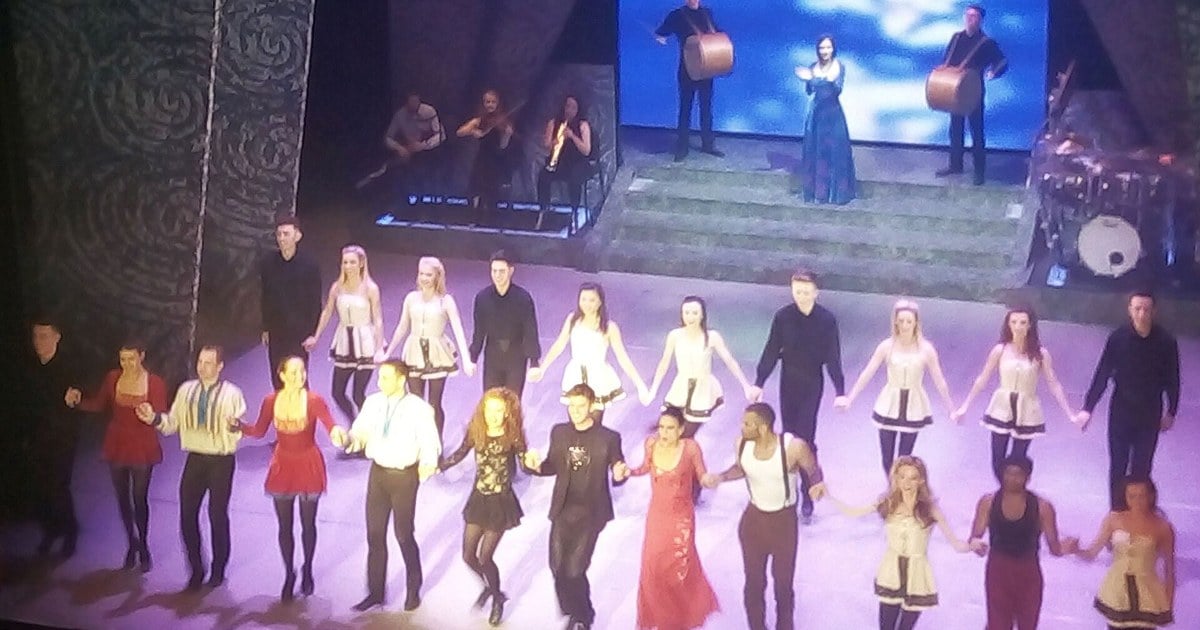
How Riverdance Went From a 7-Minute Eurovision Performance to a Global Phenomenon
On the evening of April 30, 1994, the producers of the Eurovision Song Contest had a standard television problem to solve: what to do with the gap between the last competing song and the judges’ scores coming in. Every year, this interval was filled with something — a local performance, a bit of spectacle, something to prevent mass channel-switching. It was, by design, forgettable. Nobody remembered Eurovision interval acts. That was not what they were for.
Moya Doherty decided to do something different with the gap.
As the producer of that year’s contest — held in Dublin’s Point Theatre because Ireland had won the previous year’s competition — it was her job to fill those minutes. In December 1993, she commissioned composer Bill Whelan to write the music for an Irish step dancing performance that would use the interval as an actual artistic statement. The brief called for something that could work on television, in a theatre, and in the gap between scores at a song contest. Not a lavish production, not a conservative showcase. Something that would stop people looking away.
What Whelan wrote, and what Michael Flatley, Jean Butler, and choreographer Mavis Ascott staged, ran for seven minutes. The choral vocals came from Anúna, an Irish choral group. And on the night, when it was over, the audience at the Point Theatre stood up — the first time in the history of Eurovision that an interval act had received a standing ovation.
Two Champions and a Composer
The people chosen to front the performance were not arbitrary selections. Both lead dancers arrived with records that, in hindsight, look almost too neat for the story.
Michael Flatley was Irish-American, born in Chicago, and in 1975 had become the first American to win the World Irish Dance Championship — a credential that carried significant weight in a discipline where Ireland had historically dominated the competitive field. Jean Butler had spent years performing professionally with The Chieftains from the age of 17, which meant she arrived not merely as a competition-circuit dancer but as someone already proven in high-pressure international performance contexts. Both were Irish dancing champions. Both carried, in their biographies, the particular cultural experience of carrying Irish traditional forms into the wider world.
This would matter more than anyone anticipated on the night.
What Whelan’s music did was frame Irish step dancing in a way that the form had rarely been presented at scale. The instrumentation was orchestral in its ambition, the choral element from Anúna gave it a texture that felt genuinely cinematic, and the choreography — working within the strict technical vocabulary of Irish step dance, with its locked arms and upright torso — found speed and precision that made the whole thing feel almost aggressive in its control. The combination stripped away every association with village halls and school competitions and replaced them with something that looked, to a television audience, like a high-stakes athletic event.
For seven minutes, it was all of that.
🇮🇪 Discover Your Irish Heritage
Join 64,000 people staying connected to their Irish roots. Get our free Irish Ancestry Guide — surnames, counties, parish records and emigration history — when you subscribe free.
What Happened in the Room
The Point Theatre held somewhere between three and four thousand people on that April night. Bill Whelan, the composer who had written the piece, was present when it finished. He later described what followed as “the entire audience on their feet” and noted that the performance had gone “further than we ever hoped.” John McColgan — who would go on to direct the full theatrical production that came next — later described the crowd jumping to their feet in multiple separate accounts. BBC presenter Terry Wogan, whose commentary was reaching the British audience simultaneously, gave an enthusiastic live reaction that sent the moment into a second broadcast stream in real time.
Within hours, RTÉ was fielding calls about the interval act. Not about who had won the song contest itself — about the seven minutes in the middle.
That night established something that would shape Irish cultural exports for the next three decades: that there was international appetite, at enormous scale, for a certain kind of Irish performance. The seven minutes were the proof of concept. What came next was the bet.
The Mortgage
Moya Doherty and John McColgan decided to expand the interval act into a full theatrical production. Their vehicle was Abhann Productions, their own company. To finance the production, they mortgaged their home.
This is the kind of detail that sounds apocryphal until you look at what was actually being wagered against it. Irish step dancing, in 1994, was not regarded as a commercially viable theatrical form at scale. The Eurovision performance had gone extraordinarily well, but Eurovision interval acts existed in their own contained context — successful in the moment, gone by the following week. Taking a seven-minute performance piece and betting a home on the proposition that it could sustain a full theatrical run, then an international tour, then a decades-long touring business, was not an obvious call.
The full-length Riverdance — The Show premiered at the Point Theatre in Dublin on February 9, 1995 — less than a year after that Eurovision night. The five-week run sold over 120,000 tickets. The Point Theatre seated around 3,000 people, which makes the arithmetic clear enough: the Dublin run was playing at or near capacity, night after night, for five weeks straight.
Then it moved.
Radio City, March 1996
The New York debut of Riverdance opened at Radio City Music Hall on March 13, 1996. Eight shows. All sold out.
Radio City Music Hall is one of the largest indoor theatres in the world. In New York City — which holds the largest Irish diaspora community of any American city — the response to an expanded version of what had stopped a room at Eurovision two years earlier was immediate and total. Eight sold-out performances. The ticket demand was not a narrow community event. It was a mainstream commercial result, documented in the trade press of the day.
Michael Flatley had himself grown up in the Irish-American community of Chicago, as a son of immigrants who had carried Irish traditional culture into a new country and raised a world champion inside it. Jean Butler had professional roots in The Chieftains, a band who had spent decades doing the same cultural work — making Irish traditional music legible to international audiences without smoothing away what made it distinctively itself. The people fronting Riverdance were not neutral presenters of an Irish form. They were products of the diaspora presenting that form back to itself, at scale, in a way it had never been presented before.
The Radio City sellouts in 1996 were not a surprise to anyone who understood what was happening in that room. They were a logical result.
The Numbers, Three Decades Later
Here is where the story becomes genuinely strange in the way that only durable cultural institutions do. Riverdance did not peak and become a nostalgia circuit. It became infrastructure.
In 2016 — twenty-two years after a seven-minute interval act — the show’s touring revenues exceeded $20 million in a single year. The Pollstar figure, as reported by the Irish Examiner, was $20.6 million, with an average ticket price across performances of $59.39. This is not heritage pricing or charitable programming. This is a commercially competitive touring show drawing paying audiences at scale, two decades after its creation.
Abhann Productions — still owned solely by Moya Doherty and John McColgan as the company’s only two shareholders — operates, at full deployment, two simultaneous touring productions running in different parts of the world. Each employs between 50 and 55 people in cast and crew. Two separate full productions, staffed and moving and performing concurrently.
The company’s statutory accounts, filed with Ireland’s Companies Registration Office, show revenues of €16.72 million in the financial year 2023, up 19% from €14.01 million the previous year. When FY2024 results were published, revenues had fallen 54% to €7.7 million. John McColgan, in public statements at the time, named a single cause: the absence of a US tour that year. After thirty years, the United States remains the show’s load-bearing market — the diaspora audience that filled Radio City in 1996 is still, in the broadest sense, the audience the business runs on.
The Cultural Hinge
The commercial scale is the easier part of this story to measure. The cultural shift is harder to pin down precisely, but its shape is clear enough.
By 1994, Irish step dancing had retreated in the public imagination — including in Ireland — into something associated primarily with competition, tradition, and a cultural seriousness that did not easily translate into mainstream entertainment. Its technical vocabulary was demanding and specific, and those specific rules — no arm movement, upright torso, complex footwork performed at speed — were exactly the things that made it look closed off to outsiders. You either knew what you were seeing or you didn’t.
What Riverdance did in seven minutes was make the case that the vocabulary was not a limitation. The locked arms and rigid upper body, reframed against orchestral music at performance scale, became structural — the contrast between that absolute stillness and the extraordinary speed of the footwork below was precisely the thing that made the whole performance look extraordinary rather than merely technical. The rules of the form turned out to be load-bearing to its effect. Riverdance did not modernise Irish step dancing by changing it. It reframed it by presenting it at a scale where what had seemed like constraints read as discipline.
For Ireland in 1994 — on the early edge of an economic transformation that would soon be called the Celtic Tiger — the timing was significant. A country that had defined itself, in part, through emigration was beginning to renegotiate its relationship with its own identity. Riverdance arrived as evidence that a distinctively Irish form could operate at the highest levels of international entertainment without concession, without dilution, and to enormous commercial effect. It was not a small argument to make in that particular moment.
The Coda
Michael Flatley later departed Riverdance, and a subsequent legal dispute with Abhann Productions over choreography credits and royalties was eventually settled. The terms of that settlement remain private, and the formal choreography credit for the original 1994 performance — shared between Flatley, Butler, and Ascott — carries some legal complexity as a result. Simple versions of the story involve some elision on that point.
What is not complicated is what Doherty and McColgan built by mortgaging their home on seven minutes of Eurovision television. Abhann Productions has generated tens of millions in revenue across three decades. It has run two simultaneous global tours, spun off a televised ice-skating adaptation, and employed thousands of performers and crew members across tours on multiple continents. And in March 1996, it sold out eight consecutive shows at one of the largest theatres in the world, in the largest Irish diaspora city in the United States.
Moya Doherty’s December 1993 commission to Bill Whelan asked for something to fill a gap. She did not ask for a cultural industry. She asked for seven usable minutes of television.
The interval has been running ever since.
That’s the thing about a seven-minute performance that genuinely stops a room — the room has a way of not quite settling back down afterwards. The Point Theatre audience stood up on April 30, 1994, and in the most commercially literal sense, they never entirely sat back down. From Dublin to Radio City to two simultaneous touring productions employing 50-odd people each: all of it traces back to a composer, two world-class dancers, a choral group called Anúna, and a producer who had a gap to fill and a very particular idea about how to fill it.
☘️ Join 64,000+ Ireland Lovers
Every weekday morning, get Ireland’s hidden gems, local secrets, and travel inspiration — the kind you won’t find in any guidebook.
Subscribe free — enter your email:
📲 Know someone who’d love this? Share on WhatsApp →
Love more? Join 43,000 Scotland lovers → · Join 29,000 Italy lovers → · Join 7,000 France lovers →
Free forever · Unsubscribe anytime
Tours & experiences you might love


Powered by Viator. Some links are affiliate links — we may earn a small commission at no extra cost to you.
Secure Your Dream Irish Experience Before It’s Gone!
Planning a trip to Ireland? Don’t let sold-out tours or packed attractions spoil your journey. Iconic experiences like visiting the Cliffs of Moher, exploring the Rock of Cashel, or enjoying a guided walk through Ireland’s ancient past often sell out quickly—especially during peak travel seasons.

Booking in advance guarantees your place and ensures you can fully immerse yourself in the rich culture and breathtaking scenery without stress or disappointment. You’ll also free up time to explore Ireland’s hidden gems and savour those authentic moments that make your trip truly special.
Make the most of your journey—start planning today and secure those must-do experiences before they’re gone!