

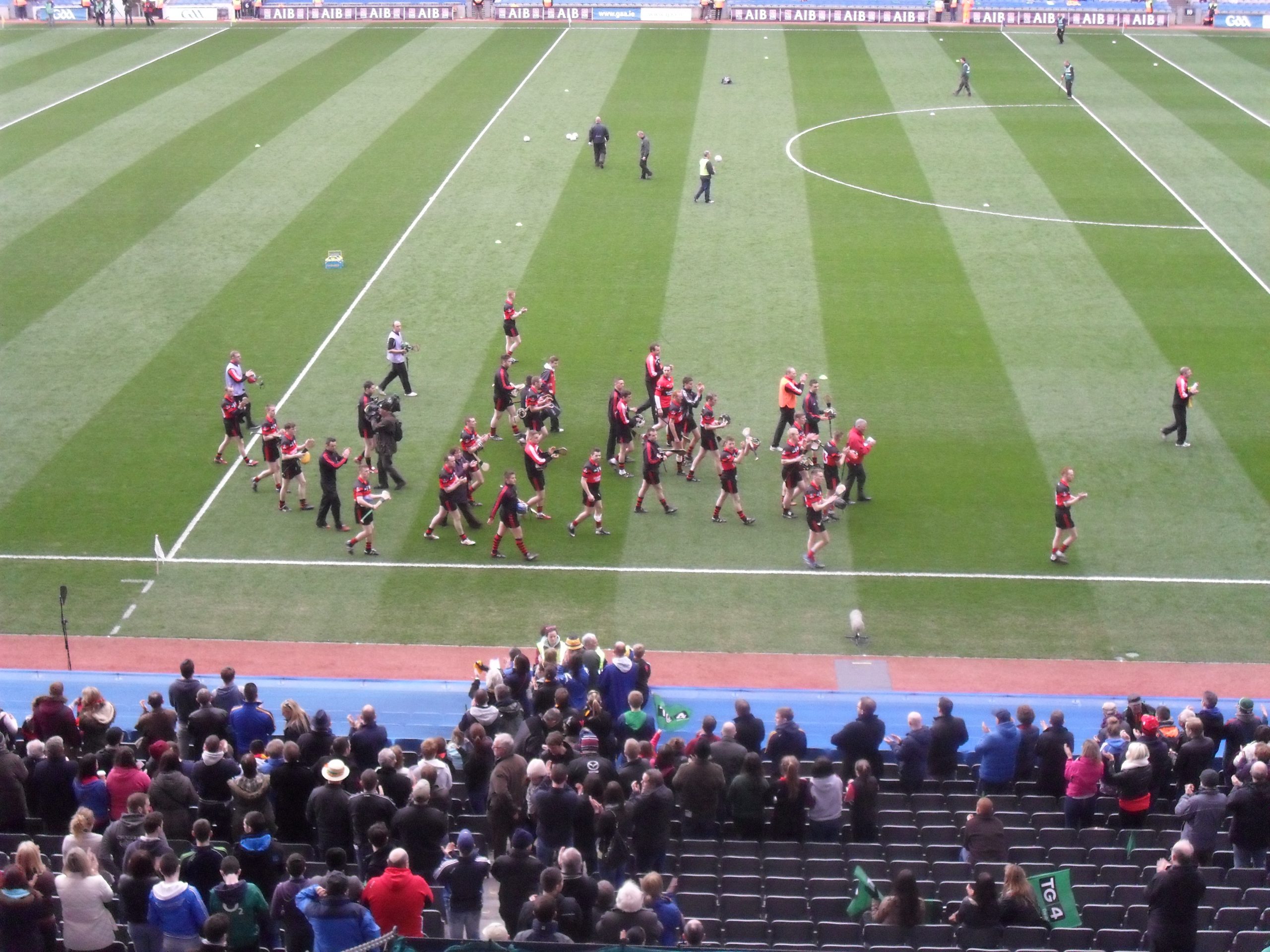
Hurling: The 3,000-Year-Old Sport Where 82,000 Fans Watch Unpaid Players Compete at Croke Park
When the final whistle sounded at Croke Park in July 2026, Limerick had just beaten Galway in the All-Ireland Senior Hurling Championship final. More than 82,000 people were in the stands. The roar that came out of that ground could have powered a small city. And on Monday morning, Gearóid Hegarty — Man of the Match in the semi-final, six All-Ireland medals to his name, widely tipped for Hurler of the Year — walked back into his classroom at Desmond College in Newcastle West to teach business studies.
This is not an oversight. It is not a quirk of the lower leagues. It is the organizing principle of the oldest field sport in the world.
What Hurling Actually Is
If you have never seen it, hurling is genuinely difficult to describe in a way that does it justice. Thirty players — fifteen per side — take to a grass pitch with curved wooden sticks called hurleys and a small leather ball called a sliotar. The ball has a cork core and a stitched leather cover; it is smaller than a baseball and a little heavier. Players can carry it balanced on the hurley, catch it out of the air with one hand, or strike it on the ground or in flight.
A well-struck sliotar regularly travels at over 150 kilometres per hour. In a 2014 All-Ireland semi-final, Kilkenny’s T.J. Reid — who owns a gym in Kilkenny city and has seven All-Ireland medals — had a shot clocked at 181.1 km/h. That is 112.5 miles per hour, faster than most pitches in professional baseball. Unlike a baseball, however, this ball is moving through an open field, with opponents running toward it.
No other field sport played between two teams on grass produces ball speeds like this. The combination of the striking action (more like a golf swing than a bat swing, executed while running at full pace), the ball’s weight and cover, and the open nature of the game means hurling generates physics that are in a category of their own among team sports. There is no timeout, no stoppage clock, no time-wasting. Sixty minutes of effectively continuous play, and nobody is wearing pads.
The sliotar also weighs between 110 and 120 grams, and nobody is wearing a helmet — or rather, helmets became mandatory only in 2010. Before that, players absorbed those ball speeds with their skulls for approximately 3,000 years.
A Game Written Into Law Before England Had a King
The earliest verified written references to hurling appear in Brehon Law, the ancient legal code of Gaelic Ireland, dating from the fifth century AD. These were not passing mentions — they were detailed provisions governing disputes and injuries arising from the game. The Seanchás Mór, the great codification of Brehon Law, specified who could use what equipment: a rí’s son, a local king’s heir, was entitled to a hurley hooped in bronze. Everyone else used copper. It was illegal to confiscate a hurley. The game was woven so thoroughly into Irish life that lawyers were already writing rules about it before the fall of the Western Roman Empire.
Irish mythological texts push the evidence further back, though into territory that sits between history and legend. The Battle of Moytura — Cath Maige Tuired in the original Irish — places a hurling match at the centre of events dated in the texts to around 1272 BC. The Táin Bó Cuailgne, the great Ulster cycle epic, describes the warrior Cú Chullainn playing hurling at Emain Macha; one version of the Cú Chullainn origin story has him earning his name by killing a fierce guard dog with a hurling ball driven down its throat as the animal charged. Hurling skill was equated explicitly with martial readiness. The game was not recreation — it was practice for war.
Physical evidence of the equipment itself dates from the twelfth century, when hurley balls begin appearing in the archaeological record. But the written and legal evidence makes clear that hurling had been organised and governed — with enough complexity to require formal law — since at least the fifth century, and probably much longer.
For context: the sport that preceded the modern football codes in the English-speaking world, folk football, was not codified until the nineteenth century. Cricket did not have written rules until 1744. The game Hegarty plays for free in front of 82,000 people has been played continuously, in broadly recognisable form, since before the Dark Ages.
Hayes’ Hotel, Thurles, November 1884
By the nineteenth century, hurling had fallen into decline. The Famine had fractured communities. English sports — cricket, rugby, athletics — were spreading through Anglo-Irish institutions, and the athletics bodies that governed Irish competition explicitly excluded the working class with a “mechanics clause” that barred labourers and tradesmen from competition.
Michael Cusack had had enough. A teacher from County Clare, Cusack convened a meeting at Hayes’ Hotel in Thurles, County Tipperary on November 1st, 1884. Seven people attended. By the end of the meeting, the Gaelic Athletic Association had been founded, with Maurice Davin as its first president and Archbishop Thomas Croke, Charles Stewart Parnell, and Michael Davitt as patrons. The stated purpose was the preservation and cultivation of native Irish games — hurling and Gaelic football — and the democratisation of sport in Ireland.
The amateur rule was not an afterthought. It was the point. The GAA was founded on the principle that ordinary Irish people — not the gentry, not the professionals, not those wealthy enough to train full-time — should own and govern their own games. The idea that players would be paid was not even on the table. Within five years, the GAA had at least 777 affiliated clubs. Within a generation, it was the dominant sporting organisation on the island.
The amateur rule has never been removed. In 142 years of existence, through independence, civil war, emigration waves, and the professionalisation of every comparable sport on earth, the GAA has maintained the principle: nobody gets paid to play.
The Numbers Do Not Make Sense (Until They Do)
In 2024, the GAA reported consolidated revenue of €132.9 million, up 19% on the previous year. Gate receipts alone came to €39.1 million. The 2025 All-Ireland hurling final — Cork versus Tipperary in a dramatic comeback win for Tipperary, played on July 20th at Croke Park — drew an attendance of 82,331, a sell-out crowd. The scenes inside the stadium were matched outside it, in pubs across the country packed for Championship Sunday.
The players who took part in that final earned nothing. Not for the match. Not for the season. Not for the years of preparation that brought them there.
In 2024, the economic consultancy Indecon published a detailed report on the realities of inter-county GAA. The figures were stark. The average inter-county player now commits more than 21 hours per week to their sport — over 8 of those hours spent travelling. They receive some modest expense reimbursements, but these have not kept pace with inflation. The average annual net loss borne by an inter-county player — accounting for out-of-pocket expenses, missed work, foregone overtime — is €4,602 per year. Tom Parsons, chief executive of the Gaelic Players Association, noted that an inter-county career was becoming “unviable” for young people trying to establish themselves professionally, secure a mortgage, or start a family.
The organisation generated €132.9 million in revenue. Its spending on player welfare rose from €7.2 million in 2023 to €9.3 million in 2024 — a real increase, but still a small fraction of the €591 million in economic activity Indecon says inter-county players themselves generate each year.
And yet: the players are not, in the main, calling for wages. They are asking for better expenses, for fairer treatment, for the demands on their time to be acknowledged. But the proposal to simply pay hurlers for their labour — to make the obvious market correction that the revenues would appear to support — is not what the GPA is actually seeking. The amateur model is, by most accounts, genuinely defended by the people who carry it.
The Man in the Classroom
Gearóid Hegarty’s story is the clearest illustration of what this looks like in practice. He is six foot four, plays as a wing-forward, and has won six All-Ireland medals — five of them in the extraordinary period between 2018 and 2023 when Limerick became the most dominant team in the modern history of the game. He has been among the best players in Ireland for the better part of a decade. He is a business teacher at Desmond College in Newcastle West, County Limerick, where he presumably also teaches his students the basics of supply and demand.
If any system of market logic were applied to Hegarty’s situation, some combination of Limerick GAA, the All-Ireland championship sponsors, or Croke Park’s television partners would be competing to retain his services. In every comparable sport — rugby, football, Australian rules — players of his stature and achievement negotiate multi-year contracts. In hurling, the arrangement is different: the county board covers his travel. He covers everything else.
He is far from alone. The Wikipedia pages of inter-county hurling players read like a directory of the Irish professional middle class. Conor Cleary, an All-Ireland winner, is a secondary school teacher. Darragh O’Connell: teacher. Shane Dooley: teacher. Conor Devitt: teacher. Darragh Lohan: teacher. The list continues. When the patterns of a system this consistent and this long-standing produce an outcome, it is worth asking whether the outcome is accidental or designed.
It is designed. The GAA explicitly organises itself around players having careers outside sport. The club and county structure, the county-of-origin eligibility rules, the seasons scheduled to avoid the worst conflicts with working life — all of it reflects the assumption that a hurler is a person who plays hurling, not a person whose identity is subsumed by it. The game was built for working people, and it has stayed that way.
There are costs to this. The Clare hurler John Conlon left his brother’s wedding reception in 2022 to make a Munster Championship match. The training loads of the intercounty season — four or five nights a week from January through September — are genuinely punishing in combination with full-time employment. T.J. Reid, Kilkenny’s all-time leading scorer and a holder of seven All-Ireland medals and six All-Ireland Club Championships, eventually left a job in agri-food sales to open his own gym, partly to get more flexibility around training. The demands are real, and the Indecon report’s language about unsustainable personal cost is not hyperbole.
The Thing Nobody Tries to Fix
Here is what makes hurling genuinely strange by the standards of modern sport: it has the scale, the revenues, and the television audiences that would ordinarily guarantee professionalisation. The Premier League was formed in 1992 partly because the money was there and the logic was irresistible. Rugby union held out longer but turned professional in 1995. The AFL has been fully professional since the 1980s. In virtually every case, once a sport reached a certain threshold of commercial interest, the players became employees.
The GAA has crossed that threshold in economic terms, and the model has not moved. That is not inertia. It is a choice, and it is renewed every year by the 500,000-odd volunteers who run the clubs and county boards, by the players who accept the terms, and by the communities that have built their identity around the game. UNESCO recognised hurling as an element of intangible cultural heritage precisely because the social structure around it — the club, the parish, the county — is inseparable from the game itself. Pay the players and you do not simply modernise a sport; you restructure the relationships that have made it what it is for fifteen hundred documented years.
A 2024 survey found that hurling is the favourite sport of one in four people in Ireland. Not the most watched, not the most followed — the favourite. The game people feel most attached to, most shaped by, most willing to defend. It is possible that the economics of the amateur model are partly responsible for that attachment. There is no transfer window, no player who left for a richer county board, no sense that the relationship between a player and his parish is a contractual one. Hegarty plays for Limerick because he is from Limerick, because he went to school there, because the people in the stand are his neighbours. On Monday he is back in the classroom. That is the deal. And for now — quietly, stubbornly, improbably — it is still the deal everyone has agreed to keep.
Somewhere in County Limerick, a teacher is marking his students’ books and counting the months until January, when training begins again.
Tours & experiences you might love


Powered by Viator. Some links are affiliate links — we may earn a small commission at no extra cost to you.
Secure Your Dream Irish Experience Before It’s Gone!
Planning a trip to Ireland? Don’t let sold-out tours or packed attractions spoil your journey. Iconic experiences like visiting the Cliffs of Moher, exploring the Rock of Cashel, or enjoying a guided walk through Ireland’s ancient past often sell out quickly—especially during peak travel seasons.

Booking in advance guarantees your place and ensures you can fully immerse yourself in the rich culture and breathtaking scenery without stress or disappointment. You’ll also free up time to explore Ireland’s hidden gems and savour those authentic moments that make your trip truly special.
Make the most of your journey—start planning today and secure those must-do experiences before they’re gone!