

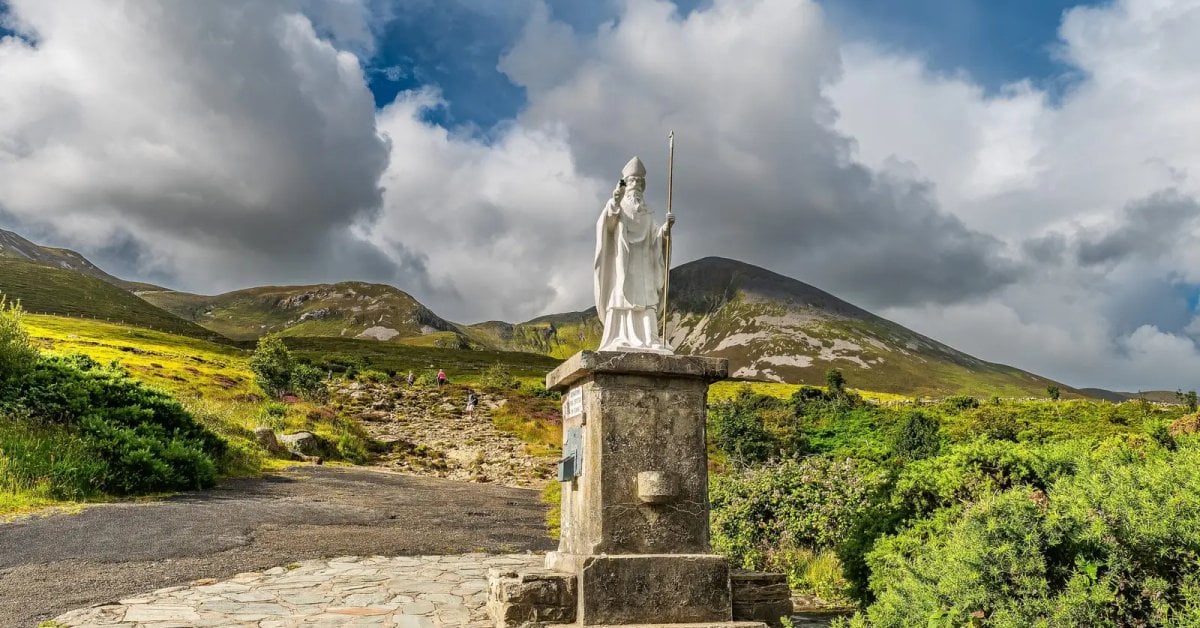
On the morning of the last Sunday of July 2025, a 21-year-old agricultural science student from County Longford named Catherine Cooney stood at the base of Croagh Patrick, a 764-metre mountain in County Mayo, handing out rosaries and medals from the Legion of Mary’s stand. Then she took off her shoes and started climbing. The path beneath her feet was made of loose quartzite — a type of metamorphic rock with edges that stay sharp no matter how many generations of pilgrims grind across it. She made it to the summit, as she had done many times before.
She was not unusual in this. She was, in fact, doing something people have been doing on this mountain for longer than Christianity has existed.
The Reek and Its Numbers
Croagh Patrick — called “the Reek” by locals, derived from the Irish Cruach Phádraig — rises above Clew Bay on the western coast of Mayo, its quartzite pyramid visible from miles out over the Atlantic. Around 120,000 people climb it every year, making it one of the most climbed peaks in Ireland. Every July, the mountain draws a concentrated surge of pilgrims for Reek Sunday, the designated day of pilgrimage observed on the last Sunday of the month.
In its peak decades — the 1960s and 1970s — Reek Sunday pulled crowds of more than 30,000 in a single day. Ireland has grown considerably more secular since then. In 2025, with the All-Ireland Senior Football final coincidentally scheduled for the same afternoon, the crowd was estimated at around 6,000. That is not a collapse of the pilgrimage so much as a recalibration: the year-round climbing numbers have, if anything, gone up.
On Reek Sunday itself, Mass is said at the summit chapel hourly from 8am to 2pm — the hourly schedule itself a quiet indicator of change; in earlier years, the demand required a service every 30 minutes, and the shortage of priests willing to make the climb meant the interval expanded.
Before the Saint, Before the Cross
The pilgrimage is officially framed around Saint Patrick, who, according to 7th-century accounts, climbed the mountain and fasted there for 40 days and 40 nights in 441 AD. He is said to have driven demonic birds from the summit, and to have banished serpents from Ireland while standing at its peak. A small oratory was consecrated there in 1905, built on foundations that turned out to be rather older.
In 1994, archaeologists Gerry Walsh and Michael Gibbons led a team up to the summit for seven weeks of excavation. What they found reshaped the understanding of the site. The rectangular stone building beneath the modern chapel — measuring roughly seven and a half metres by five and a half — was dated to the 5th century, making it the earliest church building yet excavated in Ireland. Croagh Patrick had been a site of Christian pilgrimage since Patrick’s own lifetime, or very close to it.
But the Christian layer sits on top of something much older. The same excavations found Iron Age glass beads dating from the 3rd century BC to the 4th century AD. Bronze Age flint fragments. A Celtic hill fort encircling the summit, with at least 30 hut-circle outlines clustered around it. The mountain had been occupied, ritually and practically, long before any bishop blessed it.
The pre-Christian name was Cruachán Aigle. The festival associated with it was Lughnasadh — the Celtic harvest festival held at the end of July, which is why Reek Sunday falls when it does. The mountain’s sacred status predates Patrick by millennia. Scholars, including the folklore historian Máire MacNeill, concluded that the Christian pilgrimage was essentially grafted onto a pre-existing pagan ritual landscape, the date and the destination too deeply rooted to simply be abandoned.
The Stone That Watches the Sun
Several kilometres from the mountain’s base, a flat rock sits in a field near Boheh. It is carved with more than 260 cup-and-ring motifs — swirling, pecked impressions that archaeologists date to around 5,800 years ago, in the Neolithic period. Twice a year, on April 18th and August 24th, something precise happens: the setting sun appears to roll down the western face of Croagh Patrick, descending the mountain’s profile in a slow, deliberate arc before disappearing below the horizon. This “rolling sun” effect was identified by local historian Gerry Bracken as a deliberate astronomical alignment — the stone positioned specifically to frame the mountain on dates that divided the year into equal thirds, marking the growing season.
People were watching this mountain with serious attention long before they had a word for pilgrimage.
What the Climb Is Actually Like
For the first two kilometres, Croagh Patrick is a manageable mountain walk. The gradient is steady, the path reasonably clear, and the view back over Clew Bay — with its famously numerous islands, roughly one for each day of the year — opens up behind you as you climb.
Then you reach the cone.
The final section of the ascent is essentially a wall of loose quartzite scree, rising steeply to the summit. The stone is white-grey and pale, angular and unstable. The path construction team that recently completed a four-kilometre stone pathway up the mountain — a project that took more than three years and involved the crew walking up the mountain 450 times, moving thousands of tonnes of material entirely by hand — found that the cone section consumed 60 to 65 percent of their total construction time. At the steeper angles, each step requires roughly 20 stones to hold it in place, compared to five or six lower down. Even with the improved path, the cone demands concentration, good footwear, and the patience to move carefully on the descent, which is where most injuries occur.
Barefoot, it is something else entirely.
The Barefoot Question
Nobody made Catherine Cooney take her shoes off. The barefoot ascent is not a requirement of the Reek Sunday pilgrimage, nor is it something the Archdiocese of Tuam officially encourages. The practice is described, in church communications and tourism guidance alike, as a personal devotion — an act of penance or spiritual intensity, undertaken voluntarily. In recent years it has been actively discouraged on safety grounds by Mayo Mountain Rescue, whose callouts tell their own story: more than 90 percent of the team’s emergency responses are to Croagh Patrick, totalling around 50 per year. Twenty-seven people required treatment for fall-related injuries in a single 18-month period tracked by one report — the majority of them on the cone, with the most serious injuries involving the head and lower limbs.
The mountain historically asked more of its pilgrims. Original prescribed rituals included “stations” — circuits of prayers made while circumambulating specific rocks and cairns at different points of the ascent, some of them at the base, some partway up, some on the summit itself. Pilgrims were traditionally expected to complete these rounds barefoot. By the 20th century the stations had simplified and the barefoot obligation had softened to a voluntary practice. What remained was the impulse.
Brother Bruno Mary Kelleher, a Dominican deacon from Kilkenny, climbed Reek Sunday 2025 in his black and white robes, barefoot. Martin Corcoran from Islandeady completed his 85th ascent the same day. John Finneran, 78 years old, made the climb for the 61st consecutive year, assisted back down by his son Tony.
These are not outliers. They are the Reek Sunday demographic in miniature: a mix of serious religious intent, personal tradition, endurance culture, and the particular stubbornness that comes from having done something so many times that the threshold for stopping keeps rising.
What’s Under the Mountain
There is a footnote to the Croagh Patrick story that does not appear in the pilgrimage literature. In the 1980s, geological surveys found something interesting in the rock beneath the mountain: a seam of gold. A proper one. At least 12 quartz veins with grades of around 14 grams of gold per tonne, embedded in an estimated 700,000 tonnes of ore — a potential yield of more than 300,000 troy ounces, worth, at current prices, well over €300 million.
Plans to mine it drew immediate and fierce opposition from the local community. Paddy Hopkins, chairman of the Mayo Environmental Group, led the campaign against extraction. Mayo County Council refused to permit it. The government eventually banned gold mining on the mountain entirely. The decision was celebrated in Mayo the way mining bans rarely are.
The Owenwee River, which flows near the mountain’s base, has a name that translates from Irish as “Yellow River” — most likely a reference to its flood-stained water rather than any folk memory of gold, though the coincidence is hard to resist. The mountain kept its secret for a while, and then kept it anyway.
Why It Persists
Patrick Claffey, who wrote Atlantic Tabor: The Pilgrims of Croagh Patrick and teaches religious studies at Trinity College Dublin, has noted the remarkable continuity of the site: the same summit, the same last Sunday of July, the same act of physical effort as an expression of something beyond the merely physical. The earliest documented reference to the pilgrimage appears in the Annals of Ulster, in 1113. The Boheh Stone suggests people were orienting themselves toward this mountain 5,800 years ago.
The numbers on Reek Sunday have fallen from their 20th-century peaks as Ireland changed. But 120,000 people a year still find reasons to climb a steep and difficult mountain in the west of Mayo, at least a handful of them without shoes, on stone that has been cutting feet for longer than written records exist to describe it. That is not sentiment. That is something harder to name and apparently much harder to stop.
The mountain will be there next July. So will the cone. So, almost certainly, will Catherine Cooney.
We find that quietly remarkable.
☘️ Join 64,000+ Ireland Lovers
Every weekday morning, get Ireland’s hidden gems, local secrets, and travel inspiration — the kind you won’t find in any guidebook.
Subscribe free — enter your email:
Already subscribed? Download your free Ireland guide (PDF)
📲 Know someone who’d love this? Share on WhatsApp →
Love more? Join 43,000 Scotland lovers → · Join 29,000 Italy lovers → · Join 7,000 France lovers →
Free forever · Unsubscribe anytime
Tours & experiences you might love


Powered by Viator. Some links are affiliate links — we may earn a small commission at no extra cost to you.
Secure Your Dream Irish Experience Before It’s Gone!
Planning a trip to Ireland? Don’t let sold-out tours or packed attractions spoil your journey. Iconic experiences like visiting the Cliffs of Moher, exploring the Rock of Cashel, or enjoying a guided walk through Ireland’s ancient past often sell out quickly—especially during peak travel seasons.

Booking in advance guarantees your place and ensures you can fully immerse yourself in the rich culture and breathtaking scenery without stress or disappointment. You’ll also free up time to explore Ireland’s hidden gems and savour those authentic moments that make your trip truly special.
Make the most of your journey—start planning today and secure those must-do experiences before they’re gone!