

Connemara sits at the far western edge of County Galway, where the Atlantic crashes against granite headlands and bog stretches to every horizon. It is one of the most dramatic landscapes in Europe — and a growing number of Americans now call it home. Whether you dream of a slower life, want to trace Irish roots, or simply wonder what it feels like to live somewhere truly wild and beautiful, Connemara changes people.
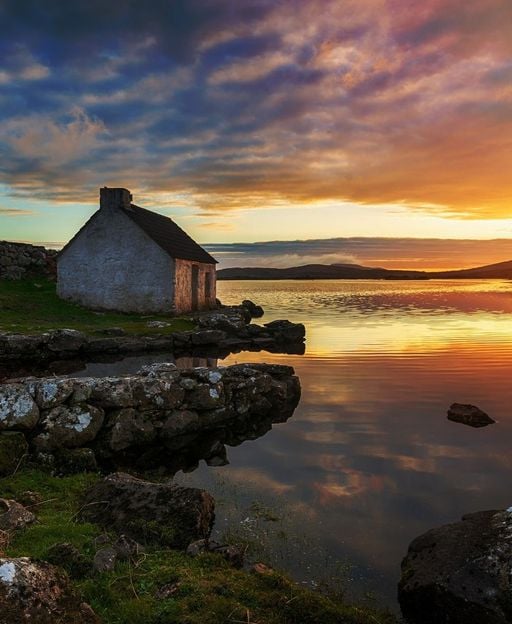
This is not the Ireland of polished tourist brochures. Connemara is rawer than that. The light shifts every twenty minutes. Mountains vanish into low cloud and reappear rinsed clean. Roads narrow to single tracks where you learn the quiet art of the Irish countryside wave. Life moves here at a pace most people only realise they were missing once they find it.
If you are planning your first visit to Ireland, Connemara deserves far more than a single afternoon. And if you have been once and cannot stop thinking about it, you are not alone. If you are only planning a visit to Connemara rather than a move, our travel guide to the region covers the sights, routes, and practicalities.
What Makes Connemara Different From the Rest of Ireland
Connemara is a Gaeltacht region. Thousands of residents speak Irish as their daily language. You will hear it in shops, at the post office, on the radio, and at school gates. Children grow up bilingual. The cultural heritage here lives in daily life rather than museum displays — alive, practised, woven into ordinary things in ways that feel quietly extraordinary to anyone arriving from abroad.
The region covers roughly 2,000 square kilometres between the Atlantic coast and the Twelve Bens mountain range. Its main villages include Clifden (the unofficial capital, population around 2,000), Roundstone (a tiny fishing harbour south of Clifden), Letterfrack (home to Connemara National Park, which covers 2,304 hectares of protected wilderness following a 2025 expansion, and has welcomed visitors since 1980), and Carna on the sheltered southern coast. Each has its own character. Each feels, in its own way, like the edge of the known world.
For Americans with Galway or Mayo roots, Connemara carries additional weight. Many families whose ancestors boarded Famine emigration ships from Galway in the 1840s trace their origins to the townlands and parishes of this coastline. The old stone walls, the bog roads, and the Irish-speaking communities they left behind still stand here — remarkably, stubbornly intact. Walking these lanes, for some diaspora visitors, feels like a homecoming they did not know they were making.
The Pace of Life Americans Tend to Fall in Love With
People who relocate to Connemara from cities — whether Dublin, New York, or London — consistently describe a shift that is hard to put into words until you experience it. Time stretches differently. Morning walks happen at a genuine pace rather than a commuter one. Meals take longer because conversation takes longer. You notice the weather in a way you probably have not since childhood.
This is not passivity. Connemara runs busy in its own way: farmers manage land their families have worked for generations, fishermen go out before dawn, and artists arrive for the extraordinary quality of Atlantic light and often stay for decades. A disproportionate number of painters, ceramicists, and writers live and work here relative to the population — the landscape has pulled creative people west for more than a century.
The community is genuine in a way that surprises many arrivals. Neighbours notice when something seems off. If you fall ill, food appears at the door. If your car breaks down on a bog road, someone will stop. For Americans accustomed to urban anonymity, this startles at first — and then, quickly, becomes irreplaceable.
Clifden: Connemara’s Most Liveable Town
John D’Arcy founded Clifden in 1812, and the town now serves as Connemara’s main hub. It has a supermarket, GP practices, a pharmacy, a secondary school, cafes, and a farmers’ market during summer months. The Alcock and Brown monument stands on the hill above town, marking where the first transatlantic aviators landed in 1919 — a reminder that world history has touched this remote place more than once.
The town is small enough to know your neighbours within a few months and large enough to have a social life without driving 80 kilometres to Galway city. For those considering a route through the west of Ireland, Clifden makes a natural overnight base — and the place where many people first start to wonder what it would feel like to stay.
☘️ Enjoying this? 64,000+ Ireland lovers get stories like this every week. Subscribe free →
What You Get for Your Money in Connemara
Property in Connemara offers something rare in the modern world: genuine space, silence, and landscape at achievable prices. You can buy a traditional two- or three-bedroom stone cottage with a garden for €120,000 to €220,000 depending on condition and location. Remote properties with sea views sometimes appear at the lower end when renovation work comes with them. Rental properties run from approximately €800 to €1,100 per month for a two-bedroom house near Clifden.
By international standards — particularly American city standards — this represents extraordinary value for the setting. A house with a mountain view, a turf fire, and the sound of Atlantic wind at the windows is not a dream reserved for the very wealthy alone.
Understanding what the move really involves — the practical steps, the costs, and the questions worth asking before you commit — takes more than a single article. The full Move to Ireland guide covers the realities in detail: what most people get wrong, what the first steps look like, and how to make the transition work from an American starting point.
Food, Drink, and the Rhythm of Daily Life
Food critics and chefs rank Connemara lamb among the finest in the world. The animals graze on heather and sea grass across the mountains and bogs, producing meat with a depth of flavour that restaurants in Dublin and London pay a premium to source. In Connemara, you buy it from the farmer at the Thursday market.
Seafood defines eating here. Fishing boats bring in Connemara lobster, crab, mussels, and wild Atlantic salmon each morning. Farmers cultivate oysters in Kilkieran Bay and the waters around Lettermore — quality famous enough to have its own autumn festival. A bowl of chowder in Clifden, made with that morning’s catch and served with brown bread, costs around €9 — better than almost anything three times the price elsewhere.
The pub culture surprises many visitors. Trad sessions happen because someone brought their fiddle, not because a manager put it on a schedule. Locals turn up. They welcome strangers with genuine curiosity rather than professional courtesy. Conversation is the entertainment — and it tends to be very good.
Art, Culture, and the Connemara Heritage
The landscape has attracted artists for more than a century. Paul Henry, one of Ireland’s most celebrated twentieth-century painters, spent years in Connemara. His images of dramatic western skies and turf stacks shaped how the world pictured rural Ireland for generations. That tradition continues. Painters, sculptors, weavers, and writers live and work here in numbers that surprise visitors who assume creativity and remoteness do not mix.
The Clifden Arts Festival, running each September since 1977, draws performers and audiences from across Ireland and internationally. Benedictine nuns have run Kylemore Abbey since 1920. The Victorian Gothic monastery — its founders built it between 1867 and 1871 on the shore of its lake — attracts 500,000 visitors per year. The walled Victorian garden, restored to its original 1.6 hectares, is among the most beautiful in the country.
For those with Irish ancestry, Connemara’s heritage is particularly resonant. County Galway’s history connects deeply to the Famine emigrations of the 1840s and 1850s. The parish records, burial grounds, and surviving Irish-speaking townlands of this coast hold the stories of families who crossed to America and never returned. Finding those places — the church your great-grandmother was christened in, the field where the cottage stood — tends to be one of the most significant experiences people describe.
Is Connemara Right for You?
Not everyone finds the remoteness easy. Some Americans arrive and flourish immediately, finding in the landscape and community exactly what they were looking for. Others discover that the distances — from major hospitals, airports, and urban amenities — create pressures they had not anticipated.
The honest answer is that Connemara works best for people who want to slow down rather than simply relocate. It rewards those who love nature, local culture, and building relationships at a slower pace — where the most interesting conversation of the day might happen at the post office or on the harbour wall at Roundstone.
For those drawn to that kind of life, very few places in the world offer what Connemara offers: a landscape of genuine wildness, a community that still knows its neighbours, a living language that connects the present to a very old past, and a cost of living that makes a beautiful life genuinely achievable. If you are seriously considering whether Ireland could be home, the Move to Ireland guide is the best place to begin.
What is the best time of year to visit Connemara?
May to September offers the most reliable weather and up to 17 hours of daylight in June and July. October and November bring dramatic skies, quieter roads, and the extraordinary colours of the bog in autumn. Winter visitors find Connemara deeply quiet rather than empty — a different, more intimate experience of the landscape.
How far is Connemara from Galway city?
Clifden, Connemara’s main town, sits approximately 80 kilometres west of Galway city — around a 1 hour 20 minute drive along the N59. Galway has an international bus station and a rail connection to Dublin (Heuston Station), making it the practical gateway for arrivals from the east. The drive from Galway to Clifden through Connemara is one of the finest in Ireland.
Is Connemara worth visiting for first-time visitors to Ireland?
Yes — Connemara is one of the most visually distinctive and culturally rich parts of Ireland, and it rewards those who take time to slow down. Most visitors who come for two or three days leave wishing they had stayed longer. The combination of mountain, bog, Atlantic coast, and living Gaelic culture is unlike anywhere else on the island.
What is Connemara best known for?
Connemara is best known for its dramatic bog-and-mountain landscape, its status as one of Ireland’s largest Irish-speaking (Gaeltacht) regions, Connemara National Park (2,304 hectares of mountains, bogs, and woodland, open to visitors since 1980), the Twelve Bens mountain range, and the quality of its seafood and lamb. Kylemore Abbey, whose founders constructed it between 1867 and 1871, is its most recognised landmark.
☘️ Join 64,000+ Ireland Lovers
Every weekday morning, get Ireland’s hidden gems, local secrets, and travel inspiration — the kind you won’t find in any guidebook.
Subscribe free — enter your email:
📲 Know someone who’d love this? Share on WhatsApp →
Free forever · Unsubscribe anytime
Tours & experiences you might love


Powered by Viator. Some links are affiliate links — we may earn a small commission at no extra cost to you.
Secure Your Dream Irish Experience Before It’s Gone!
Planning a trip to Ireland? Don’t let sold-out tours or packed attractions spoil your journey. Iconic experiences like visiting the Cliffs of Moher, exploring the Rock of Cashel, or enjoying a guided walk through Ireland’s ancient past often sell out quickly—especially during peak travel seasons.

Booking in advance guarantees your place and ensures you can fully immerse yourself in the rich culture and breathtaking scenery without stress or disappointment. You’ll also free up time to explore Ireland’s hidden gems and savour those authentic moments that make your trip truly special.
Make the most of your journey—start planning today and secure those must-do experiences before they’re gone!