

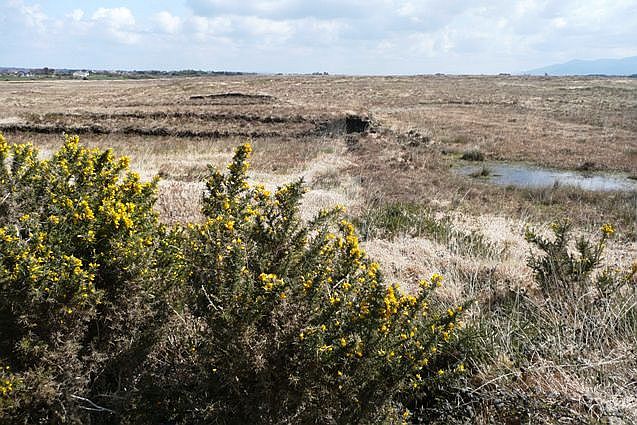
On a February morning in 2003, a peat-cutting machine at Bord na Móna’s Ballivor Works in County Meath did something its operators had not planned for: it cut through the remains of an Iron Age man.
The machine — a commercial harvester working through one of Ireland’s great raised bogs — destroyed the lower half of the body before anyone could stop it. But what it left behind was extraordinary: a human head, torso, and upper arms in such remarkable condition that the face still had recognisable features. The hair was intact. Raised up in a styled arrangement at the crown of his head, held in place by something that would take a forensic laboratory to identify.
He is known as Clonycavan Man. He died somewhere between 392 and 201 BCE. And he has spent the intervening two millennia in better condition than many objects recovered from far more recent centuries.
What a Bog Actually Does
Ireland’s bogs cover roughly one-fifth of the country’s landmass. They once supplied much of rural Ireland with fuel, and over the centuries they have swallowed and returned an astonishing variety of objects: butter, timber, Iron Age tools, gold torques. What they do to organic material is the result of a very specific combination of conditions that doesn’t occur naturally anywhere else — a cold, acidic, near-airless environment saturated with Sphagnum moss, which produces an antimicrobial compound that stops biological decay almost entirely.
Skin becomes brown and leathery. Internal organs are preserved. Stomach contents remain identifiable. Hair stays in place. What the bog takes in, it tends to keep — for centuries, sometimes millennia — as though the landscape itself had decided to act as an archive.
It is one of the most remarkable natural preservation systems on earth. And nowhere has it been more fully documented than in the Irish midlands, where the combination of deep raised bogs and commercial peat extraction has produced, entirely by accident, some of the most detailed glimpses into Iron Age life we have anywhere in Europe.
The Man with the Raised Hair
Clonycavan Man is believed to have died in his early twenties. He was relatively short — probably around 5’2″ — and before his death, he had styled his hair with care. Not just combed it. Styled it, using a blend of vegetable plant oil and pine resin that formed a gel, holding his hair raised upright in a prominent arrangement.
The styling itself is remarkable. What makes it genuinely startling is what chemical analysis of that gel revealed: the pine resin was sourced from pine species native to southwestern France and northern Spain. Not Ireland. Not Britain. The Atlantic coast of France and the Iberian Peninsula.
The analysis was conducted by archaeologist Stephen Buckley at the University of York. What it implies is almost mundane in its sophistication: Clonycavan Man was using an imported continental hair product. Which means that somewhere in Iron Age Ireland — roughly 2,300 years ago — there was a trade route moving goods from the Atlantic coast of France to the midland bogs of County Meath. That this man had access to such a product, and chose to use it, suggests he occupied a social position with access to expensive imported goods. He was not an ordinary person by the standards of his time.
He also died with a violence that forensic examination made deeply clear. State Pathologist Marie Cassidy’s analysis found three severe blows to the head that split his skull. A laceration crossed the bridge of his nose and extended under his right eye. He had been struck in the chest. He had been disembowelled — an incision approximately 40 centimetres long across his abdomen. And his nipples had been sliced off.
That last detail has attracted more sustained scholarly attention than almost anything else about him. We will come to that.
Forty Kilometres Away, a Few Months Later
In the early summer of 2003, workers clearing a drainage ditch through a raised bog near Croghan Hill, north of Daingean in County Offaly, found a second body. He is known as Old Croghan Man.
The two discovery sites are roughly 40 kilometres apart, in the Irish midlands. Two Iron Age men, both violently dead, both preserved for more than two thousand years in separate bogs, found within months of each other in the same year. In academic terms, an extraordinary coincidence. In terms of what it allowed researchers to learn, something closer to a windfall.
Old Croghan Man was a striking physical specimen. The surviving upper torso and arms — all that the drainage ditch workers recovered — indicate exceptional stature, with broad shoulders and large hands. His fingernails were well-maintained. His skin was largely intact.
The bog had preserved him almost as completely as it preserved Clonycavan Man. His stomach contents were identifiable: his last meal had been cereals and buttermilk. A spare, almost austere combination — and one that becomes more interesting when set against another finding from his remains. Isotopic analysis of his fingernail keratin, which grows at a measurable rate and captures dietary information, showed that in the four months before his death, Old Croghan Man had been eating a meat-rich, high-status diet.
The shift in that final meal — from a diet reflecting privilege and plenty to a preparation of grain and dairy — has led researchers to suggest that the last meal may have been ritualistic. That something was being marked. Something was ending.
His death, when it came, was thorough. He had been stabbed in the chest, the wound penetrating his lung. He had suffered a blow to the neck. He had been decapitated. His torso had been severed at the waist. Holes had been cut through both upper arms, and through those holes, lengths of hazel withies — cordage twisted from hazel branches — had been threaded. Whether the withies were for restraint, display, or some ritual binding, they were deliberate. So was everything else.
And his nipples, like those of Clonycavan Man, had been removed.
The Research Project
The National Museum of Ireland assembled a team of more than 35 specialists — archaeologists, forensic scientists, botanists, chemists, osteologists — to study the two men through what became known as the Bog Bodies Research Project. The results, published over years of sustained analysis, transformed what had been a pair of remarkable individual finds into the most detailed picture of Iron Age Irish life available anywhere in the scholarly record.
Not written down. Not inscribed on stone. Preserved in a bog, and recovered by accident.
The science covered ground that would have been unimaginable to earlier generations of archaeologists: isotope analysis to reconstruct diet over the months before death; mass spectrometry of the hair gel to trace its chemical signature to a specific geographic origin; forensic pathology that distinguished the sequence and probable instruments of each injury. These were not broad impressions of the past. They were fine-grained portraits of two specific individuals — their diets, their health, their status, their deaths — reconstructed across a gap of more than two thousand years.
The Theory
Eamonn Kelly spent his career at the National Museum of Ireland, eventually serving as Keeper of Irish Antiquities. He is the person most closely associated with the interpretation that now frames both bog bodies in the scholarly literature, and it turns on that shared detail — the nipple removal — more than anything else.
In early Irish custom, the act of sucking a king’s nipples was a formal gesture of submission — a way of acknowledging royal authority and pledging allegiance. It was embedded in the political language of the culture, a physical ritual with specific meaning. Which means, Kelly proposed, that deliberately removing a man’s nipples in the context of a ritual killing was not incidental violence. It was a precise symbolic act: a decommissioning. It marked the individual as no longer fit to rule. It ended something formally and permanently.
The theory goes further. Both men, Kelly observed, were found in or near territorial boundaries — the places where ancient divisions of land met, sites that in early Irish sources carry associations with the sacred geography of kingship. Both were of apparent high status. Both had been killed with a violence that far exceeds what simple execution would require. Both had their nipples removed.
Kelly’s interpretation — which has become the mainstream scholarly position on both bodies — is that Clonycavan Man and Old Croghan Man were what you might call failed kings: men who had undergone rituals associated with kingship, and who were then sacrificed when their reign or candidacy was judged a failure. The killings, on this reading, were not crimes in any recognisable sense. They were ritual acts performed at territorial boundaries, with the bodies offered to the bog — to the watery, liminal zone between worlds — as part of a ceremony intended to restore order and fertility to the land.
This remains a hypothesis. Kelly is clear about that, and the academic literature treats it accordingly. The physical evidence — the proximity to boundaries, the high-status indicators, the elaborate violence, the shared ritual mutilation on two bodies found 40 kilometres apart — is consistent with the interpretation. It does not, on its own, prove it. We are working backwards from preserved remains and early medieval texts that describe customs which may or may not reflect what was happening in the Iron Age.
But it is the most coherent account anyone has produced. And it has the quality that marks the best archaeological interpretation: it makes sense of details that would otherwise have no explanation at all.
Where They Are Now
Both men are held at the National Museum of Ireland in Dublin, which mounted an exhibition around them titled “Kingship and Sacrifice.” The name is not neutral. It is a thesis: that these two individuals — found in the bogs of Meath and Offaly by commercial workers going about unremarkable work in an unremarkable year — were, by the standards of their own society, something close to kings. That their deaths had meaning inside a ritual framework we are only now, tentatively, beginning to reconstruct.
What the bogs returned, in other words, was not merely bodies. It was a window — partial, darkened at the edges, but genuinely open — into how a pre-literate Iron Age society organised its politics, its ritual life, and its relationship with the land it depended on.
The most vivid portrait we have of what it meant to be alive in Ireland 2,500 years ago didn’t come from a manuscript or a monument or a carefully excavated ceremonial site. It came from a drainage ditch and a peat machine, doing commercial work on an ordinary morning in the Irish midlands, in a year when nobody expected the bog to give anything like this back.
There is something quietly extraordinary about that. Ireland holds its history in many ways — in stone walls and round towers, in annals and oral tradition, in the names of places that carry meanings no one has spoken aloud for centuries. But it also holds it in the bogs: cold, dark, patient, and in no particular hurry to let go.
☘️ Join 64,000+ Ireland Lovers
Every Friday, get Ireland’s hidden gems, local secrets, and travel inspiration — the kind you won’t find in any guidebook.
Already subscribed? Download your free Ireland guide (PDF)
Free forever · One email per week · Unsubscribe anytime
Tours & experiences you might love


Powered by Viator. Some links are affiliate links — we may earn a small commission at no extra cost to you.
Secure Your Dream Irish Experience Before It’s Gone!
Planning a trip to Ireland? Don’t let sold-out tours or packed attractions spoil your journey. Iconic experiences like visiting the Cliffs of Moher, exploring the Rock of Cashel, or enjoying a guided walk through Ireland’s ancient past often sell out quickly—especially during peak travel seasons.

Booking in advance guarantees your place and ensures you can fully immerse yourself in the rich culture and breathtaking scenery without stress or disappointment. You’ll also free up time to explore Ireland’s hidden gems and savour those authentic moments that make your trip truly special.
Make the most of your journey—start planning today and secure those must-do experiences before they’re gone!